


Travis County Warrants
🔷
Travis County Warrants 🔷
How to Search for Travis County Warrants, Texas
To check for an active warrant in Travis County, Texas, start with the Travis County Sheriff’s Office or the court named on your court order, bond paperwork, or hearing notice. If the matter involves the Austin Police Department, check Austin’s wanted person list as well. A municipal ticket in Pflugerville, Manor, or Lakeway may need to be looked up through that city’s court. For related felony, misdemeanor, civil, or family case records, use the clerk or court that holds the case file. You can also reference the county’s Law Library court records guide for guidance on how to access court records online.
The most useful detail is usually the name of the issuing court. An Austin address can appear in an Austin Municipal Court case, a Justice of the Peace case, or a felony filed in a district court. A case number helps you identify the right record, especially when multiple people have the same name. If you only have a name and a general location, use the steps below to narrow the search and confirm any result.

How Warrants are Issued in Travis County
Arrest warrants based on probable cause
An arrest order in many Texas counties generally starts with sworn information about a suspected offense. In a criminal investigation, an officer may submit an affidavit describing what happened, identifying the person suspected of the offense, and explaining the facts that connect that person to it. Those facts could come from witness statements, recordings, physical evidence, or an officer’s observations. A magistrate reviews the submission to decide whether probable cause supports issuing the warrant. Reference the Texas Code of Criminal Procedure, Chapter 15 for specific information on how these are issued through the courts.
Texas law requires an order for someone’s arrest to identify the accused by name or provide a reasonably definite description if the name is unknown, state the alleged offense, and carry the magistrate’s signature and title. Once issued, the court order directs a peace officer or other authorized person to take the accused into custody. Probable cause is the threshold for issuing the warrant. Guilt is determined through the criminal case. This is outlined in the Texas Code of Criminal Procedure, Articles 15.01–15.05
A case can reach the warrant stage before it shows up as a filed felony in a public court index. The District Attorney’s Office explains that a criminal case is usually filed once a person is arrested. If you suspect a new warrant and cannot find a felony case by name, check with the Sheriff’s Central Unit for Warrants unit or the agency handling the matter.
Warrants Issued After a Court Case Begins
A court can also issue an order for someone’s arrest after a case is underway. A missed required appearance is one example. The court may use a warrant or capias to bring the defendant before it. In a felony case, a capias can also be issued after indictment under Article 23.03, subject to the statute’s procedures and exceptions. If a docket says “capias issued,” check the surrounding entries and ask the clerk whether the order is outstanding and which case event prompted it.
Travis County Search warrants
Search warrants are utilized to authorize officers to search for specified property or evidence within the scope of the judicial search order. A magistrate reviews a sworn application and must find probable cause before issuing one. For example, investigators might request authority to search a specified location for items connected to a burglary. To request a search order or related documents, identify the issuing court and ask its clerk what records are available. An active arrest warrant lookup answers a different question about whether a person is wanted. This information can be resourced from the Texas Code of Criminal Procedure, Chapter 18
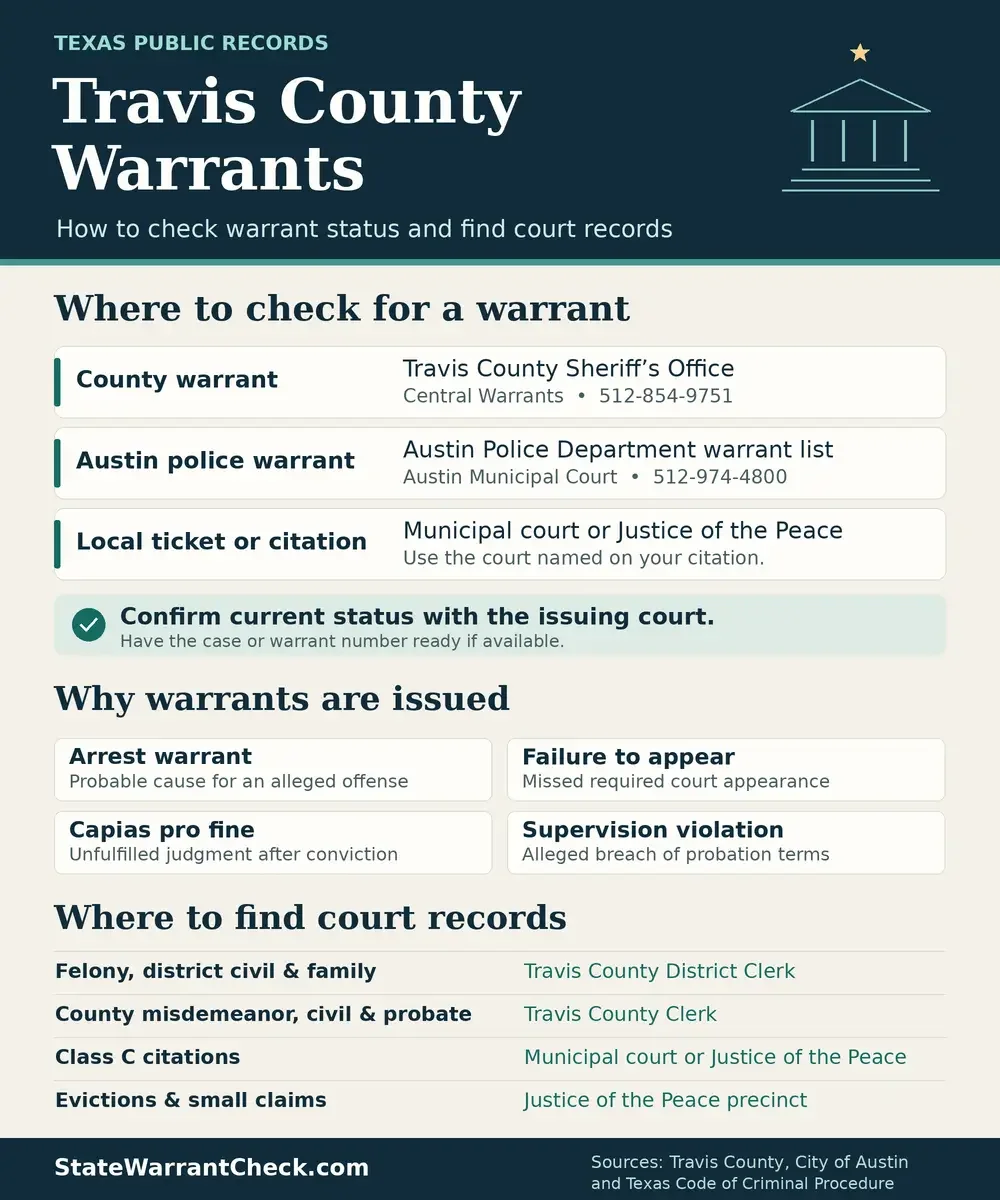
Common Types of Warrants and Why They’re Issued
Class C warrants account for substantial documented volume in Austin. The city has reported 17,860 issued for the year of 2024. That figure covers the city’s reported issuances during the entire year. It does not count unique people or tell you how many warrants are active today. The most relevant categories for a personal lookup depend on whether the legal matter began with a citation, a criminal investigation, or an ongoing court case.
Failure to Appear Judicial Orders
A failure-to-appear judicial order can be issued when a defendant misses their required court appearance. A common example in municipal and justice courts is a traffic citation followed by a missed appearance. Texas Code of Criminal Procedure Article 45A.105 generally requires sufficient notice and an opportunity to appear before a justice or municipal judge issues an arrest order for failure to appear in court. The statute also requires recall of a failure-to-appear court orders if the defendant voluntarily appears and makes a “good-faith” effort to resolve it before the order is executed. The public can ask the issuing courthouse clerk how it accepts voluntary appearances and whether it’s possible to request a new setting.
Capias Pro Fine Orders
A capias pro fine is a post-judgment order for someone’s arrest. In a municipal or justice court, it can arise when a defendant fails to satisfy a judgment according to its terms. For issuance of a court order based on failure to satisfy a court issued judgment, Article 45A.259 requires there must be an undue-hardship hearing where the defendant either misses that hearing or fails to comply with the specific judicial order. If the issue is not being able to pay, it is possible to request a hardship hearing and what options it can consider, such as a payment plan or potentially community service.
Arrest Orders for Alleged Misdemeanors and Felonies
A judicial arrest order can arise from a new criminal allegation. Examples include an alleged assault, theft, burglary, or other offense investigated by local police or the Sheriff’s Office. The classification of offense generally depends on the type and seriousness of the criminal act and the facts of the case. For related criminal court records, Class A and B misdemeanor cases generally lead to the Travis County Clerk, while district-court felony records lead to the District Clerk. If the only information you have is a police incident number, ask the agency or court whether there is also a court cause number you can use.
Community Supervision Violation Court Orders
A judge may issue a court order for an alleged violation of a condition of community supervision, often called probation. The conditions are specific to the case. Examples can include a reporting revoke community requirement or participation in court-ordered treatment. If the respective court case shows a motion to revisit, the original case number can be used to look up the relevant hearing information and warrant status. The motion records an allegation, and the docket may show later orders affecting the case. This is outlined in the Texas Code of Criminal Procedure, Article 42A.751.
Where Travis County Warrants are Commonly Issued
Austin has the most documented judicial order activity in the county, particularly for Class C municipal cases. The city’s 17,000+ issuances in 2024 shows there is significant volume. The County’s 2026 reporting also tracks warrants issued and cleared by the Sheriff’s Office. However, these official sources do not establish whether Austin accounts for a majority of all Travis County court orders, or also include a ranking of neighborhoods and smaller municipalities.
For individual searches, it’s important to identify the issuing county court, then check the courthouse name that is on the respective paperwork. This will help to identify the origin of the corresponding court order and the issuing judge or magistrate.
1. Gather the Name and any Case Identifiers
It’s important to have the full legal name, including a middle name or suffix if available. Keep the date of birth, citation number, and any relevant warrant number handy for search fields or for a clerk who needs to confirm the match. For an old ticket, check the issuing agency and the court listed near the appearance instructions. If you are looking up someone else’s record, make sure to have their full name and date of birth if possible.
2. Check With the County Sheriff’s Office
Go to the county sheriff’s website and follow the prompts to access publicly available records. Check for any available arrest order number, court, and case number. The sheriff’s office advises to verify the accuracy of the website’s information before relying on it for any legal purposes. If the search is unavailable, the result is ambiguous, or you need to confirm an active arrest order, call the Central Warrants Department at 512-854-9751. Ask whether the warrant is currently outstanding and which court to contact for verification.
3. Check Austin’s Warrant list and Case Portal When Relevant
Austin’s publicly accessible records portal is available through APD. Follow the search link on the city’s official service page and check any court suffix shown in the result. Austin Police directs people whose records end in MC to call Austin Municipal Court at 512-974-4800, and those records ending in CC to call the Community Court at 512-974-4879. You can also check with the Austin Police Court Services Unit for more information.
4. Contact the Issuing Court to Confirm the Current Status
Ask whether the court bench order is outstanding, recalled, or already executed. If the court issued more than one order, it’s recommended by the courts to confirm each respective order independently. Ask what event led to issuance, what options the court offers, and whether an upcoming hearing is scheduled. Online case histories can preserve the original issuance entry after a later recall. If you see multiple entries, share the dates of issuance with clerk so they can confirm that the recall applies to the same court order.
If the matter involves a citation, confirm the legal consequences before paying the fine. Some online payment systems automatically treat a payment as a plea which can potentially lead to a conviction. If the case involves missed payments on an existing judgment, ask the court about its procedures for requesting a hearing.
How to look up Travis County Criminal Court Records
Felony Records from the District Clerk
A good place to start is with the county’s Odyssey Portal through the District Clerk or District Attorney. Search by case number if available. According to the District Attorney’s Office, court case or docket numbers starting with D-1-DC identifies it as a felony case. Once you find the case, you can see which court is handling it, what charges were filed, and what has happened so far. The portal calls this case history the
If you need a copy of the formal charges, the court’s signed decision, or another document you can’t find online, request it from the District Clerk. For questions about copies, call 512-854-9420, option 3.
The District Clerk also has a separate online search for criminal court documents from 2008 onward. Felony cases filed before 2004 may be archived and missing from Odyssey. If you can’t find an older case, ask the clerk to check the archives. Give them the person’s full name, the approximate year the case was filed, and the case number if you know it.
Misdemeanor Records
Use the County Clerk’s Court Data search for misdemeanor cases filed in county court. If you’re searching by case number, check the County Clerk box. The online list goes back to January 1981, and some case documents are available online. Look for the latest entry to see whether the case is still open or how it ended. If the entry is too brief, ask the Misdemeanor Division for a copy of the court’s decision or dismissal order.
Class C Cases, Hearing Dates, and Arrest Paperwork
For a Class C misdemeanor, such as many traffic tickets, start with the city court or Justice of the Peace court named on the ticket. To find an upcoming hearing in a felony or county misdemeanor case, use the county’s Criminal Docket Search. If you’re expected to appear, confirm the date and time with the court.
If someone has already been arrested on a warrant, Texas law says the magistrate’s clerk must make the warrant and the sworn statement used to get it available for public inspection. Ask the clerk how to view the paperwork or request a copy.

Travis County Warrants - FAQs
Can I look up a Travis County warrant for free?
The Sheriff’s Office and Austin Police Department provide free publicly accessible online warrant searches. Courts also offer public case lookups. Fees may apply when a clerk must retrieve records or issue copies, especially certified copies. For someone’s current warrant status, check with the issuing court or appropriate warrants unit if the online search leaves any doubt.
Why does my court record show a warrant when I already dealt with it?
A register of actions can show an earlier warrant entry alongside later activity. Find the most recent entry connected to that warrant and ask the court to confirm the current status using the cause and warrant numbers. If the court recalled it, ask how to obtain a copy of the recall order or confirmation for your records.
Does a Texas DPS criminal history search show active warrants?
The public Texas Department of Public Safety name search is intended for available conviction and deferred adjudication records. Use local warrant resources to check whether a particular order is active, and use the court’s record to follow how the underlying case ended.
How can I tell if an arrest led to a conviction?
Look up the court case and check how it ended. The signed judgment or dismissal order can tell you more than a booking entry, which records that someone was taken into custody.
Can an arrest record still exist after a case is dismissed?
Yes. A dismissal ends the case, and records of the arrest and court proceedings may still exist. In some circumstances, a person can ask a Texas court to order removal or to restrict access to eligible records.
What’s the difference between a court summons and an arrest order?
A summons tells someone when and where to appear in court. An arrest order directs an officer to take the person into custody.
What does “capias” mean on a criminal court record?
A capias is a court order directing an officer to arrest someone and bring them before the court. It can be issued at different points in a case, including after a felony indictment.
How can I find out if someone is in the Travis County Jail?
Use the Travis County Sheriff’s Office Inmate Search and enter the person’s name. The search is for people currently in custody.
Where can I find someone’s bond amount in Travis County?
Look up the person in the Sheriff’s Office Inmate Search. Bond information appears under each charge, so check every charge listed.
What’s the difference between a court docket and a case history?
The criminal docket helps you find scheduled hearings. The case history, called the Register of Actions in Odyssey, shows what has already happened in the case, including filings and court actions.
Why can I see a case online but can’t open the actual documents?
Some public searches show a list of filings without giving you access to the documents themselves. If you need a specific document, give the clerk the case number and the document’s title or filing date.
Can a job background check include more than criminal history?
Yes. Depending on the background report, it may include employment history, credit information, or other public records, such as bankruptcy filings.
What does the public Texas DPS criminal history search cover?
It provides available Texas records related to convictions and deferred adjudication. It may also include arrest information connected to those outcomes.
Can my background check pull up someone else’s record?
Yes, potentially. People with the same or similar names can be mixed up in a name-based search. If a result looks unfamiliar, check the full name, date of birth, and case details where available