


Texas Warrant Check
🔷
Texas Warrant Check 🔷
How to Run a Texas Warrant Check
Warrants issued in the state of Texas are always a serious legal situation that are important to address sooner rather than later. Warrants can lead to arrests, additional fines, suspended licenses, court complications, and long-term legal issues if ignored. The good news is that many warrants can be resolved proactively before they escalate into a more serious situation.
Understanding how these legal court orders work in Texas, the different types of civil and criminal warrants commonly issued, and how to perform a warrant search can help you make informed decisions and take the appropriate next steps.


Common Types of Warrants Issued in Texas
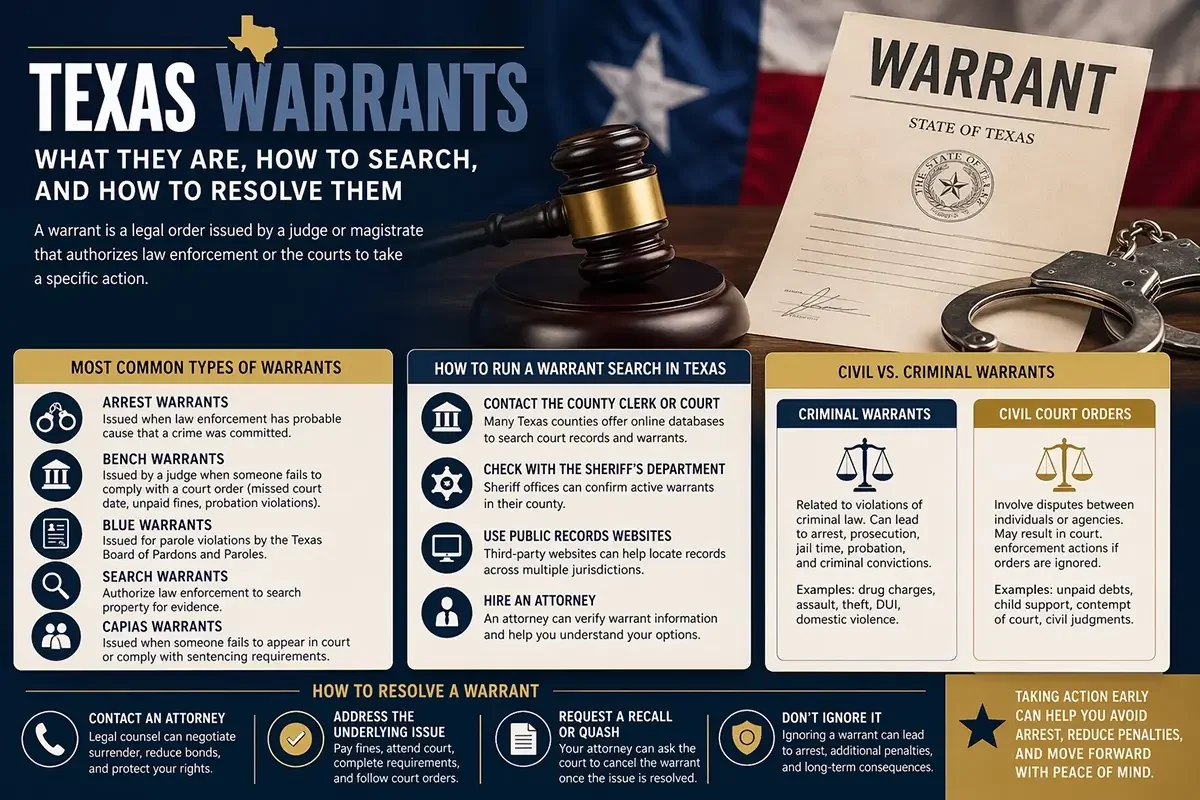
Texas state and county courts regularly issue several different types of warrants depending on the legal situation involved. Depending on the nature of the violation these can be generally bucketed in to two main types, either civil or criminal. While both are serious legal mandates to be followed, a civil violation will result in a court appearance or following through with a missed court order, where a criminal violation will result in an arrest and jail time. Below are the most commonly issued court ordered warrants through the state.
Texas Arrest Warrants
A court order for someone’s arrest is generally only issued after law enforcement officers or prosecutors present evidence to a judge demonstrating “probable cause” that a crime may have been committed. Probable cause does not mean someone has been found guilty, but rather that enough evidence exists for the courts to authorize an arrest and allow the TX criminal justice process to move forward. In Texas, arrest warrants are most commonly connected to active criminal investigations involving misdemeanor or felony offenses.
Once a judge signs the arrest order, law enforcement officers are legally authorized to apprehend the individual of interest into custody. Depending on the severity of the alleged criminal offense, a judicial arrest order may remain active indefinitely until the matter is resolved through the courts. In most situations, that person will not even realize a warrant has been issued until they are stopped for a traffic violation, contacted by law enforcement, or discover it during a background check.
Common reasons for Texas arrest warrants include:
Assault and aggravated assault charges
Drug possession, trafficking, or distribution offenses
Theft, burglary, robbery, or shoplifting allegations
DUI/DWI and intoxication-related offenses
Domestic violence or family violence accusations
Fraud, forgery, identity theft, or financial crimes
Probation or parole violations
Weapons-related offenses
Failure to appear in court for a criminal matter
In the majority of cases, the person of interest will be arrested after an initial investigation has already taken place, but they can also stem from missed court appearances or violations of prior court orders. The seriousness of these court orders often depends on the underlying criminal offense, prior criminal history, and whether the person of interest is considered a flight risk or danger to the public.
If you believe one has been issued in your name, it is considered best-practice to address the matter proactively rather than waiting for law enforcement contact you. Consulting with a criminal defense attorney can help you get in front of better understand your rights, verify the warrant information, and determine the safest path toward resolving the issue.
Texas Bench Warrants
Texas bench warrants are court orders issued directly by a judge when an individual fails to comply with a legal obligation or court directive. Unlike traditional arrest warrants that are typically tied to new criminal investigations, bench warrants often stem from procedural violations or failure to follow the requirements set by the court. In many situations, these matters begin as non-criminal or lower-level issues, but they can quickly escalate if ignored.
A bench warrant gives law enforcement the authority to detain the individual and bring them before the court to address the unresolved matter. While some bench warrants involve misdemeanor or criminal cases, many are connected to civil enforcement actions, traffic matters, unpaid obligations, or contempt-related proceedings.
Most common reasons for civil court orders issued include:
Missing a scheduled court appearance
Failing to pay court-ordered fines or fees
Ignoring a subpoena or court summons
Violating probation or supervision requirements
Failure to complete court-ordered programs or community service
Contempt of court violations
Failure to comply with child support orders
Ignoring other court instructions or deadlines
This type of civil judicial order is are among the most frequently issued in the state of Texas because courts rely heavily on compliance with scheduled hearings and legal obligations. Even relatively minor matters, such as unpaid traffic tickets or missed municipal court appearances, can eventually result in a civil warrant being ordered.
Texas Blue Warrants
Texas also issues “Blue Warrants,” which are most commonly related to parole violations. If a parole officer finds that someone violated the terms of their parole, the Tx Board of Pardons and Paroles may issue an court order for arrest authorizing detention and arraignment in court.
Unlike some other types of warrants, an arrest order for a parole violation can be especially serious because those detained under these conditions may not immediately qualify for bond or release while awaiting a parole revocation hearing. In many cases, the person remains in custody until the Board of Pardons and Paroles reviews the alleged violation and determines whether parole should be reinstated, modified, or fully revoked.
Texas Search Warrants
These are generally not directed at arresting someone immediately, but they can still play a major role in an ongoing criminal investigation and may eventually result in criminal charges being filed. Tx search warrants are primarily used to gather relevant evidence such as documents, electronic records, weapons, drugs, financial information, or other materials believed to be connected to alleged criminal activity.
In many cases, investigators use the evidence collected during the execution of a search warrant to build a case before deciding whether to pursue arrests or formal prosecution. Even if no arrest occurs at the time of the search, the findings can later be presented to prosecutors or a grand jury to support additional legal action.
How to Run a Warrant Search in Texas
There are multiple ways to search for active TX warrants depending on the county, court, or agency involved. Most of these court issued orders are issued by the county, which is usually the best starting point for your research.
Contact the County Clerk or Courts
One of the most reliable ways to check for warrants is through the county court system. The majority of Texas counties maintain online databases where the general public can access civil and criminal court records online.
You may need:
Full legal name
Date of birth
Case number (if available)
Some counties also provide criminal arrest and inmate lookup tools directly through sheriff department websites. You can also check statewide for fugitives and wanted criminals through the state’s Parole Division.
Check With the Sheriff’s Department
Many county sheriff offices maintain active warrant divisions. You can often contact them directly to inquire about outstanding warrants.
However, if you believe you have a serious criminal situation at hand, it may be wise to consult with an attorney before contacting law enforcement directly, as you may be arrested on the spot.
Use Public Records Websites
Public records websites can provide confidential and anonymous searches that compile court and public record data from multiple jurisdictions. These services can sometimes uncover records that may not appear in a single county search.
While convenient, third-party databases may not always reflect the most current status of active records. That said, it’s important to verify any important information you find through official channels.
Hire an Attorney
For more serious criminal matters, a criminal defense attorney can often verify active arrest orders on your behalf, while helping you understand your legal options and risks. They can also help post bail when surrendering yourself.
Texas Criminal Warrants
These are commonly known as criminal court orders for someone’s arrest. They are always connected to allegations of violations of criminal laws. These are generally significantly more serious than civil court orders because they can lead directly to arrest, prosecution, jail time, probation, and criminal convictions.
Examples include:
Felony arrest orders
Misdemeanor arrest orders
Various drug charges
Assault charges
Theft investigations
TX criminal warrants will remain active until the individual is arrested or the charges are resolved in court.

Civil Court Orders and Civil Warrants
Examples of civil violations can include a wide range of legal disputes or court enforcement matters that are generally not considered criminal offenses at the outset. However, failing to comply with court requirements tied to these matters can still result in serious legal consequences, including fines, wage garnishments, license suspensions, or even court-issued warrants in certain situations. While these punitive measures are mostly in the form of fines, ignoring a serious civil court order can eventually lead to a person serving jail time.
1). Unpaid Debts
Civil cases involving unpaid debts commonly include credit cards, loans, medical bills, or contract disputes. While owing money is not typically criminal, ignoring court notices or failing to appear in court can lead to additional legal consequences.
2). Child Support Enforcement
Texas courts aggressively enforce child support obligations. Falling behind on payments can result in wage garnishments, license suspensions, contempt proceedings, or other court enforcement actions.
3). Contempt of Court
Contempt of court occurs when someone disobeys a judge’s order or fails to comply with court requirements. This can include missing hearings, violating custody orders, or ignoring subpoenas.
4). Failure to Comply With Civil Judgments
After a court issues a civil judgment, the person(s) involved are expected to follow the court’s specific instructions. Failing to comply with payment orders, settlements, or other legal obligations can lead to punitive enforcement actions by the court.
However, some civil violations can still result in civil warrants or court enforcement actions if someone ignores a judge’s orders. For example, failure to appear for child support matters can eventually lead to garnished wages, or a contempt violation.
The important distinction is that civil matters usually do not begin as criminal accusations, although failing to comply with court mandates will likely create more serious legal consequences over time.
What Happens If You Ignore a Court Order?
Ignoring a judicial court order can significantly worsen your legal situation over time. Even if the original issue seemed relatively minor, failing to address one can lead to additional legal complications and increased penalties. In many cases, judicial orders do not simply “go away” on their own and may remain active until the court matter is fully resolved. Of course, a criminal court order can become significantly more serious and complicated than a civil court order if it is ignored or left unresolved.
Possible consequences can include:
1). Being arrested during routine traffic stops or police encounters
2). Additional fines, court fees, and penalties added to the original violation
3). Jail time or extended detention until your court appearance
4). Suspension of a driver’s license or other driving or travel privileges
5). Difficulty obtaining employment, passing background checks, or security clearances
6). Increased bond amounts, stricter release conditions, and extended probation terms
7). Probation or parole violations which can lead to a person’s immediate jail time
8). Damage to personal and professional reputation, and potential revocation of credentials
In some of the respective legal situations, unresolved court orders can remain active for many years and continue appearing in law enforcement databases and public record searches. The longer these stay active, the greater the chance the issue may escalate into a more serious legal and financial burden. Taking proactive steps early often provides more options for resolving the matter with the courts

Texas Warrants - FAQs
How can I check if I have an active warrant in Texas?
A good starting point is to search through county court records, sheriff department databases, or public records websites. Some Texas counties offer online lookup tools, while others may require contacting the court directly.
What is the difference between a civil and criminal court order?
Criminal matters usually include alleged violations of state criminal laws, while civil matters typically involve disputes such as debts, child support, or noncompliance with court instructions. With criminal violations, you’ll likely be arrested, and with civil violations you’ll be fined or have to appear in court.
How long do arrest orders stay active in Texas?
Most of the time these orders will remain active indefinitely until the court matter is resolved or formally dismissed. There are no statute of limitations on most judicial orders which means they do not go away on their own.
What is probable cause in a criminal investigation?
Probable cause means law enforcement has collected enough evidence for a judge to reasonably believe a crime may have occurred. This is a 4th Amendment requirement for any judicial body to issue a warrant for someone’s arrest, or search and seizure of their property.
What does contempt of court mean?
Contempt of court occurs when someone knowingly ignores or disobeys a judge’s instructions or specific court requirements. In many cases, individuals are given warnings or opportunities to comply before a contempt charge is issued, but continued noncompliance can quickly escalate the situation. Once contempt proceedings begin, they can significantly complicate an individual’s legal and financial circumstances, and even lead to jail time.
What is a Texas bench order?
A bench order is issued directly by a judge or magistrate, is given out when someone fails to comply with court requirements, such as missing hearings or ignoring legal obligations. These are considered civil violations and result in a person’s mandatory appearance in court, paying any respective fines, or following through with a specific civil mandate.
Can unpaid traffic tickets lead to an arrest?
In some situations yes, but most commonly are additional fines and suspension of driving privileges and driver’ license suspension. Only the most serious tickets and citations left unpaid, such as a DUI, will lead to a person’s arrest.
Is it better to surrender myself to the courts voluntarily for an arrest warrant?
Generally speaking, yes. Taking proactive steps early will often give you more options and may help reduce the overall legal consequences involved. When a judge sees that you’re taking your legal situation seriously, it may lead to more favorable outcomes such as reduced fines or jail time.