

Check For Capias Warrants By State
🔷
Check For Capias Warrants By State 🔷
The Importance of Capias Warrants
A capias warrant is a serious civil legal matter that most people do not fully grasp until it directly affects them. Whether issued for a civil matter, or sometimes for criminal charges, a court issued capias warrant has the potential of law enforcement arresting a person and taking them into custody until their court appearance. While, the majority of the time these are considered civil infractions, they occasionally are tethered to criminal cases where a person can be subjected to additional charges and jail time. It’s important to address these immediately as they do not go away and can lead to additional charges, fines and incarceration.
In the following sections, we will cover what a capias warrant is, how to run a capias warrant check, the implications of having a civil capias warrant issued in your name, and what steps to take if you discover one exists.

What Is a Capias Warrant?
A capias warrant (translated from the Latin phrase “Capias ad Respondendum”, referring to “You Need to Answer”) which is a court order directing someone to appear in court, whether it’s of their own will, or in some cases, forcefully by law enforcement.
These differ from arrest warrants that are based on allegations of crimes, which are frequently issued because of non-compliance with a court requirement. The most common reasons these are issued are from these civil and criminal violations:
Failing to appear in court for a civil or criminal case
Ignoring a subpoena issued for someone’s court appearance
Unpaid court-ordered fines or fees
Violating a specific court order
Capias warrants can exist for both criminal and civil cases, while a majority of these warrants are issued for civil violations. However, if this civil warrant is ignored, it can lead to an arrest warrant being issued where that person will be apprehended, and detained until their court appearance.
How to Run a Capias Warrant Check
Capias civil warrants are mostly considered public records, which means they can often be searched without needing to obtain special permission. It is important to note that availability may vary by state and county, not all jurisdictions will publish civil capias warrants online. Here are some of the most common ways to check for these warrants online:
1. County Court Clerk Websites
The majority of county county courts in every state will publish warrant and case information online. Searching by name or case number is often the best way to lookup these through the respective courthouse websites. If you cannot find what you are looking for online, contact the clerk of the courts directly for assistance.
2. Sheriff or Law Enforcement Databases
Many sheriff’s offices maintain searchable warrant databases that may include criminal related capias warrants. However, since these are mostly considered civil matters, not all sheriff departments will host this information for public viewing.
4. Third-Party Public Records Services
Most background check websites and public-records platforms will aggregate public warrant data across the United States, and allow searches by name or court case number. One of the benefits of using these services is your searches can be anonymous, and you can search multiple jurisdictions at once. Many of these services will also allow national searches which can be helpful if you are uncertain where a warrant was issued.
What to Do if You Have a Capias Warrant
If you discover, or have as suspicion, that a capias warrant has been issued in your name, take action ASAP to verify it and deal with it before you encounter any additional consequences.
1. Do Not Ignore It
Capias warrants do not expire simply because time passes, as there is not a statute of limitation. Ignoring the issue can leads to additional consequences.
2. Contact an Attorney
Consulting with a qualified attorney can be helpful for these reasons:
a). Review the underlying case and it’s validity
b). Contact the courts on your behalf and potentially have it dismissed
c). Arrange for you to make a voluntary appearance to be in compliance
d). Help reduce any penalties or avoid being detained by law enforcement
3. Verify the Warrant Details
Verify the specific details is very important, by confirming these details:
a). Where and when the courts issued the warrant
b). The specific reason and details for the warrant
c). Any required payments, documents, or court orders
4. Arrange a Court Appearance
By voluntarily addressing the courts about your warrant will often result in a better outcome for you than being arrested and brought to court.
5. Comply With the Court Order
Resolving the original issue is a good first step. Whether it’s a delinquent payment, missed appearance, or lack of documentation. This is usually the fastest way to have the warrant recalled or quashed by a judge.
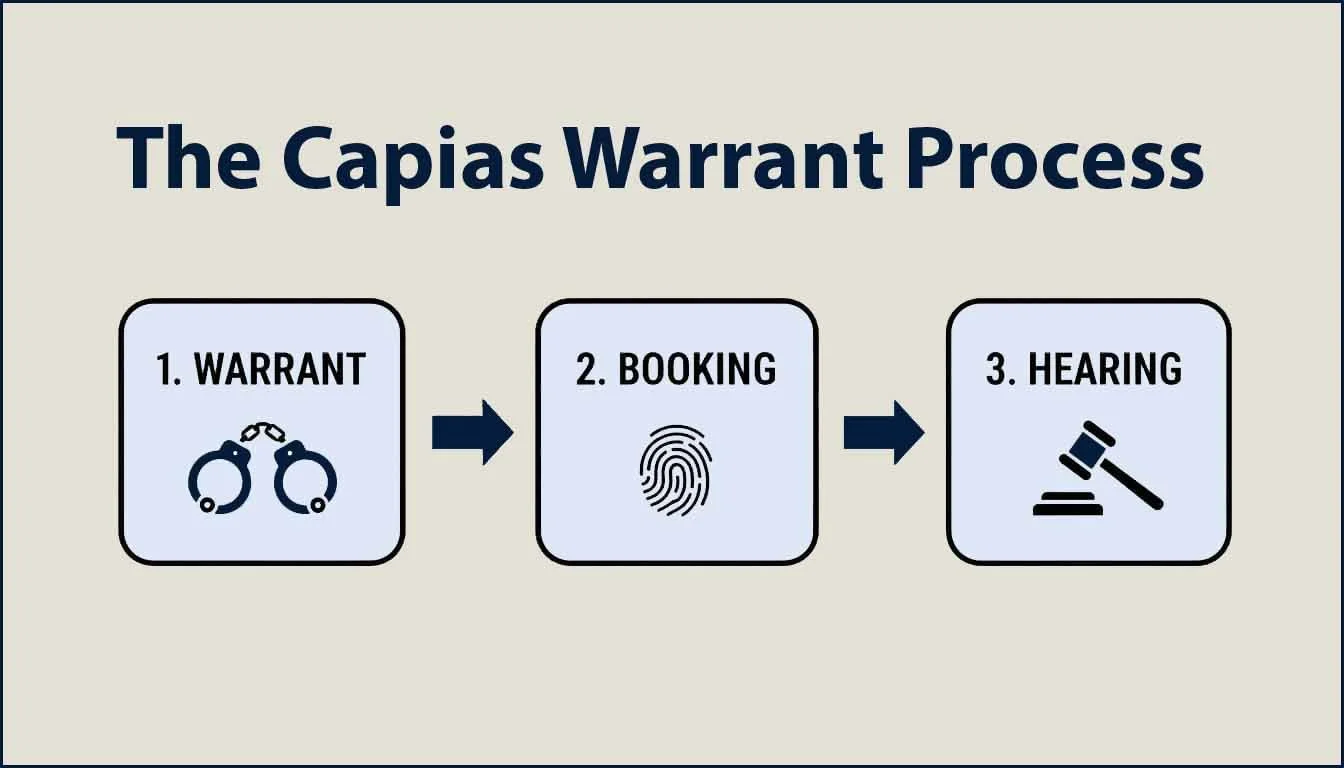
Capias Warrant Details
Having an active capias warrant issued in your name can lead to a multitude of serious consequences, including:
1). Being arrested during routine traffic stops and ID verifications.
2). Being detained by law enforcement until a court appearance or posting bail.
3). Additional penalties including fines, court costs, or community service.
4). Charged with contempt of court.
5). Negative marks on background checks.
6). Travel limitations and various complications in some jurisdictions.
While these warrants are mostly civil in nature, law enforcement can be legally authorized to arrest and detain you, even without notifying you first.
However, for civil legal matters that were a result of a failed court order, you can often rectify your situation by complying with the original order by paying overdue fines or rescheduling a missed court appearance.

Capias Warrants - FAQs
How serious is a capias warrant?
A capias warrant is a serious court order that authorizes law enforcement to take someone into custody and bring them before the court. Depending on the jurisdiction, it may relate to criminal charges, a missed court appearance, a supervision violation, or certain civil proceedings. Ignoring it can leave you subject to arrest and may lead to additional consequences under applicable law.
Can I bond out of a capias warrant?
Possibly, but release on bond is not guaranteed. Eligibility depends on the jurisdiction, the underlying case, the terms of the capias, and any other holds or court orders. Some cases allow release after posting an established bond, while others require an appearance before a judge. Flight risk is not the only consideration; public safety, prior noncompliance, and statutory restrictions may also matter.
How do I handle a capias warrant?
Start by identifying the issuing court, case number, and reason the capias was issued. An attorney can explain your options, while the court clerk can provide procedural information. Depending on the case, you may need to request a hearing, address a missed obligation, seek recall of the capias, or arrange a surrender. Paying a fine or rescheduling a hearing does not automatically cancel every capias. Confirm its status with the court and keep copies of any relevant orders.
Is a capias warrant a type of bench warrant?
The terms can overlap, but their meaning depends on the jurisdiction. Some courts use “capias” for a bench warrant issued after someone fails to appear or comply with a court requirement. Elsewhere, a capias may be issued at another stage of a criminal proceeding. Both can authorize arrest, so the wording and underlying case matter more than the label alone.
Are capias warrants considered public records?
Some capias warrants and related court records are publicly accessible, but access varies by jurisdiction, case type, and the status of the record. Sealed cases, confidentiality rules, or restrictions on pending law-enforcement matters may limit access. Even when a record is public, it may not be available online or show up on a background check.
Do capias warrants show up on a background check?
They can, but not every background check includes active warrants. Results depend on the databases searched, the provider’s coverage, reporting restrictions, and how recently records were updated. A missing result does not establish that no capias exists. Likewise, an older entry does not prove that the order remains active. Confirm its current status with the issuing court.
Are capias warrants considered criminal records?
A capias issued in a criminal case may appear in criminal court records, even if the person has not been convicted. A capias associated with a civil proceeding does not, by itself, establish a criminal charge or conviction. The underlying case determines the context, and the existence of a capias is not proof of guilt.
How can I find out whether I have a capias warrant?
Start with the court connected to any missed hearing, pending case, or supervision matter. Check its official public case-search system, if available, or ask the clerk about the procedure for verifying warrant status. If you are unsure where the case originated, prior court notices or an attorney may help identify the jurisdiction. Third-party records can provide leads, but they may be incomplete or outdated. Before appearing in person, understand that an active capias may result in arrest.
Can a capias warrant be recalled or quashed?
Yes, a court may recall or quash a capias when there is an appropriate legal basis. Depending on the circumstances, this might involve addressing a missed appearance, correcting an error, complying with an obligation, or obtaining a ruling on an attorney’s request. Resolving the underlying issue does not necessarily cancel the capias automatically. Obtain confirmation that the court has withdrawn it; the underlying case may still continue.
Do capias warrants ever expire?
There is no single nationwide expiration rule. Many capias warrants remain active until they are executed, recalled, quashed, or otherwise resolved, but the applicable rules depend on the jurisdiction and type of order. A deadline for bringing criminal charges is a separate issue from how long an existing capias remains enforceable. Do not assume that an older capias has expired—verify its status with the issuing court or through an attorney.