

Check For Active Civil Warrants
🔷
Check For Active Civil Warrants 🔷
State Civil Warrants Explained
Civil warrants are commonly misunderstood, as many people assume that any warrant automatically means criminal charges or an imminent arrest. However, that is not always the case. A warrant issued for a civil violation comes from from non-criminal court matters and are almost always issued when a person fails to comply with a specific legal obligation ordered by a judge or magistrate.
Understanding how these civil court orders work, and how to resolve them, can help you avoid unnecessary complications and escalation. In many situations these can be easily resolved by complying with the failed court order, or by rescheduling a missed court appearance. We’ll cover the various types of civil violations that lead to these types of warrants and what course of action you can take to resolve them.

What Exactly Is a Civil Warrant?
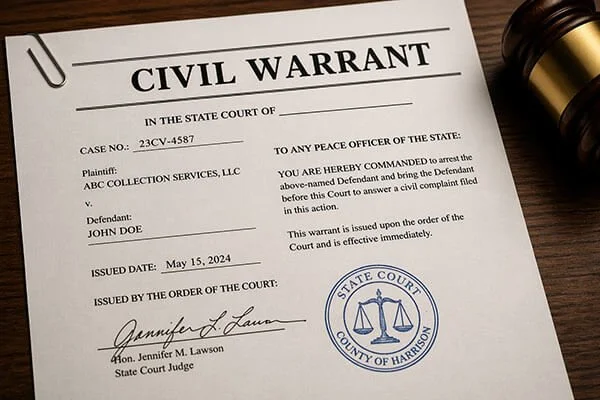
A civil, or non-criminal, warrant, is a court-issued legal order used to enforce compliance in for a specific civil violation that is most commonly a failed order from a judge or magistrate. Unlike criminal warrants, which are tied to criminal allegations, these typically stem from disputes, overdue fines, missed court appearances, or failures to follow court orders in civil cases.
These types of court orders are commonly used as a legal enforcement tool when someone:
Fails to appear in civil court
Ignores a specific legal order
Fails to make a fine, payment, submit documentations, or other court-mandated actions
They are always issued by a judge or magistrate, then entered into court records, and ending up becoming part of the public record which anyone can see. These are serious legal matters, while not usually arrestable offenses, but can cause a multitude of issues and headaches including additional fines and civil penalties that are imposed. In extreme cases it can lead to; not being able to renew a driver’s license, limitations on obtaining certain professional certifications, or travel restrictions outside the United States.
Can a Civil Warrant Lead to Criminal Charges?
In most cases no, civil violations do not include criminal charges. However, they can be escalated under certain circumstances, such as contempt of court or failing to reply to a subpoena.
Here’s how that can happen:
Failure to comply repeatedly with a civil order may result in contempt of court.
Contempt of court can carry heavy fines and penalties, or short-term detention in extreme cases.
If a civil warrant is ignored long enough, a judge may issue another order allowing law enforcement to detain the person of interest until they have complied with the court’s wishes.
It is important to note that if a person is detained for a civil violation, the detention is typically coercive, and not punitive. This is usually a last resort by the courts, attempting to compel compliance, and is not considered punishment for a crime.
Additionally, civil violations do not create a criminal record on their own, but unresolved court action can create serious legal and financial consequences which can lead to a judgment or lien. While these court directives do not have a criminal implication, they are recorded as public records that will show up on a background check.
Reasons Civil Warrants Are Issued
When a warrant for a civil violation is issued, it can be for a wide range of non-criminal legal issues. Some of the most common civil violations include:
Failure to Appear in Civil Court
This is when a person misses a scheduled court date for matters such as:
1). Small claims cases
2). Various civil lawsuits
3). Family court hearings
Failure to Comply With a Court Order
These types of violations can range widely as any order given by a judge is bucketed into this category. The most common failed court orders are:
1). Ignoring a subpoena to appear in court
2). Failing to provide required documents
3). Not following a judge’s ruling, or settlement terms
Unpaid Civil Judgments or Fines
Courts also commonly issue non-criminal warrants when someone fails to:
1). Pay court-ordered fines or fees
2). Satisfy a civil judgment
3). Meet payment obligations tied to lawsuits or administrative actions
Child Support & Family Court Issues
When it comes to family legal matters, warrants are often issued for:
1). Delinquency of child support payments
2). Failure to appear at child custody or child support hearing
3). Ignoring specific family court directives
Contempt of Court
Civil contempt is also relatively common. These are when someone is disrespectful or does not follow court procedures. The most common contempt of court violations are:
1). Disobeying a direct court order
2). Refusing to comply with a judge’s instructions
3). Interfering with the court’s authority and procedures
Key Insights About Civil Court Orders
Civil court orders are not criminal allegations and do not carry criminal charges. They are issued for civil violations that can often be resolved by addressing the underlying legal issues.
1). They are issued to enforce compliance in civil court matters
2). Ignoring them can lead to fines, detention, or escalating penalties
3). Most civil court orders can be resolved by compliance or court coordination
4). Early action is the best way to minimize consequences
What If You Have a Civil Warrant?
Ignoring any type of warrant almost always makes the situation worse. The best approach is compliance and action.
Step 1: Confirm the Violations
The first step is to identify and verify:
1). The issuing court and judge
2). The underlying case and violations
3). The reason the warrant was issued
Step 2: Contact the Court or Clerk
In many situations, the court can explain:
1). What action is required to resolve the underlying civil violations
2). Whether payment, documentation, or a court appearance is necessary
Step 3: Comply With the Court Order
Typical resolutions will include:
1). Paying all outstanding fines or fees
2). Appearing before a judge or magistrate
3). Submitting the required paperwork
4). Scheduling a compliance hearing
Step 4: Consult an Attorney if Needed
Legal counsel can be especially helpful if:
1). The warrant involves contempt of court
2). Large sums of money are involved
3). There might be a risk of detention
4). The case has been ongoing or has significant legal complications
Step 5: Obtain Proof of Resolution
Once resolved, make sure to request:
1). Written confirmation of the resolution
2). Updated court records about your violation
3). Documentation showing the warrant was cleared or withdrawn

Civil Warrants - FAQs
What is a court enforcement order in a civil case?
A court enforcement order is a legal directive in a civil case, which is always issued by a judge or magistrate, to compel someone to follow a court ruling in a civil matter. These orders may include appearing in court, paying a judgment, paying a fine, or complying with specific legal requirements.
Is a civil court warrant the same as a criminal arrest warrant?
No. A civil court warrant is tied to non-criminal legal matters, while criminal arrest warrants are issued for alleged crimes. Civil warrants focus on compliance, not punishment.
Is a contempt of court warrant considered a criminal record?
No. Contempt in civil cases are not the same as criminal convictions, but they can appear in public court records and background checks related to civil proceedings.
How long do court-issued civil orders remain active?
Most remain in effect until the person of interest complies with the court’s requirements or the judge decides to withdraw or quash the order.
Do civil violations show up on background checks?
They can appear in public record searches, depending on the database and the jurisdiction reporting the information. This means they are likely to show up on a background check, even through they are not criminal allegations.
What types of cases commonly lead to civil compliance warrants?
The most common cases include small claims disputes, family court matters, unpaid fines, missed hearings, and failure to follow the court rulings. These will lead to a civil violation and a court compliance order will be issued for the person of interest.
Can I clear a civil court warrant without appearing in court?
Yes, in many situations this is possible, and can be resolved by paying fines, submitting paperwork, or coordinating directly with the county court clerk.
Will a civil warrant expire on it’s own?
They do not typically expire or go away after a certain amount of time. They will usually remain in effect until the civil court orders are met, or a judge quashes it.