


Arizona Warrant Check
🔷
Arizona Warrant Check 🔷
How to Check for Active Warrants in Arizona
Arizona courts and law enforcement agencies issue thousands of warrants each year for a variety of criminal and civil matters. These legal directives authorize law enforcement officers to take specific actions, such as making an arrest, conducting a search, or compelling a person to appear before a judge. Understanding how these court orders work, how to perform a free Arizona warrant search, and how they may affect employment, housing, and background screenings can be instrumental when addressing legal issues before they become more serious.
This guide explains how Arizona warrants are issued, the differences between felony and misdemeanor warrants, where they originate from within the state, and how members of the public can access this information online.
What Does It Mean to Have a Warrant?
Having a warrant issued in your name can become a very serious legal situation. These are essentially court-issued judicial orders signed by a judge or magistrate that has either civil or criminal implications. Civil orders are usually a result of a civil violation such as a missed court hearing, or unpaid legal fees. Where a criminal order is much more serious, most commonly issued when a person is suspected of committing a crime or violates probation requirements.
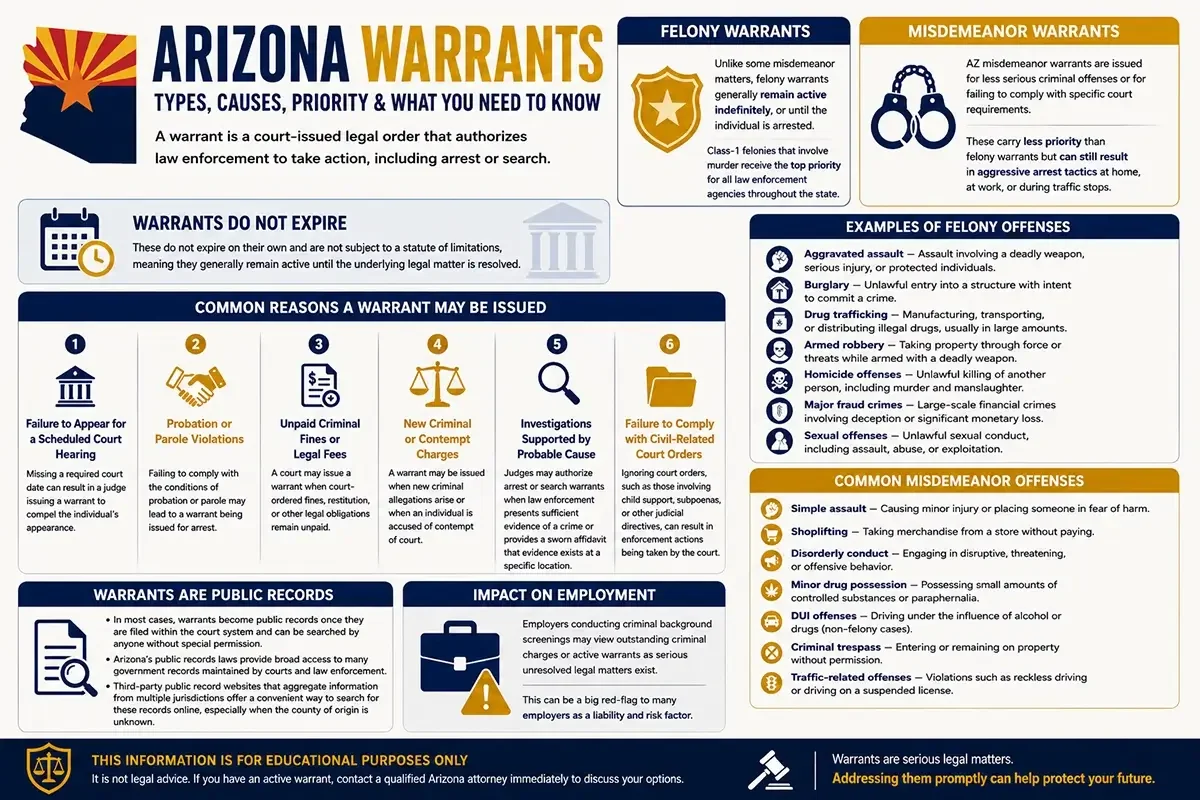
Once issued, the order is entered into state and national law enforcement databases, allowing officers throughout Arizona and, in some cases, throughout the United States to enforce it. These do not expire on their own and are not subject to a statute of limitations, meaning they will remain active until the underlying legal matter is resolved.
Common reasons for issuance include:
1). Failure to appear for a scheduled court hearing – Missing a required court date can result in a judge issuing a bench order to compel a person’s appearance before the court. This is typically a civil violation unless it’s for an ongoing criminal trial where a subpoena was ignored.
2).Probation or parole violations – Failing to comply with the court’s conditions of probation or parole will likely lead to an arrest order being issued for that person’s arrest and incarceration.
3). Unpaid criminal fines or legal fees – In legal scenarios, a court may issue a bench order when court-ordered fines, restitution, or other financial obligations remain unpaid. These are typically civil violations that do not result in someone’s arrest.
4). New criminal charges or contempt charges – An arrest warrant may be issued when new criminal charges are filed, or when an someone is accused of contempt of court for a violation of a legal mandate.
5). Criminal investigations supported by probable cause – Judges may authorize arrest or search warrants when law enforcement presents sufficient evidence that a crime has been committed or provides a sworn affidavit establishing probable cause that evidence exists at a specific location.
6). Failure to comply with civil-related court orders – Ignoring specific court orders involving child support, subpoenas to appear, or other judicial directives, can result in enforcement actions being taken by the court.
While there is a significant difference in the legal implications between civil and criminal court orders, they are both enforced and stay in effect until the court order is satisfied or the underlying legal matter is resolved.

How to Run a Free Arizona Warrant Check
Several resources are available to the public for conducting a free warrant search in Arizona. Most of these no-cost options are provided by official government agencies, including the Arizona Department of Public Safety, county courts, sheriff's offices, and other law enforcement departments. Additionally, there are numerous third-party public records websites that offer access to warrant information and criminal records, often for a nominal fee. These services may provide more comprehensive background information by compiling records from multiple jurisdictions and public databases. Below are some of the most commonly used resources available to the general public.
AZ Department of Public Safety
The Department of Public Safety (DPS), the state's primary law enforcement agency and home to the State Trooper, provides a statewide warrant search tool that is accessible to the public. To perform a search, users will need the individual's full name and date of birth.
Because records and reporting practices can vary between counties, the Arizona DPS advises users to verify any search results with the respective county court before taking any legal action. According to the DPS, "you should verify your search results with the respective county court, as some records cannot be relied on for accuracy."
AZ County Court Websites
Since warrants are primarily issued by the county courts, this is often the most reliable method of searching for records. The majority of AZ county courts provide online case search systems that allow users to search by name and review public court records. These databases often display active bench and arrest orders, missed court appearances, pending criminal cases, prior convictions, and upcoming hearings.
AZ County Sheriff's Offices
Many county sheriff's departments maintain searchable online databases of active arrest orders. These records are generally updated regularly and may include: Full name, date of birth, physical description, criminal charges, court case number, issuing county court and judge.
AZ Judicial Branch Records
The Arizona Judicial Branch provides online access to court records and case information through its public court case lookup system. While not all county courts participate in the same database, these resources can be helpful for identifying pending criminal cases, missed court appearances, scheduled hearings, and other court actions that may indicate an arrest warrant has been issued.
Users can typically search by name, case number, or court location to review publicly available case details. Depending on the jurisdiction, court records may include criminal charges, court dates, case status updates, and judicial orders. If an arrest order has been issued as part of an ongoing criminal proceeding, that information may populate within the case file or docket history.
Clerk of Court Offices
Another option is to contact the corresponding county clerk's office to request information about pending criminal cases and respective court orders. This is a reliable option for anyone that cannot find what they are looking for online. The county clerk’s office is responsible for managing records and assisting the public along with their other duties. However, in some jurisdictions, you may need to schedule an appointment to visit the clerk's office and review court records in person.
Public Records Websites
There are numerous third-party public records services that aggregate court records, criminal case information, and active judicial orders from counties and jurisdictions throughout Arizona. These databases can be particularly useful for individuals who are unsure where a case originated or do not know which county to search.
Unlike county-specific court websites, many public records platforms allow users to conduct broader statewide searches, helping to identify records that may exist across multiple jurisdictions. While these services often charge a nominal fee, they can save time by consolidating information from various courts and government agencies into a single searchable database. As with any records search, it is advisable to verify and findings with the appropriate court or law enforcement agency, as some records may be inaccurate or out of date.
What Is a Felony Warrant?
Arizona felony warrants are the most serious judicial arrest orders given out. These are issued when a person is suspected of committing a felony-level offense, or has failed to comply with court requirements related to a felony case.
Felonies are the most serious criminal offenses that include:
Aggravated assault - Offenses involving factors such as the use of a deadly weapon, causing significant bodily harm, or assaulting police officers or other government agents.
Burglary - Unlawfully entering home, business, or vehicle with the intent to commit a crime.
Drug trafficking - The manufacturing, transportation, distribution, or sale of illegal controlled substances, usually involving large quantities of illegal substances.
Armed robbery - The taking of property from another person through force, threats, or intimidation, while armed with a deadly weapon
Homicide offenses - killing of another person, including manslaughter, second-degree murder, and first-degree murder. Some of which are considered capital crimes.
Major fraud crimes - Financially motivated crimes involving large sums of money, identity theft, insurance fraud, securities fraud, or embezzlement.
Sexual offenses - Including sexual assault, sexual abuse, rape, and child exploitation offenses
Because felony charges carry significant penalties, law enforcement agencies generally prioritize the execution of felony court orders over all others.
How Felony Arrest Orders Are Enforced
Felony criminal charges may result in:
Immediate arrest during traffic stops
Arrest at a residence or workplace
Extradition from another county or state
Inclusion in state and federal law enforcement databases
Increased bail amounts
In serious cases, specialized fugitive task forces may become involved in locating individuals who have active felony criminal charges. Unlike some misdemeanor matters, felony arrest orders will remain active indefinitely, or until the individual is arrested.
Class 1 felonies, which include heinous crimes such as first-degree murder, are among the most serious crimes under the state’s law and receive the highest enforcement priority. Any person that is wanted for these offenses may be actively pursued by local, state, and federal law enforcement agencies, and their information may be entered into statewide and national criminal justice databases to facilitate their apprehension.
What Is a Misdemeanor Warrant?
Misdemeanor warrants are typically issued for less serious criminal offenses or for failing to comply with specific court requirements related to misdemeanor cases. While these court-issued arrest orders generally carry a lower enforcement priority than felony arrest orders, they can still result in aggressive arrest tactics by taking someone into custody at home, at work, or while being pulled over for a traffic citation.
Common misdemeanor offenses include:
Simple assault - Causing minor injury or placing someone in fear for their safety
Shoplifting - Theft of merchandise from a retail store without paying
Disorderly conduct - Disruptive and offensive behavior that disturbs the peace of the public
Minor drug possession - Possession of small amounts of illegal controlled substances
DUI offenses - Driving while intoxicated by alcohol, drugs, or controlled substances
Criminal trespassing - Entering another person or business’ property without permission
Traffic-related offenses - Serious traffic violations such as DWIs or reckless driving
While misdemeanor charges are generally considered less serious than felony charges, they can still lead to arrest and incarceration without notice.
How Misdemeanor Arrest Orders Are Enforced
Enforcement may occur when:
A person is stopped by law enforcement
An officer conducts a records check
The individual appears in court for another matter
The person applies for certain government licenses
Most people are surprised to learn that a seemingly minor missed court appearance can result in their arrest. This is especially true with criminal charges that typically carry a jail or prison sentence if found guilty
Why Are Most Warrants Issued?
Although many people assume warrants are primarily issued for serious criminal conduct, the most common reason is for civil violations, often a failure to appear in court or unpaid legal fees. A simple missed hearing can quickly escalate into a more serious legal issue if left unresolved.
However, criminal charges that lead to arrest warrants are the most serious, where law enforcement are legally mandated to find, apprehend, and detain the person of interest until they can be formally arraigned in court.
Other frequent causes include:
Missed court dates
Probation violations
Failure to pay court fines
New criminal allegations
Failure to comply with sentencing requirements
Violations of protective orders
Are Warrants Public Records?
In most cases, warrants become public records once they are filed within the court system. This means they are generally accessible to anyone and can often be searched without obtaining special permission.
Arizona's public records laws provide broad access to many types of government records maintained by courts, law enforcement agencies, and other public entities. As a result, anyone has the ability inspect or obtain information related to active judicial orders, criminal cases, and other court proceedings.
Third-party public records websites that aggregate information from multiple jurisdictions can also provide a convenient way to search for these records online, particularly when the county of origin is unknown.
Publicly available information may include:
Court case information
Criminal charges
Active court orders
Convictions & sentencing records
Incarceration records
Probation & parole records
Civil records
Vital records
However, certain records may be sealed, restricted, or temporarily withheld if disclosure could interfere with an active investigation or endanger public safety.

Why Are Most Warrants Issued?
Although many people assume warrants are associated arrest orders for serious criminal offenses, the reality is that many are issued for procedural or compliance-related matters. In fact, some of the most common reasons involve individuals failing to meet court obligations, such as appearing for scheduled hearings or failing to pay court fines or other legal requirements. What may begin as a relatively minor issue can quickly escalate into a more serious legal matter when left unresolved.
Other frequent causes include:
1). Missed court dates - Failing to appear or reschedule a missed court appearance. These are most commonly issued for missed criminal hearings.
2). Probation violations - Violating the terms of probation, failing a drug test, missed meetings with parole officer, or brought up on new criminal charges.
3). Failure to pay court fines - Unpaid court fines, legal fees, or restitution payments that have gone well past the grace period of the payment terms.
4). New criminal allegations - If probable cause has been determined where a person is suspected to have committed a criminal act.
5). Failure to comply with judicial directives - Disregarding court protocols, subpoenas, or other legal orders.
6). Violations of protective orders - Allegations of violating a restraining order, protection order, or no-contact order.
Can Warrants Show Up on Background Checks?
Yes, since they are considered public records, they will likely show up during background screenings, particularly those conducted for employment, housing, professional licensing, and government security clearances.
Background checks may reveal:
1). Active warrants - Arrest orders that include alleged criminal charges, issuing court and judge or magistrate.
2). Criminal history - Prior criminal convictions including misdemeanors and felonies, that can stay on a person’s record indefinitely.
3). Court cases - Civil or criminal court records, and ongoing proceedings that are currently being litigated or awaiting disposition.
4). Arrest records - Arrest history, responsible law enforcement agency, jail location, resulting criminal convictions.
5). Convictions - Criminal cases that resulted in a guilty plea, guilty verdict, or other conviction entered by the court.
6). Incarcerations - Records of confinement in a local jail, county detention center, state prison, or federal correctional facility from a criminal conviction.
7). Probation & Parole records - Information about court-ordered supervision, including probation terms, parole status, and compliance history.
8). Vital records - publicly available vital records such as birth, death, marriage, and divorce records.
9). Driving records - Motor vehicle records that may include traffic violations, license suspensions, DUI convictions, accidents, and vehicle records.
Accessing Records Through Arizona Public Record Laws
Arizona's public records laws give every citizen the right with broad access many of the records maintained by government agencies, courts, and law enforcement departments. Although Arizona is not governed by the federal Freedom of Information Act (FOIA) for state records, the state has its own public records statutes that operate under similar principles of transparency and public accountability.
Members of the public can often obtain warrant-related information by:
1). Searching county court records - Most state courts maintain online databases that allow public access to search civil and criminal case information, court filings, and active judicial orders by name or case number.
2). Contacting sheriff's offices - County sheriff's departments maintain records of arrests, incarcerations, inmates, and active warrants through online databases or public records requests.
3). Requesting public records from government agencies -The general public can make records requests to certain agencies to obtain information that may not be readily available online.
4). Reviewing court case files - Court records often contain details about criminal charges, judicial orders, hearings, and judicial orders associated with a case.
5). Using online public access systems - Various public access portals and government records databases provide convenient access to searchable records from multiple jurisdictions throughout the state.
Because most government records are generally public; employers, landlords, journalists, private investigators, and everyone else may be able to access publicly available information without needing permission or having to submit a special request.

Arizona Warrants - FAQs
How to check if I have a warrant in Arizona?
While there are multiple online resources to check for active warrants in Arizona, it’s usually a good idea to start with official channels as they are more reliable. The county court clerk, county sheriff department, or the state’s Department of Public Safety are all good starting points.
Third-party public records websites can also be useful, particularly when searching across multiple counties or jurisdictions at the same time. These services often offer greater convenience by aggregating records from various sources into a single searchable database. However, because information may not always be updated in real time, it is advisable to verify any significant findings through the respective government agency before taking any legal action.
Do warrants expire in Arizona?
Generally, no. Warrants do not expire on their own and typically remain in effect indefinitely until the underlying legal matter is resolved or a judge recalls, quashes, or otherwise dismisses the court order. Ignoring one can often lead to additional complications, including increased fines, penalties, driver’s license suspensions, or sometimes new criminal charges.
Can law enforcement arrest someone at work?
Yes, if an arrest order was issued to apprehend someone and bring them before a judge, law enforcement has the right to arrest that person at home, at work, or any place that person is lawfully encountered.
What types of offenses lead to judicial arrest orders being issued?
Any allegation of a criminal offense where there is probable cause. This can be a suspected criminal act, probation violation, absconding from the authorities for criminal charges, or violations of serious court orders.
Are third-party public records websites reliable?
Many public records websites are convenient and provide useful information, but records may not always be updated in real time. Public record sites are a good starting point to do the initial research as they can search statewide or nationwide for publicly available information, but it’s advisable to verify any significant findings through the respective reporting government agency.
Can I be extradited for a warrant in Arizona?
Yes, you can be extradited for a felony offense or, in some cases, a serious misdemeanor charge. Depending on the circumstances, a person may be transported from another county within Arizona or even from another state to face the underlying charges. Generally, the more serious the offense, the greater the likelihood that law enforcement agencies will pursue extradition and allocate resources toward locating and apprehending the person of interest.