

Georgia Warrant Search
🔷
Georgia Warrant Search 🔷
Georgia Active Warrant Guide
If you believe you may have an active warrant in Georgia, taking proactive steps to verify your status is important. An outstanding warrant can result in an unexpected arrest at any time; at work, home, or any interaction with law enforcement. Fortunately, there are several official resources that can help you determine whether one exists.
This guide explains how to conduct a Georgia warrant search, what type of court order it stems from, the consequences of ignoring one, and how to handle a bench order that is mandating immediate action. The information we’ll unveil will help you find the best course of action to take if you find yourself in a complicated legal situation.
How to Run a Georgia Warrant Search
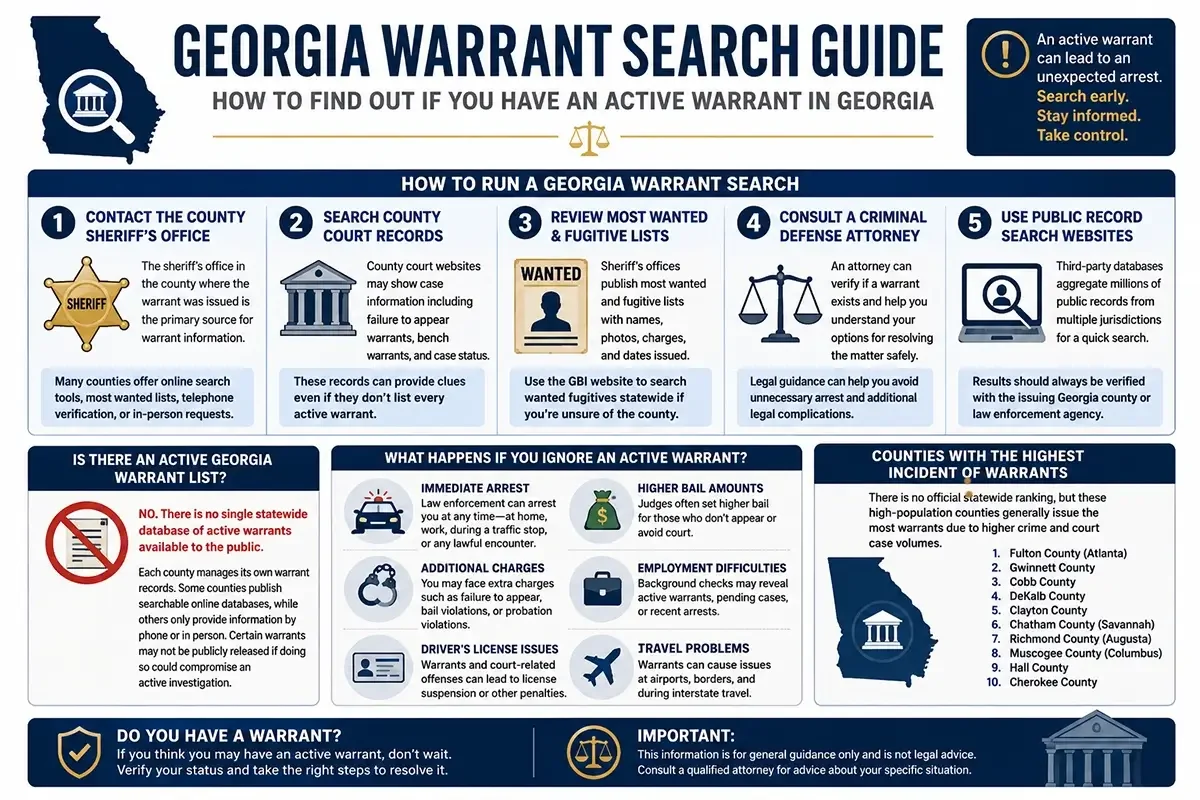
Unlike some states, Georgia does not maintain a single statewide public database containing every county issued active warrant. Instead, warrants are maintained at the county level, usually by the respective county courthouse clerk, or the county sheriff's office. The official state government advises the public to first determine the county involved and then contact that county's sheriff or county courthouse clerk for their inquiry.
1. Contact the County Sheriff's Office
The sheriff's office is usually the primary agency responsible for maintaining active arrest orders from the corresponding county courts. These orders are publicly searchable either directly through the sheriff’s website or by contacting their office for assistance.
Most GA Counties Offer:
1). Online warrant search tools
2). Most Wanted lists
3). Telephone verification
4). In-person records requests
For example, to search for Dekalb county warrants, the public can visit the Dekalb County Sheriff Department website or call their office in person @ (404) 298-8111 for assistance. For Fulton County, or Gwinnett Counties it will be a similar process.
2. Search County Court Records
Most GA county courts publish criminal case information online that may indicate active arrest or bench orders. If the information is not available online, you can also contact the clerk of the courts directly for help. However, you may need to make an appointment to talk to someone directly.
Publicly Available Information Includes:
1). Failure to appear notices
2). GA bench warrants
3). Upcoming hearings & trials
4). Civil court records
5). Criminal case status
6). Convictions and sentencing records
Court records may provide valuable clues even if they do not explicitly list every active judicial orders. For example, Forsyth county courthouse offers a public-access court case tool that can be searched by name, case number, or attorney name. This system provides publicly available court case information, including active judicial orders, once a user registers their information.
3. Review County Most Wanted and Fugitive Lists
Many Georgia sheriff's offices maintain online Most Wanted and Fugitive Lists that can be a useful starting point if you know which county may have issued the judicial arrest order. These pages often include the names, photographs, charges, and other identifying information for individuals wanted by local law enforcement.
If you're unsure which county to search, the Georgia Bureau of Investigation (GBI) also maintains a statewide database of wanted fugitives, allowing you to search for wanted individuals sought by agencies across the state. Keep in mind that these resources primarily focus on criminal arrest orders and fugitives. They generally do not include civil bench orders for minor infractions, or every active warrant issued within the state.
4. Use Public Record Search Websites
Public record search websites can be a convenient way to begin a GA warrant lookup. These services compile millions of public records from counties, courts, correctional facilities, and government agencies across the entire United States, allowing users to search multiple jurisdictions from a single database.
With a simple name search, these platforms may help uncover criminal history information, active judicial orders, prior arrests, court cases, and other publicly available records without having to search each county individually.
Third-Party Databases May Include:
1). Active arrest warrants
2). Prior arrests
3), Criminal court cases
4). Court filings & hearing
5), Criminal convictions
6), Sentencing records
7). Incarceration & inmate records
8). Vital records
9). Vehicle records
10). Property records
While third-party databases can be an excellent starting point, they may not always reflect the most recent court activity as delays in reporting can occur. Because reporting times vary among jurisdictions, any potential match should be verified with the issuing state county or the appropriate law enforcement agency before relying on the information.

What Is a Georgia Arrest Warrant?
A Georgia arrest warrant is a judicial order signed by a judge or magistrate that authorizes law enforcement officers to arrest someone suspected of committing a crime. These arrest orders are only issued after a judge determines there is probable cause to believe a criminal offense has occurred or when someone fails to comply with an existing court order, such as missing their scheduled court appearance.
Common Reasons an Arrest Order May Be Issued
Failure to Appear in Court - Missing a scheduled court hearing or appearance, without first receiving approval from the court, is one of the most common reasons a judge orders someone’s arrest, regardless of whether the original offense was a misdemeanor or felony.
Probation or Parole Violations - Violating the conditions of probation or parole such as missing required meetings, failing a drug test, or committing a new criminal offense will likely result in that person being jailed and an extension of their parole or probation terms.
Unpaid Criminal Fines or Court Costs - Repeatedly failing to pay court-ordered fines, restitution, or other legal financial obligations without making payment arrangements with the court can lead to additional penalties, increased fines, and potentially jail time.
New Criminal Charges - When probable cause has been determined that a person has committed a new criminal offense, a judge may issue an arrest order authorizing officers to immediately locate and take that person into custody.
Domestic Violence Allegations - Typically involving allegations of family violence, or violations of protective orders are taken very seriously and can result in a judicial order for that person’s arrest, if sufficient evidence exists.
Drug-Related Offenses - Court ordered arrests are are commonly issued in connection with drug possession, distribution, manufacturing, trafficking, or other violations of Georgia's controlled substance laws.
Theft or Fraud Investigations - Various crimes involving theft, burglary, identity theft, forgery, embezzlement, or financial fraud may result in an apprehension and detainment once investigators establish probable cause.
Assault or Other Violent Crimes - Anyone accused of assault, battery, robbery, homicide, or other violent offenses will likely have a warrant issued for their arrest to make sure they appear before the court to answer the respective criminal charges.
Once issued, a judicial arrest order generally remains active until the person of interest is taken into custody, voluntarily appears before the court, the underlying legal matter is resolved, or the issuing judge recalls or quashes the order. Simply waiting does not cause a court order to go away on their own, as they do not expire or have a statute of limitation.
What Is a Georgia Bench Warrant?
A Georgia bench warrant is a court order issued directly by a judge when someone fails to comply with a court order or legal obligation. Unlike an arrest order, which is typically issued after probable cause is established that a crime has been committed, a bench order originates from the court itself and is most often issued for civil violations rather than a criminal offense.
The most common reasons bench orders are issued is failure to appear (FTA)for a scheduled court hearing. However, judges may also issue civil orders when someone fails to pay court-ordered fines or restitution, violates the terms of their probation, ignores a direct subpoena, or otherwise disobeys a bench order.
Once a civil court order is issued, it will likely active until the person listed appears before the court, the overdue fines are paid, or the judge recalls the order. If you believe a bench order has been issued in your name, it's advisable to the appropriate county court clerk to resolve the issue. In many situations these civil violations can be resolved without additional penalties, or jail time.

Is There an Active Georgia Warrant List?
There is no single statewide database or public list containing every active warrant in Georgia. Instead, warrant records are maintained by the individual county that issued the judicial order. While some county sheriff's offices provide searchable online databases, others only release information by telephone or through an in-person records request. Additionally, certain arrest orders may be withheld from public access if releasing the information could compromise an ongoing criminal investigation or ongoing law enforcement operation.
How Do I Know If I Have an Active Warrant?
Many people are unaware that a bench or arrest warrant has been issued in their name until they are stopped for a traffic violation or unexpectedly contacted by law enforcement. While judges are not generally required to notify someone before issuing a bench order, there are often warning signs that one may exist. If any of the following situations apply to you, it may be worth verifying your status through official county resources.
You Missed a Scheduled Court Appearance
Failing to appear for any required court hearing is one of the most common reasons judges issue civil bench orders. Even if you simply forgot the date or believed the hearing had been rescheduled, a judge may still issue an order mandating your appearance in court.
You Failed to Pay Court-Ordered Fines or Restitution
Ignoring your court-ordered financial obligations without contacting the court, setting up a payment plan, or requesting additional time may result in enforcement actions, including additional fines and penalties.
You Violated the Terms of Probation or Parole
Missing any required appointments with your probation officer, failing a drug test, being charged with a new crime, or otherwise violating the conditions of your supervision can lead to your apprehension and appearance in court to face additional penalties, extension of parole or probation terms, and possible jail or prison time.
Law Enforcement Informed you that Charges were Pending
If state or county investigators have contacted you regarding an ongoing criminal investigation, or advised that charges may be filed, a judge could issue an arrest order after reviewing the evidence presented by the corresponding law enforcement agency.
Someone Reported that Officers Were Looking For You
Friends, family members, neighbors, or employers might inform you that police have visited your home or workplace asking about your whereabouts. While this does not automatically mean a warrant has been issued, it is a strong indication that you should verify your legal status.
Your Attorney Advised That Charges Might Be Filed
If your attorney has indicated that state or county prosecutors are preparing to file criminal charges against you, a court order for your arrest may be issued shortly thereafter, particularly if law enforcement cannot easily locate you. It’s important to heed this warning and make an action plan with your attorney in case.
If you believe an active warrant may exist, avoid assuming that no news means no arrest. The safest course of action is to verify your status through the appropriate county sheriff's office, the corresponding court, or a criminal defense attorney. Addressing the matter quickly and proactively can often give you more options than waiting until an unexpected arrest occurs.

Georgia Warrants - FAQs
Can I search for someone else's warrant in Georgia?
Yes., the majority of warrant records are public throughout the state, although the amount of information available varies by county. You can search via the respective county courthouse website, county sheriff departments, or third-party public record websites.
Do court orders expire on their own?
Not usually, as there are no statutes of limitations on time-lines for these to expire. They typically only go away after the underlying legal issues have been resolved, an arrest has been make, or a judge voluntarily recalls them. Other than those reasons, it is rare for court orders to expire on their own.
Can I call a sheriff's office to ask about a warrant?
Many sheriff's offices provide warrant information by calling them directly, while others require an in-person request or offer online public-access search tools.
Will a warrant show up on a background check?
Often, yes. Many criminal background checks include pending criminal cases and warrant-related information, depending on the reporting source and the type of screening being conducted. It’s safe to assume that these will show up on most background checks for employment, security screenings, and housing applications.
What should I do if I find out I may be arrested?
If you confirm an active court order for your arrest, consider speaking with a criminal defense attorney before taking any action on your own. An attorney can explain your rights, your legal options and, in many cases, help arrange a voluntary surrender or court appearance under controlled circumstances.