

Fulton County Warrants
🔷
Fulton County Warrants 🔷
Fulton County Warrant Guide
If you believe there may be an active warrant in your name, or someone you know, it's important to understand how the legal process works and what platforms are publicly available. Fulton County, which includes most of Atlanta, handles thousands of criminal warrants every year through the county sheriff's office. The majority of these are searchable through both official and unofficial channels as long as you have a name, or case number.
This guide explains how to perform a Fulton County warrant search, whether this information can be accessed anonymously, and what steps to take if you discover there is an active warrant for your arrest.
How to Search For Warrants in Fulton County
If you're searching for warrant information in Fulton County, there are multiple official and unofficial platforms available depending on the information you're seeking.
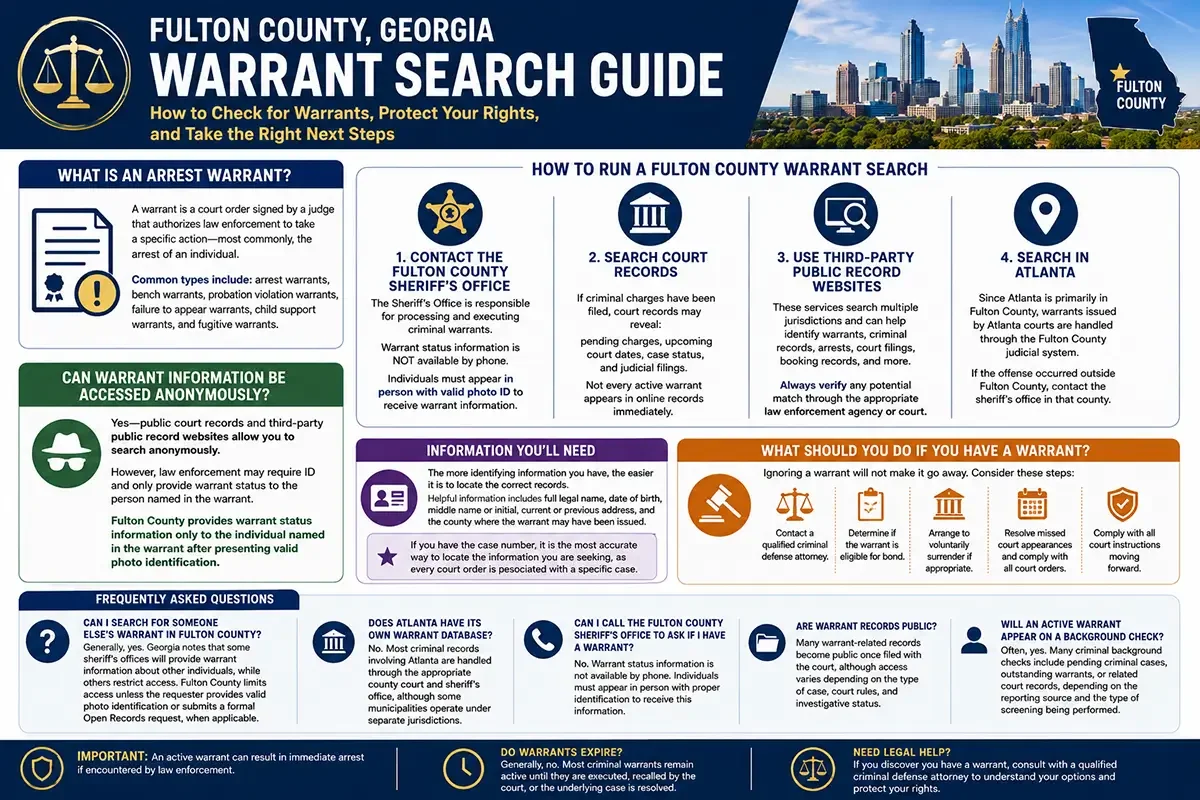
Contact the Fulton County Sheriff's Office
The County Sheriff's Office is responsible for processing and executing criminal arrest orders issued within the county. Because of the volume or arrest orders issued annually, in excess of 21,000 per year, the county has a dedicated warrant unit.
Unlike some counties, Fulton County does not provide warrant status over the phone. The best way to obtain active warrant information is by either showing up in person with a photo ID, or making an open records request online.
Search County Court Records
If criminal charges have already been filed, you may be able to locate warrant-related information by searching county court records. Depending on the case, court records may include:
1). Pending criminal charges
2). Upcoming court dates and hearings
3). Case status and disposition
4). Judicial filings and court orders
5). Convictions and sentencing records
6). Civil and criminal court case information
Keep in mind that not every active court order will immediately appear in online court records. In some cases, there may be delays before records become publicly available, and certain judicial orders may remain unavailable until they have been executed or formally filed with the court.
Use Third-Party Public Record Websites
Many people begin their search with third-party public records websites, or background check services, that compile court and criminal records from multiple jurisdictions. These services can be a convenient starting point because they search records across an entire state, making them especially useful if you're unsure which county may have issued the warrant.
These Services May Help Identify:
1). Active arrest and bench warrants, and other judicial orders
2). Criminal records, convictions, sentencing information, and incarceration records
3). Arrest history, booking records, inmate records, and mugshots
4). Civil and criminal court filings, hearings, and case records
5). Jail records and other publicly available judicial information
Because reporting schedules and record availability vary by agency, any potential match should always be verified with the issuing courthouse or the respective law enforcement agency before relying on the information provided by third-party providers.

What Is a Fulton County Arrest Warrant?
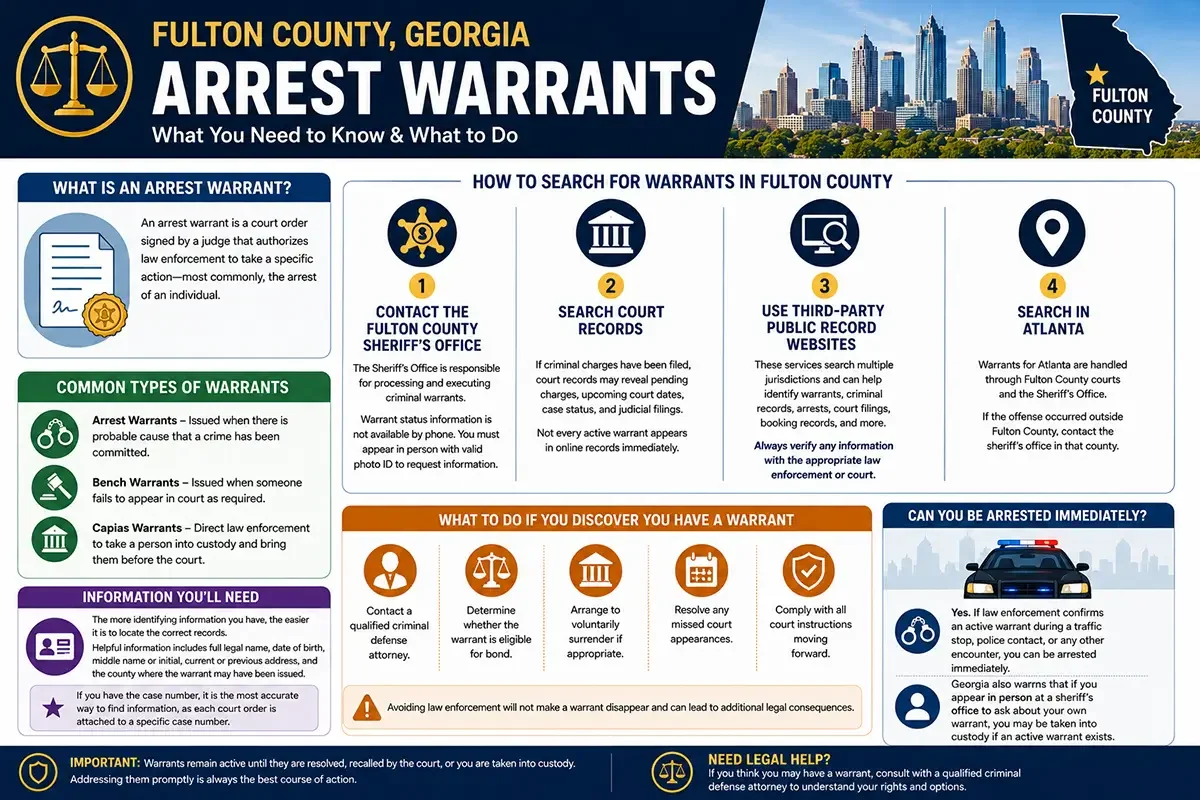
An arrest warrant is a court order signed by a judge that authorizes law enforcement to take a specific action. In most cases, this means arresting an individual who is accused of committing a crime or who failed to comply with an existing judicial order.
Common Arrest Orders Issued in Fulton County Georgia Include:
Arrest orders for criminal allegations
Bench orders for failing to appear in court
Probation violation judicial orders
Failure to pay child support violation orders
Fugitive warrants from other jurisdictions
Once issued, the majority of these judicial orders will remain active until they are executed, recalled by the court, or otherwise resolved.
Can Warrant Information Be Accessed Anonymously?
Yes. If the warrant information you're searching for is considered public record, you generally do not need permission or need to provide your own personal information to conduct a search. Public court records and third-party public records websites typically allow anyone to search anonymously without notifying the person being searched.
However, contacting law enforcement directly may not always be anonymous. Some agencies require identifying information before discussing criminal records, while others will only disclose information to the individual named in the arrest order. Fulton County specifically states that warrant status information is provided only to the person of interest after presenting valid photo identification. However, this could result in immediate detention.
If maintaining your anonymity is important, many people begin by searching public court records or third-party public records databases before contacting law enforcement. This approach can provide preliminary information while allowing time to verify any findings and, if necessary, consult with a qualified criminal defense attorney about the appropriate next steps.
What Information Is Needed to Search for Arrest Orders?
The more identifying information you have, the easier it will be to locate the correct court records and determine whether an active arrest order exists. At a minimum, you should have the individual's full legal name and, if possible, their date of birth to help distinguish them from others with similar names. Additional identifying details such as a middle name or middle initial, current or previous address, and the county where the court order may have been issued, can help to improve the accuracy of your search.
Georgia recommends having at least the person's full legal name, and date of birth if available when requesting any court case information. If you have the case number, it is the most accurate way to locate the information you are seeking, as every court order is associated with a specific case number.
What Should You Do If You Discover You Have a Warrant?
Learning that a warrant for your arrest has been issued can be very stressful, but addressing it quickly is generally the best course of action. Depending on your circumstances, you may want to consult with a criminal defense lawyer to understand your rights and legal options. They can help you determine whether the arrest order is eligible for bond, and discuss whether voluntarily surrendering is best path forward. If the arrest order resulted from a missed court appearance or allegation of a crime, resolving the underlying issue as quickly as possible may help move the case forward. It's also important to comply with all future court orders and deadlines as this shows the courts that you’re working towards a resolution. Attempting to avoid the arrest order will only make your situation worse and more legally complicated, as these do not expire and will likely result in additional charges or additional jail time.
You Can You Be Arrested Immediately
If law enforcement confirms an active warrant during a traffic stop, police contact, or any other encounter, officers may arrest you on the spot. Georgia also cautions that if you appear in person at a sheriff's office to inquire about your own status, you may be taken into custody if an arrest order is found. If you’re in doubt of your status, it’s advisable to talk with an attorney to assist you with your inquiry and lay out the available legal options for facing or resolving the criminal charges filed against you.
Do Arrest Orders Expire?
Generally, no. Most criminal arrest orders remain active until they have been resolved through a formal legal process. In most cases, an arrest order stays in effect until the individual is taken into custody, a judge recalls or quashes the order, or the underlying criminal charges are dropped. Simply waiting for time to pass does not typically cause a judicial order to expire, and it may remain enforceable indefinitely. Because outstanding criminal charges can result in an arrest during any law enforcement encounter, it is generally advisable to address the matter promptly rather than assume it will go away on its own.

Fulton County GA Warrants - FAQs
How to Run a Warrant Search in Atlanta, Georgia
Since Atlanta is primarily located within Fulton County, most criminal arrest orders issued by Atlanta courts are handled through the Fulton County judicial system.
To search for an Atlanta Warrant Information, You Can:
Review available Fulton County court records.
Contact the County Sheriff's Office - Make an Open Records Request.
Check with the Atlanta Police Department - Open Records Unit
Search reputable public records databases for preliminary information.
If the alleged criminal offense occurred outside Fulton County, you may also need to contact the sheriff's office in the county where the judicial order was issued.
Can I search for someone else's warrant in Fulton County?
Generally, yes. The state of Georgia notes that some sheriff's offices will provide warrant information about other individuals, while others restrict access. Fulton County is among the jurisdictions that limit access to certain public information unless the person making the request provides valid photo identification or submits a formal Open Records request.
Does Atlanta have its own criminal records database?
No. Most criminal records involving Atlanta are maintained by the appropriate county court and sheriff's office, although some municipalities within the metropolitan area operate under separate jurisdictions. Georgia also offers a statewide felony conviction record search that is available to the public for a fee. To perform a search, you will generally need the individual's full legal name and date of birth.
Are warrant records public?
Many warrant-related records become public once officially filed with the court, although access varies depending on the type of case, court rules, and investigative status. Certain records may remain sealed for privacy reasons, or for open investigations.