


Search and Seizure Warrants
🔷
Search and Seizure Warrants 🔷
What is a Search Warrant?
A search warrant is more than just a court order that gives law enforcement the authority to search a home, business, vehicle, or electronic device. It represents a judge's determination that there is probable cause to believe evidence related to a crime may be found at a specific location.
Search warrants are important legal tools used during criminal investigations to help law enforcement gather evidence while protecting a person’s constitutional rights. Before a warrant can be issued, investigators must present evidence to a judge demonstrating why they believe a search is necessary and what evidence they expect to find.
In the United States, search warrants are rooted in the Fourth Amendment of the Constitution, which protects US citizens from unlawful searches and seizures by law enforcement. This means that law enforcement must obtain a warrant from a judge before entering and searching private property. However, there are some exceptions that may allow officers to conduct a search without a warrant, such as when they witness a crime in progress, obtain permission from the property owner, or have an emergency situation that requires immediate action to protect public safety or preserve evidence.

What Do Search Warrants Look Like?
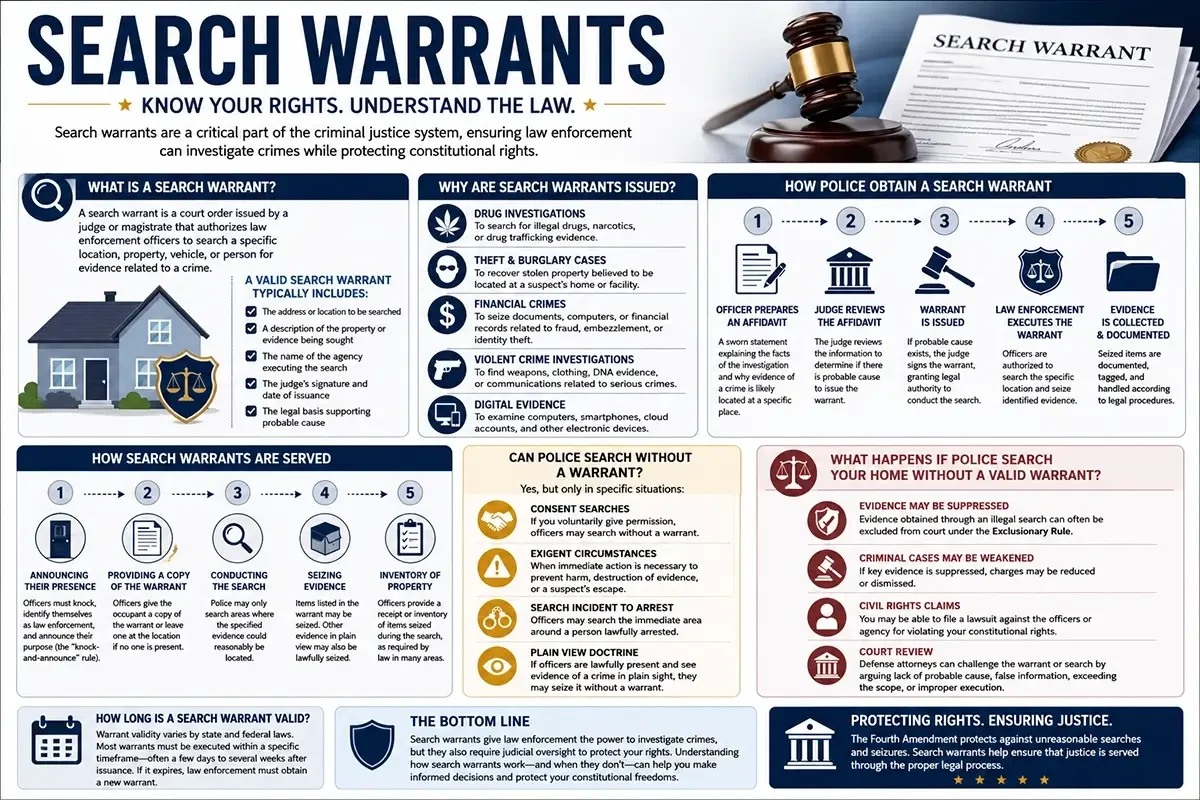
Search warrants are legal judicial orders that document specific information regarding evidence, for an ongoing investigation, that is likely located at a specific location. While these documents can vary by state and county, however most contain several key pieces of information, including:
The address, location, or device that can be searched
A description of the evidence or property officers are looking for
The law enforcement agency authorized to conduct the search
The judge's signature and the date the warrant was issued
A summary of the facts establishing probable cause
These legal orders are very specific about where officers can search and what they are allowed to seize. This helps prevent overly broad searches and protects the rights of citizens. If the legal terms are violated during a search, it could invalidate any evidence that is collected and not be allowed in the ensuing trial.
Why Are Search and Seizure Warrants Issued?
Judicial search orders are issued when probable cause can be demonstrated to the courts, or a sworn affidavit from law enforcement, that evidence of a crime exists at a specific location or on an electronic device. Without probable cause, there cannot be a legitimate search of a person’s property or location unless exigent circumstances exist.
Common Reasons Search Orders are Issued Include:
Drug Investigations
Officers may seek a warrant to search someone’s home, a vehicle, or business suspected of containing illegal drugs, narcotics, or evidence of drug trafficking.
Theft and Burglary Cases
A court order may be issued for searching a suspect's home, vehicle, storage unit, business, or another specific location where investigators believe stolen property is being kept. There must be reasonable suspicion that evidence is in that specific location.
Financial Crimes
Search warrants are also commonly used to seize documents, computers, email accounts, electronic devices, or financial records connected to various types of fraud, embezzlement, or identity theft investigations.
Violent Crime Investigations
Police may seek relevant evidence such as weapons, clothing, DNA evidence, text messages, emails, or electronic communications related to assaults, robberies, or homicides.
Digital Evidence
Modern search orders frequently authorize the seizure and examination of computers, smartphones, tablets, cloud storage accounts, crypto accounts, and other digital accounts that may contain evidence of a crime.
How Do Police Obtain a Search Order?
Before any type of warrant can be issued, an officer must submit evidence, or an affidavit directly to a judge so they can to determine whether “probable cause” exists. Once a judge makes this determination they will sign the legal order to search a specific location for a set period of time.
An affidavit is a sworn statement that explains:
The facts of the ongoing investigation
Why the officer believes a crime has occurred
Specific evidence supporting probable cause
The specific location to be searched (e.g. home, vehicle, etc.)
Any relevant items or evidence that is expected to be found
Once a judge reviews all the available evidence and information, they will make a determination whether probable cause exists, or does not. If sufficient evidence is presented, the judge will likely sign the judicial, allowing law enforcement to proceed with the search.
How Are Search Warrants Served?
After a warrant is signed by a judge and officially issued, law enforcement officers will execute or "serve" the warrant by conducting the search authorized by the court. They will present it to anyone at the location to be searched. If no one is there, officers have the right to enter the premises without the owner or resident being present.
The Search Process Generally Includes:
Officers Announcing Their Presence
In the majority of situations, officers must first knock, identify themselves as law enforcement, and announce their purpose before entering the property. If no one answers they may enter the property or location without anyone being present.
This is commonly known as the "knock-and-announce" rule. If law enforcement reasonably believes that announcing their presence could endanger officers, allow a suspect to flee, or lead to evidence being destroyed, they may be permitted to enter without prior notice. In some cases, a judge may authorize a no-knock warrant before the search takes place.
Providing a Copy of the Warrant
The majority of the time, officers will provide the property owner or occupant with a copy of the search order, or leave one at the location if nobody is currently present. While this is usually a formality, certain situations make it so they do not immediately supply the court order before serving it.
Conducting the Search
Police may only search areas where the specified evidence could reasonably be located, which protects citizens from unlawful searches and seizures.
For example, if officers are searching for a stolen vehicle, they generally would not be permitted to search inside a kitchen cabinet or small drawer where a vehicle could not possibly be concealed. The areas searched must be reasonably related to the type of evidence described in the warrant.
If officers exceed the scope of the legal order, or fail to follow proper legal procedures during the search, a court can determine that the search was unlawful. In these circumstances, evidence that was obtained through an improper search may potentially be excluded from trial.
Seizing Evidence
Any evidence that is specifically listed in the judicial search order may be seized. In some cases, officers may also seize evidence of other crimes if it is discovered in plain view during the lawful search
Inventory of Property
For accountability reasons, most counties now require comprehensive inventory lists of items that were seized during the search. If these protocols are not followed it can potentially lead to dismissal of evidence at a trial.
What Is a No-Knock Search Warrant?
A no-knock warrant allows officers to enter a property without first announcing their presence. These orders are typically reserved for situations where law enforcement can show that announcing their presence would potentially:
1). Endanger other police officers or bystanders
2). Result in the destruction of evidence
3). Increase the risk of a suspect fleeing
Because of various public concerns and legal challenges, many states have restricted or limited the use of no-knock warrants in recent years. There has been some abuse reported about these no-knock situations that have compromised both evidence and people’s constitutional rights.
According to the U.S. Department of Justice, no-knock entries are typically restricted to limited circumstances involving safety concerns to personnel and evidence, and require additional approval before being authorized by a judge.
How Long Is a Search Order Valid For?
Search orders have expiration dates that can vary by federal, state, and local jurisdictions. Once the court order is issued, officers must execute the search within a specific timeframe, which can range from a few days to several weeks depending on the respective laws.
These expiration timelines help make certain that the information used to establish probable cause remains current and relevant.
What Happens if the Search Order Expires?
If the search order expires before it is executed, officers will need to return to court and obtain a new warrant before conducting the search. This usually requires investigators to demonstrate that probable cause still exists and a valid reason to believe evidence related to the investigation remains at the location. These requirements help verify that search orders are based on current information rather than outdated evidence.

Frequently Asked Questions About Search Warrants
What states require a search warrant after a canine alert
While there is not a single list of states that require a warrant to search a location after a police canine alerts law enforcement, many states allow this. When a trained police dog alerts law enforcement, it can effectively establish probable cause to search a vehicle or home without needing a warrant. However, some states still require additional permissions for privacy protections under their state’s constitution. It’s also important to note that these laws can vary depending on whether the search includes a vehicle, a home, personal property, or electronic devices. Because search and seizure laws frequently change through state legislation, it’s advisable to review your current state’s laws for verification.
Can a cop search your car without a warrant?
Yes, a cop can search a vehicle without first obtaining a warrant in certain situations. Under the "motor vehicle exception" to the Fourth Amendment, police officers may conduct a search if they have probable cause to believe the vehicle contains evidence of a crime, illegal drugs, or other types of contraband. Police may also search a vehicle if the driver gives their consent, or during certain circumstances following the driver’s arrest. However, the police must still comply with relevant laws, and the legality of their search may be challenged in court if they failed to follow proper procedures.
How long does it take to get a search warrant?
The time required to obtain a judicial search order can vary quite a bit depending on the circumstances of the criminal investigation. In time-sensitive situations, law enforcement may be able to secure a warrant within a matter of hours by presenting evidence and an affidavit to a judge. More complex investigations will often take longer if additional evidence is needed to establish probable cause. Once a judge determines there is sufficient evidence, they will issue a court order to search a location or electronic device.
Do police need a warrant to search your phone?
The majority of the time police will need a warrant because smartphones contain large amounts of personal information. Police must obtain a court ordered to search before accessing the contents of a person’s phone. This requirement was made by the U.S. Supreme Court in the case of Riley v. California (2014), which stated that officers need a judicial order to search digital information stored on a mobile device. There are however certain limited exceptions, such as when the owner voluntarily consents to the search, or if an emergency circumstances exists.
What Happens If My Home Was Illegally Searched by Police?
If the police unlawfully searched your home, any evidence obtained during the search may be challenged and potentially thrown in court. Under the Exclusionary Rule, in Mapp vs. Ohio, any evidence that is obtained in violation of the Fourth Amendment can potentially be excluded from trial. This basically means that prosecutors may not be allowed to use it against you during your criminal trial.