

Florida Warrant Check
🔷
Florida Warrant Check 🔷
How to Check for Active Warrants in Florida
Warrants in Florida, like other states, are court-authorized legal orders that address civil violations and criminal allegations. These court directives mandate a person’s response or authorize law enforcement officers to take specific actions, including making an arrest, conducting a search, or compel an individual to appear before the court. If you believe you may have an active warrant in Florida, it is important to verify the information through official court channels, law enforcement agencies, or reputable public records databases.
Because court ordered warrant are often maintained at the county level, finding accurate information can sometimes require searching multiple jurisdictions. Understanding the different types of these court orders, how they are issued, and how to look them up can help you determine whether one exists and what steps you should take next.
Commonly Issued Florida Warrants
Warrants are legal orders issued by a judge or magistrate that authorize law enforcement or the courts to take a specific action. They may be issued in connection with criminal investigations, missed court appearances, probation violations, child support matters, and other legal proceedings. Criminal judicial orders are generally based on probable cause and may authorize an arrest, search, or other enforcement action. While many court orders involve criminal matters, others stem from civil violations and are intended to compel compliance with specific legal obligations. Depending on the type of order issued, the consequences can range from fines and penalties to arrest and detention.
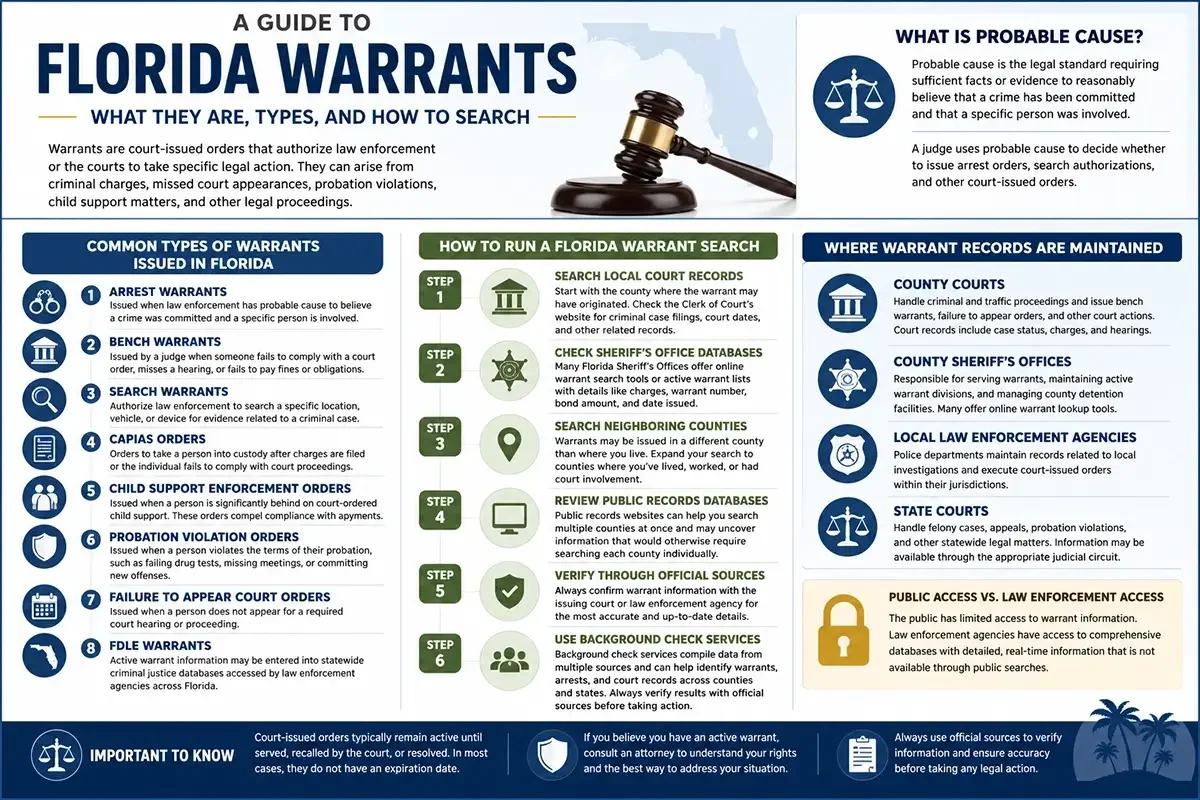
Common Types of Warrants Issued in Florida Include:
1). Arrest Warrants - Issued by a judge when presented with sufficient evidence establishing probable cause that a crime has been committed. This legal authorization allows officers to take the person suspected of committing the alleged crime into custody and initiate the criminal court process.
2). Bench Warrants- Issued directly by a judge (also known as the ‘Bench’) when an person fails to comply with a court order or legal obligation. Common reasons include missing a scheduled court proceeding, failing to pay court-ordered fines, or neglecting other legal requirements imposed by the court.
3). Search Warrants - Court-authorized directives that authorize law enforcement officers to search a specific location, vehicle, residence, business, or electronic device for evidence related to an ongoing criminal investigation. The locations that are searched must be compliant with the Fourth Amendment of the Constitution.
4). Capias Orders - Judicial directives commanding law enforcement to take an individual into custody after criminal charges have been officially filed, or when a person fails to comply with a court order. These are most commonly associated with criminal cases and post-conviction legal matters.
5). Child Support Enforcement Orders - Legal actions that are issued when a child’s parent falls significantly behind on court-ordered financial support obligations. These enforcement measures are designed to compel compliance with support payments and other family court mandates.
6). Probation Violation Orders - Issued when a probation officer, or the court, determines that a person has violated the conditions of their probation terms. Violations commonly include failing drug tests, missing required meetings, committing new criminal offenses, or failing to complete court-mandated rehabilitation programs.
7). Failure to Appear Court Orders -Initiated when a person does not attend a scheduled court hearing or proceeding as required. Missing a required court date can lead to immediate legal consequences and may result in the sheriff department being authorized to locate and detain the individual until their next court appearance.
8). FDLE Warrants - While the Florida Department of Law Enforcement (FDLE) does not typically issue these legal arrest orders directly, active warrants may be entered into statewide criminal justice databases accessed by law enforcement agencies throughout Florida. This allows officers across all state jurisdictions to identify outstanding court actions and take appropriate enforcement measures.
Once a court order has been issued, it generally remains active until it has been served, recalled by the court, quashed, or otherwise resolved through the legal process. In most cases, these court-issued authorizations do not have a statute of limitations or automatic expiration date, meaning they can remain in effect indefinitely until appropriate action is taken to address them.

How To Run a Florida Warrant Search
If you believe there may be an active warrant issued in your name, or someone else’s, conducting a thorough search can help you determine whether court action has been issued for an arrest or a civil violation. Because this information is often maintained at the county level, it may be necessary to search multiple jurisdictions to obtain a complete picture. The following steps can help guide your search.
Step 1: Search Local Court Records
The first place to begin is with the county court where you believe the legal matter originated. Many Florida counties provide public access to court records through the Clerk of Court's website. These databases may contain information related to criminal cases, civil cases, traffic violations, missed court appearances, probation matters, and other legal proceedings that could result in a judicial order being issued. Beginning your search in the county where the alleged offense occurred is usually the most effective starting point.
Step 2: Check Sheriff's Office Databases
Many county sheriff's offices maintain online criminal record search tools that are available to the public. These databases are frequently updated and may provide more direct information regarding active enforcement actions, arrest records, jail records, and county inmate records. If online access to records are not available, some sheriff's offices may provide information through their warrant division or public records department.
Step 3: Search Neighboring Counties
It’s commonly assumed that judicial orders will only be issued in the county where they currently live. However, court actions are often initiated in the jurisdiction where the alleged offense, violation, or legal proceeding occurred. If your initial search of local records does not produce results, try expanding your search to neighboring counties or locations which may help you uncover additional information.
Step 4: Review Public Records Databases
Third-party public records websites compile information from multiple public sources. These third-party resources are especially helpful in providing broader searches across numerous counties and states. These services are commonly used for looking up court records, criminal records, arrests, and active court orders, incarcerations records, and vital records without visiting multiple government websites. While these services can save a lot of time with your research, and significant findings should be verified through official government sources before making any legal decisions.
Step 5: Background Check Services
Background check services can provide another method for identifying potential arrest orders, criminal cases, arrests, court records, and incarcerations.. Many background screening providers compile information from public court records, law enforcement agencies, correctional facilities, and other government agencies into a single searchable report. These services can be especially useful when performing a broad search that spans multiple counties or states, as they may uncover records that would otherwise require searching multiple county court and law enforcement databases individually.
What Is an FDLE Warrant?
Many people search for an "FDLE warrant" when attempting to determine if they have an active arrest order in Florida. The Florida Department of Law Enforcement serves as the state’s criminal justice agency and maintains numerous criminal justice databases used by law enforcement agencies, as well as the public, throughout the state.
While FDLE assists with criminal history information and statewide law enforcement records, warrant records are generally maintained by:
County Courts - Oversee and issue many county criminal arrest orders and civil bench orders.
County sheriff's Offices - Serve arrest orders and maintain county arrest records, jail records, and inmate records.
Local Law Enforcement Agencies - Municipal police departments maintain records related to investigations conducted within their jurisdiction.
State Courts - Handles a wide range of criminal matters and may issue judicial orders associated with felony cases, appeals, probation violations, and other statewide legal proceedings.
Although certain criminal history information is available to the public through FDLE resources, public access is quite a bit more limited than the databases available to law enforcement agencies.
Police officers, sheriff's deputies, and other authorized personnel have expanded access to comprehensive criminal justice database systems that contain detailed information regarding active warrants, criminal cases, arrests, and active investigations from other state jurisdictions, and related law enforcement records.
What Is Probable Cause
Probable cause means there is enough evidence for a judge to reasonably believe that a crime may have occurred and that a particular person may be connected to it. This legal standard is commonly used when issuing arrest orders and search authorizations, allowing law enforcement to take a suspect into custody or search a home, vehicle, business, or electronic device for evidence related to an investigation. Probable cause helps protect individuals from being subjected to arbitrary arrests or searches without sufficient justification.

How To Handle a Arrest Warrant in Florida?
Discovering that there is an active court-issued arrest order in your name can be stressful and overwhelming, but ignoring the situation will likely your situation worse. Depending on the circumstances, an outstanding Fl arrest warrant can result in being arrested at home, work, or while driving. Ignoring the situation and criminal allegations can lead to additional charges, increased fines and jail time, or complications with future court proceedings.
Most judicial arrest orders stay active for as long as it takes to either apprehend the person of interest, or until the underlying criminal charges are resolved. Taking the initiative to address the charges against you is usually the best way to protect your rights and minimize potential consequences.
Possible Options to Address the Charges Against You Include:
Contact a Criminal Defense Attorney
One of the safest options many people in this situation take is to setup a consultation with an experienced criminal defense attorney. An attorney can review the details of your criminal charges, explain the legal implications, and help determine the most favorable course of action based on the circumstances.
A criminal defense attorney may be able to help determine:
1). The significance of judicial order that has been issued and the potential consequences
2). The underlying criminal allegations and what it means to be convicted of those charges
3). Whether bond has been established, if bond is possible, and what are your legal options
4). Whether the arrest order can be recalled or quashed, and if there are any discrepancies
5). Potential penalties and consequences if you are convicted of the charges against you
6). Available legal defenses and resolution options, including plea bargains or pleading no-contest
In some situations, legal counsel may even be able to communicate with the court on your behalf before you make an appearance. While this is not always an option, a qualified attorney should be able to explain all your available legal options to you.
Contact the Court Directly
Depending on the nature of the criminal charges, contacting the court directly can give you valuable insights regarding the status of your case. Court clerk, or other personnel may be able to provide specific details regarding hearing dates, case numbers, payment obligations, or procedural requirements needed to resolve the issue.
The court may provide information regarding: upcoming hearings, outstanding fines, bond requirements, case status updates, or any other relevant procedures required for addressing the criminal matter. While court staff is not allowed to provide legal advice, they can explain the administrative requirements and next steps.
Arrange a Voluntary Surrender
In certain situations, voluntarily turning yourself in may be the best option, and will often be viewed more favorably than waiting to be taken into custody. By addressing your criminal allegations head-on, you demonstrate a willingness to comply with the legal process and resolve the issue promptly.
Some of the Benefits of Voluntary Surrender Include:
1). Showing cooperation with the court, and not wasting the time of legal process
2). Reducing the likelihood of being arrested unexpectedly at home, work, or while driving
3). Allowing time to arrange legal representation and planning a solid defense
4). Giving yourself an opportunity to prepare financially for bond or other legal expenses
5). Improving your standing before the court and showing initiative to resolve the underlying issue
Before surrendering, it may be savvy to first speak with an attorney to get a better understanding of what to expect, and whether alternative options may be available. While you still retain your constitutional rights after being taken into custody, your ability to freely communicate, gather documents, and manage personal affairs may become more limited until the matter is resolved or bond is posted.
Resolve Outstanding Court Obligations
Many court-issued enforcement actions stem from unresolved legal obligations rather than new criminal charges. Missed court appearances, unpaid fines, probation violations, failure to complete court-ordered programs, and child support issues are some the most common reasons these judicial actions are issued.
Protecting Yourself While Addressing Judicial Orders
Because active judicial orders can lead to serious legal consequences, it is important to verify any information obtained through public records websites, background check services, or unofficial databases. The Florida State Courts System encourages the public to use official court records and case information systems when researching important legal matters and court proceedings. Official court records provide the most accurate and up-to-date information regarding the status of an ongoing case, upcoming hearing dates, criminal charges, and judicial actions. Anyone who discovers an active arrest order in their name should consider consulting with criminal defense lawyer to understand their rights, the charges against them, and available options before taking any legal action.

Florida Warrants - FAQs
Do I check if I have a warrant in Florida?
It’s generally best that you start with official government channels when researching active warrants. You can start with the court website in the jurisdiction that you live, contact your county sheriff department, or use the state’s FDLE criminal record system. If you cannot find what you are looking for through official channels, you can try using third-party resources such as public record websites, which will allow you to search multiple jurisdictions. These services can be useful for finding court records, criminal history reports, or outstanding legal actions that might not be found through a single county search.
How can I search Florida court records online?
Most counties in Florida offer public online access to court records that may include criminal cases, hearing dates, judicial actions, convictions, sentencings, and other information related to active legal proceedings.
What happens if I miss my required court date?
If you miss a required court appearance, it can lead to a ‘Failure to Appear’ violation. This may result in a judge issuing a bench order to either reschedule your court appearance, or authorize law enforcement to locate and detain you until the matter is addressed.
Can law enforcement search my home without my permission?
Generally, no. In most situations, law enforcement officers must obtain a search order from a judge, that is based on probable cause, before searching a private residence. This means that there needs to be sufficient evidence to reasonably believe that there is evidence related to an ongoing criminal investigation located in someone’s home. However, there are a few exceptions that might allow a search without a court order, such as getting consent, responding to an emergency, or other exceptions recognized under Florida law.
What is the Florida FDLE?
The FDLE is the Florida Department of Law Enforcement, which is a statewide agency that helps support police departments, sheriff's offices, and other law enforcement agencies throughout the state. The FDLE maintains criminal records, assists with major investigations, operates forensic laboratories, and manages criminal information systems that help the various law enforcement agencies keep track criminal cases and share information throughout the state.