

Indiana Warrant Check
🔷
Indiana Warrant Check 🔷
Indiana Warrant Search Guide
If you believe a warrant may have been issued in Indiana, it's important to verify the information through reliable sources as soon as possible. Indiana provides several public resources that allow individuals to publicly search for court records, including judicial bench and arrest orders online.
This guide explains how to search for Indiana warrants, the different types of judicial orders, how the MyCase Indiana system works, and what to do if an arrest order has been issued in your name.
What Legal Purposes Do Warrants Serve?
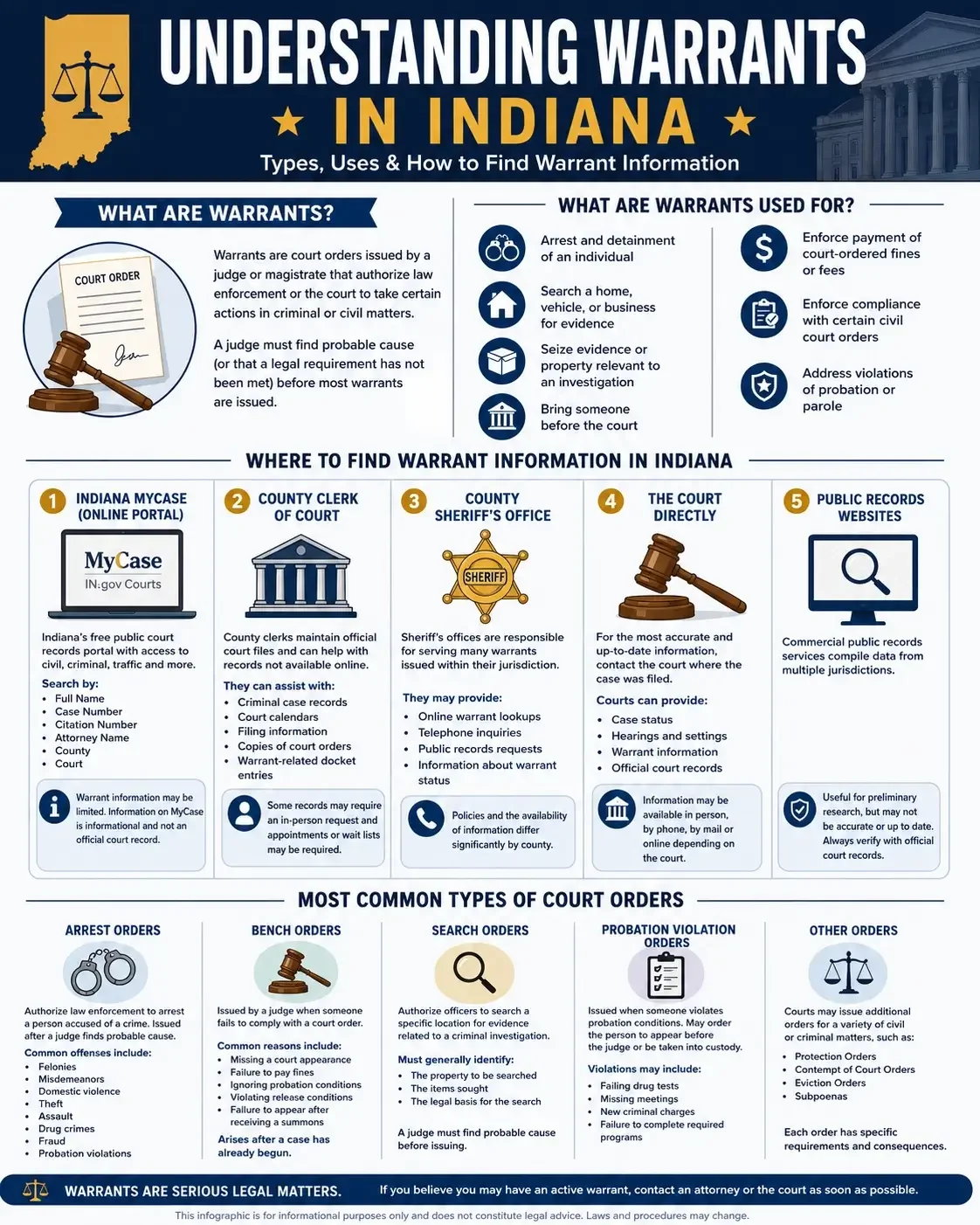
Warrants are court orders issued by a judge or magistrate that authorize specific legal actions in either criminal or civil matters. In criminal cases, an arrest order authorizes law enforcement to locate, arrest, and detain an individual who is suspected of committing a crime. A bench order, by contrast, is typically issued when someone fails to comply with a court order, such as appearing for a scheduled hearing, paying court-ordered fines, or otherwise failing to fulfill a legal obligation. While these are among the most common types of court orders, many others exist, each carrying different legal consequences depending on the circumstances.
Depending on the situation, a warrant may authorize law enforcement or the court to:
1). Arrest and detain a person of interest until their court arraignment
2). Search of a home, vehicle, business, or other location for relevant evidence
3). Seize evidence or property relevant to an ongoing criminal investigation
4). Compel an individual to appear before the court as ordered
5). Enforce payment of court-ordered fines, fees, or other legal obligations
6). Enforce compliance with certain civil court orders or procedures
7). Address violations of probation or parole orders as outline by the courts
Before issuing a court order, a judge must determine that there is sufficient legal justification, such as probable cause, in a criminal investigation or evidence that a person has failed to comply with an existing court order. This judicial oversight helps verify that court orders are issued in accordance with the state laws and the constitutional rights of those involved.

How to Search for Active Indiana Warrants
Unlike some states, Indiana does not maintain an official statewide "warrant list." Instead, warrant information is generally maintained through county courts and local law enforcement agencies. As a result, identifying the county where the original court order was issued is the first step in conducting an effective search. If you're unsure which county to begin with, using a reputable public records website or other third-party records aggregator can help narrow your search and identify the appropriate county before verifying the information through the official court or sheriff's office.
The most search common methods include:
1. My Case Indiana Warrants
The Indiana Judicial Branch operates an online public access portal called MyCase. the state's free online public records portal that provides access to millions of court records from participating courts across the state. This records portal provides access to millions of court records from state, county, and municipal courts. MyCase allows the public to search many civil, criminal, traffic, probate, and family court cases all in one place. This makes this resource one of the most convenient platforms for researching INcourt records.
MyCase allows users to search by:
Full Name – Search by first and last name to locate matching court cases.
Case Number – View a specific case when the court-assigned case number is known.
Citation Number – Search traffic citations, ordinance violations, DUIs/DWIs
Attorney Name – Locate cases associated with a particular attorney.
County – Narrow results to a specific Indiana county where the case was filed.
Court – Search records from a particular circuit, superior, city, or municipal court.
If a criminal case includes an active warrant, the case history may indicate that an arrest order has been issued, although not every county or court necessarily has the same information. MyCase contains records from the state’s county and municipal courts using Indiana's Odyssey case management system,. This system covers the majority of Indiana’s courts. It’s also important to note that Information shown on this platform is informational and is not considered an official court record.
2. County Clerk of Court
Each of the state’s 92 county court clerks are responsible for maintaining the official court records for cases filed within that county. If you're unable to locate information through MyCase or online resources, the county clerk's office is often the best place to get search assistance. Clerks can assist with locating court files, explaining public records procedures, and providing access to documents that may not be accessible online.
Depending on the county, records may be available online, by telephone, by mail, or through an in-person visit. It’s usually recommended to make appointments for records requests, however some counties will accommodate walk-in visitors during normal business hours. Processing times and availability can vary based on the county's current workload.
A county clerk may be able to assist with accessing:
Criminal Case Records – Review filings, charges, hearing dates, dispositions, and other publicly available criminal case information.
Court Calendars – View upcoming hearings, scheduled court appearances, and other court events.
Case Filing Information – Obtain details about when a case was filed, the parties involved, and the court assigned to the matter.
Copies of Court Orders – Request copies of publicly available orders, judgments, sentencing documents, and other official court records.
Warrant-Related Docket Entries – Review docket entries that may indicate when an arrest or bench order was issued, recalled, served, or otherwise resolved.
Not all records are available to the general public, including documents that are sealed, confidential, or restricted by state law. Some warrant information may be withheld from online access if the respective case is sealed. In certain other situations, an in-person formal public records request may be necessary. If you need certified copies of court documents, they must generally be obtained directly from the clerk's office, which typically have additional certification fees.
3. County Sheriff's Office
The state’s county sheriff's offices play a central role in executing and serving warrants issued by courts within their jurisdiction. While judges issue arrest orders, it is typically the sheriff's office that is responsible for locating individuals named in arrest, bench, or tax court orders and carrying out the court's order. Many sheriff's departments also maintain records related to active arrest orders and may offer limited public access to that information.
The services offered vary from county to county, but a sheriff's office may provide:
Online Warrant Searches – Some counties maintain searchable online databases that allow the public to check for active court orders by name. For example, in DeKalb County, the Sheriff Department offers public access to active searchers through their Most Wanted Platform.
Telephone Inquiries – Certain county offices will confirm whether an active arrest order exists over the phone, although they may limit the information they provide because of privacy restrictions.
Public Records Requests – If the information you are looking for is not available online, you may be able to request records under Indiana's public records laws, subject to any applicable exemptions.
Civil Process Information – Some sheriff's offices also provide information regarding the service of civil court orders, subpoenas, eviction notices, and other legal documents.
Record Lookup Assistance – In some cases, staff may explain whether a judicial order has been served, recalled, or remains active, or direct you to the respective county court for additional information.
Because each Indiana county establishes its own procedures, the availability of public information can differ significantly. Some sheriff's offices publish active wanted person’s lists online, while others provide information only in person or in response to an in-person records request. If you are unable to locate the information online, contacting the corresponding county sheriff's office in the county where the court order was likely issued is often the next best step.
5. Public Records Websites
Commercial public records websites aggregate information from a variety of public sources, allowing users to search records from multiple jurisdictions in one place. These services can be a convenient starting point for locating preliminary information, especially when you are unsure which county or state may have issued a warrant or when researching publicly available court records across several jurisdictions.
Depending on the provider, these databases may include:
Criminal Court Records – Information on criminal filings, charges, court proceedings, and case outcomes.
Arrest and Warrant Information – Preliminary records that may indicate the existence of an active or previously issued warrant.
Court Case Histories – Docket information, hearing dates, case status, and judicial actions.
Address and Identity Records – Current and historical addresses, aliases, and other publicly available identifying information.
Other Public Records – Property records, marriage and divorce records, bankruptcies, liens, judgments, and other government records, depending on the database.
Although these services can save time by searching multiple sources simultaneously, they should be used for informational purposes only. Public records databases may not be updated in real time, and the information they contain can be incomplete, outdated, or inaccurate. For that reason, any potential warrant or court record should always be verified through the appropriate Indiana court, county clerk, or sheriff's office before relying on the information or taking legal action.
For the most accurate and up-to-date information, official court records and law enforcement agencies remain the most reliable resource for verifying the existence and status of an active bench or arrest order.
Counties That Issue the Most Warrants
While Indiana does not publish a yearly statewide ranking of active warrants, there are a few outliers that have account for the majority of judicial order issued each year. Based on population, criminal caseloads, and court activity, these counties generally process the highest volumes of criminal cases and therefore are likely to issue the greatest number of arrest orders each year:
Marion County (Indianapolis) – As Indiana's most populous county and home to the state capital, Marion County handles the largest volume of criminal filings in the state.
Lake County (Gary, Hammond) – One of the state's busiest judicial systems with significant felony and misdemeanor caseloads.
Allen County (Fort Wayne) – Another major judicial district serving the northeastern part of the state with high annual criminal case volume.
St. Joseph County (South Bend) – Processes tens of thousands of criminal and traffic cases annually through its circuit and superior courts.
Hamilton County (Carmel, Fishers, Noblesville) – One of the state’s fastest-growing counties with increasing court activity, which is closely tied to it’s population growth.
While these counties (in general) issue the most court orders due to population and caseload, smaller counties in the state may have higher rates relative to their population.
Most Common Types of Indiana Court Orders
The courts of Indiana issue a multitude of different court orders depending on the circumstances. While some are very serious and demand the arrest of an individual, others are less punitive and result in fines and non-criminal penalties.
Arrest Orders
A court order for someone’s arrest gives law enforcement the ability to detain a person accused of committing a criminal offense. While that person will have their day in court, there was enough conclusive evidence for a judge to say there was probable cause. However, while someone is arrested for an allegation of a crime, this does not determine guilt, it simply authorizes the person's arrest so the criminal case can proceed through the judicial process.
Judges typically issue arrest orders after reviewing:
1). Police Investigation Reports – Police reports that summarize the facts of the alleged offense and criminal charges.
2). Sworn Affidavits – Written statements made under oath by law enforcement officers, governments, witnesses, or victims describing the events that support the criminal allegations.
3). Probable Cause Affidavits – Documents outlining the evidence that effectively show there is sufficient legal basis to believe a crime was committed and that the named person of interest committed it.
4). Supporting Evidence – Additional evidence, such as photographs, surveillance footage, witness statements, or forensic findings, may also be considered by the court.
Allegations of criminal acts typically involve:
1). Felonies – Serious crimes such as robbery, burglary, aggravated battery, major drug offenses, and capital crimes.
2). Misdemeanors – Less serious criminal offenses, including certain theft, trespassing, disorderly conduct, and simple assault cases.
3). Domestic Violence Offenses – Allegations involving domestic battery, intimidation, stalking, or violations of protective orders.
4). Theft and Property Crimes – Shoplifting, burglary, auto theft, fraud, embezzlement, and other offenses involving unlawful taking of property.
5). Assault and Violent Crimes – Battery, aggravated assault, weapons offenses, and other crimes involving physical harm or threats of violence.
6). Drug-Related Crimes – Possession, manufacturing, trafficking, or distribution of controlled or illegal substances.
7). Fraud and Financial Crimes – Identity theft, forgery, credit card fraud, check fraud, insurance fraud, and similar criminal offenses.
8). Probation or Community Corrections Violations – Violating the conditions of probation orders, community supervision, or other court-ordered programs may also result in a person’s arrest.
Bench Orders
A bench order is a judicial order issued directly by a judge when a person fails to comply with a court directive or fails to fulfill a legal obligation with an ongoing case. Unlike an arrest order, which is issued for a criminal allegation, a bench order generally results from a person's failure to follow instructions previously issued by the court.
Bench warrants are commonly issued for reasons such as:
1). Failure to Appear (FTA) – Missing a scheduled court hearing, arraignment, trial, or other mandatory court appearance.
2). Failure to Pay Court-Ordered Fines or Fees – Not paying fines, restitution, legal court fees, or other financial obligations relevant to the courts.
3). Violating Probation Conditions – Failing to comply with the set terms of probation, including missing probation officer check-ins, failing drug tests, or not completing court-ordered alcohol or drug treatment programs.
4). Violating Pretrial Release Conditions – Failing to comply with the conditions of bail or pretrial release, including travel restrictions, no-contact orders, or tampering with electronic monitoring.
5). Ignoring a Court Summons or Subpoena – Failing to appear to testify or participate in a mandatory court proceeding.
Bench orders are generally civil in nature, where a judge determines that a person has failed to comply with one of its orders. Once issued, a bench warrant authorizes law enforcement to locate and bring the individual before the court so the judge can address the underlying violation.
Depending on the circumstances, a judge may recall or quash a bench order after the person of interest voluntarily appears before the court, resolves the underlying legal issue, or can present a valid legal reason for failing to comply. However, until the court order is resolved, it will likely remain active indefinitely.
Search Warrants
An Indiana search warrant is a court ordered action that gives investigators and officers the right to search a specific location for evidence related to an ongoing criminal investigation. Before issuing a search order, a judge must determine probable cause that evidence of a crime is likely to be found at the location identified in the order. This requirement is a Constitutional protection to protect citizens from unreasonable searches and seizures.
Search orders may authorize officers to search a variety of locations, including:
1). Private Residences – Homes, apartments, condos, storage facilities, garages, and other dwellings.
2). Motor Vehicles – Cars, trucks, motorcycles, boats, and other vehicles connected to a criminal investigation.
3). Businesses – Offices, retail stores, warehouses, and commercial properties.
4). Electronic Devices – Computers, smartphones, tablets, external hard drives, and other digital storage devices, when authorized by the court.
A valid search order generally must clearly identify:
1). The Property to Be Searched – The warrant must specifically describe the location or property that law enforcement is authorized to search.
2). The Evidence Being Sought – The warrant should identify the items officers are searching for, such as weapons, illegal drugs, financial records, electronic data, stolen property, or other evidence relevant to the investigation.
3). The Legal Basis for the Search – The warrant must be supported by a sworn affidavit establishing probable cause and explaining why investigators believe evidence of a crime will be found at the specified location.
The lawful search of a person’s residence or property can only be executed within a limited period of time and must be carried out in accordance with the terms authorized by the court order. Evidence obtained during the search can and will likely be used in a criminal prosecution, provided the search was conducted lawfully in accordance with the order. In some circumstances, evidence obtained through an unlawful search can be challenged and might be excluded from being entered as evidence.
Probation Violation Orders
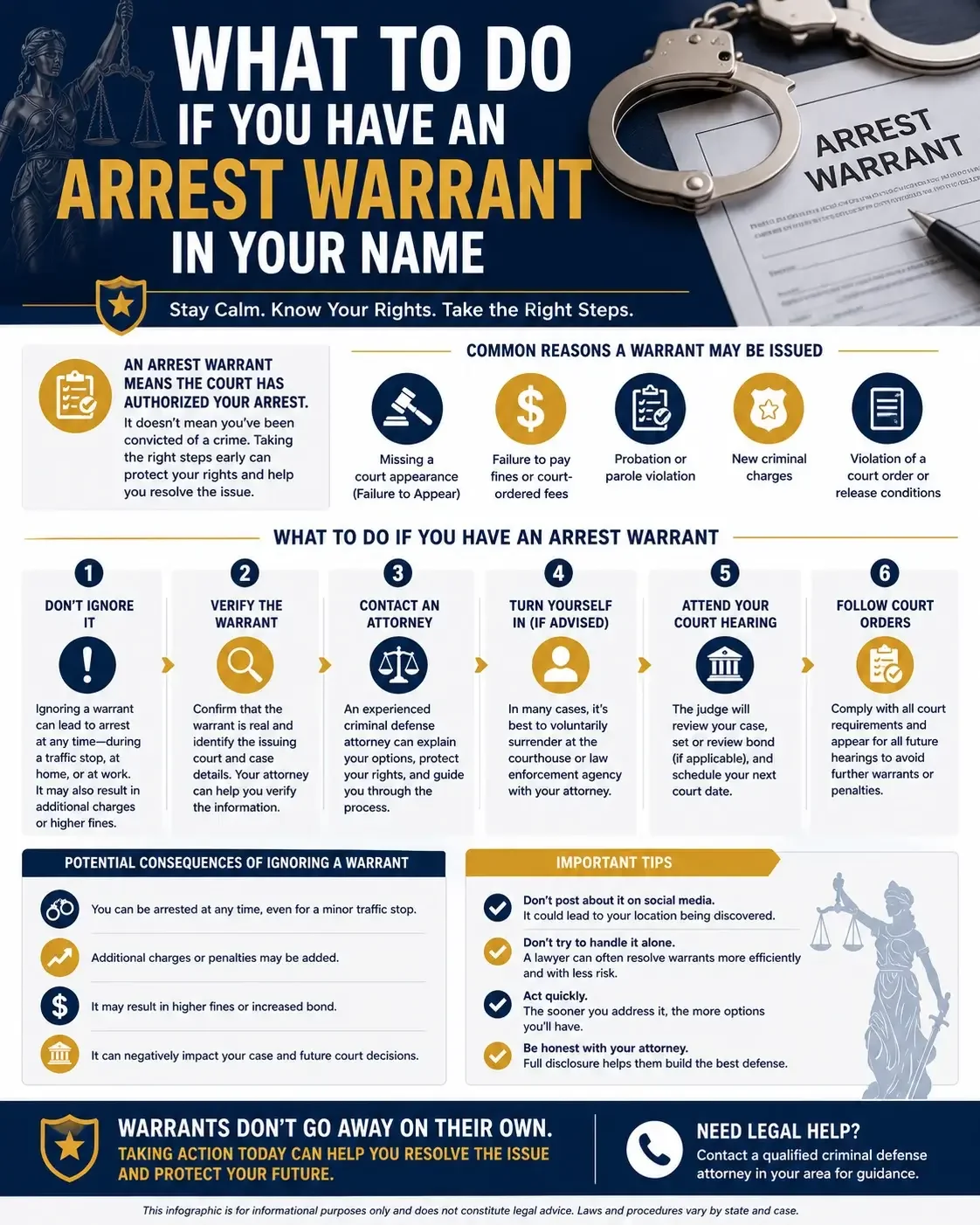
When someone is placed on probation, they are required to comply with specific court set conditions, as an alternative to serving time in jail or prison. If any of the set conditions are violated, a judge can issue a probation violation order effectively arresting and bringing the individual before the court until their violation hearing.
Common probation violations include:
1). Failing Drug or Alcohol Tests – Testing positive for illegal substances or refusing to submit to required drug testing.
2). Missing Meetings with a Probation Officer – Failing to report as directed or maintain regular contact with a supervising officer.
3). New Criminal Charges or Arrests – Accusations and criminal charges filed for committing another offense while still on probation.
4). Failure to Complete Court-Ordered Programs – Not finishing court-ordered counseling, substance abuse treatment, anger management classes, community service, or other required programs.
5). Failure to Pay Court-Ordered Financial Obligations – Falling behind on restitution, fines, court costs, or supervision fees without court approval.
6). Violating Other Conditions of Supervision – Such as traveling outside an approved area, possessing firearms, or violating a no-contact order.
When the court finds that there is evidence to support a probation order has been violated, that person may be arrested and have a new hearing to determine what action is appropriate.

Indiana Warrants - FAQs
Do Indiana Warrants Expire?
It’s rare that they expire on their own, with the exception of search warrants. All other court orders usually stay in effect until the legal issue is resolved, a judge recalls or quashes it, or if the criminal charges are dropped.
Can someone else search for my court records?
Yes, for the most part. The majority of IN court records are public unless they have been sealed, expunged, or made confidential for privacy reasons. Availability depends on the type of case and the court involved, and whether it’s an active case.
What happens after someone is arrested and taken into custody?
That person is usually booked into jail before appearing before a judge, which includes their fingerprints and mugshots taken after their criminal charges are presented to them. Depending on the case, the court may determine bail, schedule future hearings, or order continued detention until their arraignment.
Is it safe to travel with an active arrest order?
It can certainly be risky. Travel may increase the risk of being detained if law enforcement identifies the outstanding order during an encounter. TSA checkpoints have become a more common place for people to be arrested in these situations. It is often advisable for anyone facing an unresolved criminal matter to consider seeking legal advice before traveling.
Are search orders the same as arrest orders?
No. A search order authorizes detectives to search a specific location for evidence for an investigation, while an arrest order gives officers the authority to take a particular individual into custody for an alleged crime.