

Tennessee Warrant Check
🔷
Tennessee Warrant Check 🔷
Guide to Tennessee Warrants
Finding out whether you or someone else has an active warrant in Tennessee can be important for a multitude of reasons. Since all warrants are also a form of court order, having an outstanding order for an arrest should be taken seriously. These judicial orders commonly result from criminal charges, a missed court appearance, failure to comply with specific court requirements, or other unresolved legal matters. In some situations, a person may not even realize that an order for their arrest has been issued until they encounter law enforcement.
Fortunately, there are several ways to conduct a Tennessee warrant search, including checking county court records, sheriff's office databases, and other public-record resources. Because these records are generally issued and maintained at the local level, knowing which county is connected to the case can make the search considerably easier.
This guide explains how to search for active warrants in Tennessee, where these records originate, the most common types issued by courts, and what to consider if you discover one in your name.
Why Are Warrants Important to Know About?
An outstanding warrant, or court order, rarely disappears simply because time has passed. If law enforcement confirms that an active arrest directive exists, the person named in the record may potentially be taken into custody, depending on the circumstances and type of order.
The Rule of Criminal Procedure 4 provides that a TN arrest warrant may be issued when there is an affidavit of complaint and supporting information that clearly establishes probable cause to believe that a criminal offense was committed and that the defendant has committed it. The order directs law enforcement to arrest the suspect and bring that person before an appropriate judge or magistrate.
These records are especially important because Tennessee arrest warrants are not necessarily limited to the county where they originate. Under Rule 4, an arrest order may be executed in any county within the state. That means moving from Memphis to Nashville, Knoxville, Shelby, or another part of the state does not necessarily prevent an outstanding judicial order from being enforced.
Finding an unresolved record early may provide an opportunity to verify the information, determine why it was issued, speak with the appropriate court or an attorney, and understand the steps necessary to address the matter.

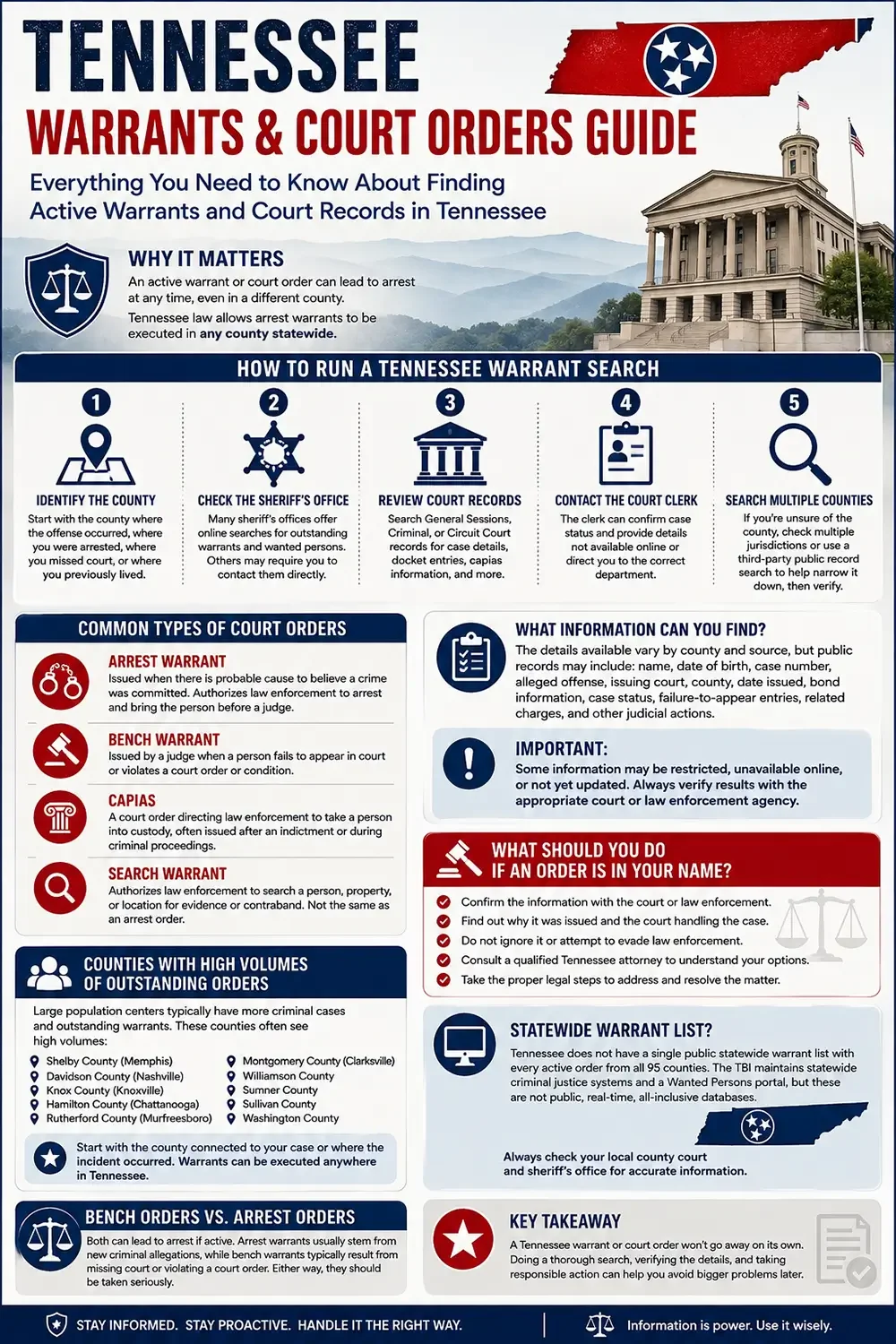
How to Run a Tennessee Warrant Search
There is no single search method that will necessarily uncover every outstanding warrant throughout the state. Instead, searches are generally most effective when they begin with the county where the criminal case, alleged offense, or missed court appearance occurred.
If you’re unable to determine the county where an active warrant or court record originated, a good starting point may be a third-party public records search. These privately operated resources aggregate publicly available information from multiple jurisdictions across the state, allowing users to conduct a broader search using a person’s name and other identifying information. Search results can often help identify the county, court, or jurisdiction associated with a criminal case or outstanding arrest order.
However, information obtained through a private database should be treated as a starting point rather than definitive confirmation that an arrest order is currently active. Records may be incomplete, delayed, or no longer current. Once you identify the likely county or court, verify the information directly with the corresponding county court, court clerk, or sheriff’s department to determine its current status.
1). Identify the County Connected to the Case
Start by determining the county most likely associated with the record. This is often the county where the person of interest currently resides.
Try using this search criteria to determine where the record originated:
The county where the alleged offense occurred
The county where the person was previously arrested
The location of a pending criminal case
The county where a scheduled court appearance was missed
The jurisdiction where the person previously lived
The county where law enforcement investigated the incident
If you know the county, you can quickly narrow down your search.
2). Search the County Sheriff's Office
Many Tennessee sheriff's offices maintain information about wanted individuals, outstanding arrest orders, jail records, or fugitive apprehension.
Availability varies considerably by jurisdiction. Some agencies provide searchable online databases, while others require the person to contact the sheriff's office directly.
For example, the Shelby County Sheriff's Office provides an online outstanding-warrants search and states that its dedicated Fugitive Division can answer inquiries concerning active orders issued by Shelby County courts.
When using these databases, having the person’s complete legal name, address, and date of birth can help distinguish between people with similar names.
3). Check County Court Records
Because these orders generally originate through the respective county judicial system, TN county court records can provide another valuable source of information.
Depending on the case, relevant records may be maintained by a General Sessions Court, Criminal Court, Circuit Court, or other courts with jurisdiction over the matter.
Court Docket Information May Show:
Criminal Charges: The specific criminal offense or offenses associated with the case, including felony or misdemeanor allegations.
Case Numbers: The unique number assigned by the court, which can be useful for locating additional records or requesting information from the clerk.
Court Dates: Scheduled and previous hearings, arraignments, trials, or other required court appearances.
Failure-to-Appear Entries: Records indicating that a defendant missed a required court appearance, which may result in additional judicial action.
Bond Information: Available details about bail or bond, including the amount set by the court and, in some cases, conditions associated with release.
Case Status: Whether the criminal matter is pending, active, closed, dismissed, or otherwise resolved according to the court's records.
Capias Information: Details showing whether the court has issued a capias directing law enforcement to take the named individual into custody.
Other Judicial Actions: Additional court activity, such as motions, orders, judgments, continuances, probation-related proceedings, or other developments affecting the case.
The TN criminal procedure rules require the General Sessions Court clerk to record the issuance of every arrest order and every criminal summons in the respective county.
4). Contact the County Court Clerk
If online records are incomplete or difficult to interpret, contact the corresponding county clerk of the court handling the case.
When you inquire with the county clerk, make sure to have the person’s full name, date of birth, and case number, if you know it, as this can help the clerk locate the correct record. The specific case number is the best way to access the correct record.
The clerk may be able to confirm whether there is an unresolved case or direct you to the agency responsible for providing additional information.
5). Search Multiple Counties When Necessary
If you do not know where an order may have originated, checking multiple jurisdictions may be necessary. This is particularly useful for people who have lived in multiple TN counties or have had previous encounters with courts or law enforcement in different parts of the state.
A broader public-record or background search can also help identify counties associated with previous criminal cases. Once a likely jurisdiction is identified, the information should be verified through the appropriate court or sheriff department.
Is There a Statewide Tennessee Warrant List?
Tennessee does not provide a simple public statewide list containing every active arrest and bench order issued by every county court. The TN Bureau of Investigation (TBI) maintains statewide criminal justice systems containing wanted-person information that is publicly accessible. The TBI website also has an Integrated Criminal Justice Portal that includes a Wanted Persons component. However, that portal is not a public-facing database where anyone can simply enter a name and search every outstanding order across all 95 counties across the state.
The TBI also publishes a Most Wanted list, but this contains selected fugitives rather than everyone with an outstanding court order. TBI criteria generally require a qualifying serious offense or fugitive circumstance before an individual is considered for the list. For most members of the public, the best approach is therefore to search the appropriate county court and sheriff's office resources.
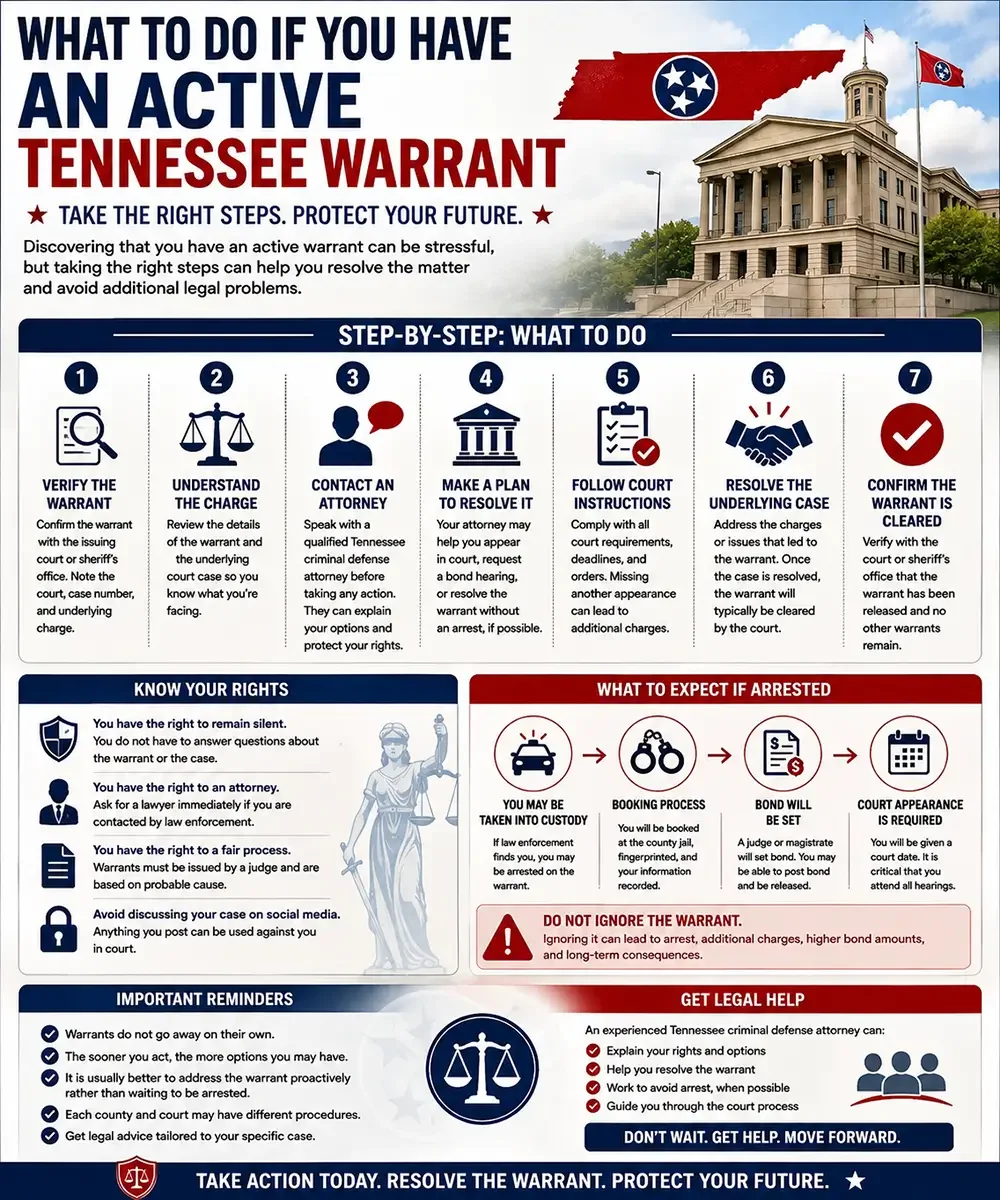
The Most Common Types of Warrants in Tennessee
Not every judicial order issued by a TN county court serves the same purpose or carries the same legal significance. Some direct law enforcement to make an arrest, while others may result from a missed court hearing, direct officers to take someone into custody during an ongoing criminal case, or permit a search of someone’s property for evidence. Understanding these differences can help you interpret the information found during a TN warrant search, can be instrumental in determining what the particular court order may mean for the person named in the record.
TN Arrest Warrants
Orders for a person’s arrest authorizes law enforcement to apprehend and take a named person into custody in connection with an alleged criminal offense, until they can be formally charged in court. According to state law, these orders are issued when there is a signed affidavit of complaint that there is probable cause of a criminal offense, and that the suspect committed it. The document outlines the defendant, county of issuance, and alleged offense and directs that the defendant be arrested and brought before an appropriate court.
TN Bench Warrants
A bench order is issued by a judge after someone fails to comply with a court requirement, not for an allegation of a criminal act. One of the most common reasons is failure to appear for a scheduled proceeding. For example, Criminal Procedure Rules state that a bench order will be issued when a defendant fails to appear in response to a direct criminal summons. Other circumstances for the issuance of a judicial order can involve failure to comply with conditions imposed by the court.
TN Capias Orders
A capias order is another type of court-issued directive giving law enforcement the authority to take a person into custody. The term commonly appears in the state’s criminal court records following an indictment or in other stages of criminal proceedings. If a court docket contains the word "capias," it usually indicates that the court has authorized the defendant to be taken into custody immediately.
TN Search Warrants
A search order is much different from other court orders because its primary purpose is not necessarily to arrest someone. Instead, it authorizes law enforcement to search a particular person or location and seize specified evidence, contraband, property, or in some circumstances, a person. They also have an expiration date unlike other judicial orders. If the order is not executed in the allotted time then a new order will need to be issued. Because search orders are associated with investigations rather than simply identifying wanted persons, they should not be viewed the same as outstanding arrest records when running a name-based search.
Are Bench Warrants as Serious as Arrest Warrants?
A bench order should not be ignored simply because it may have resulted from missing court rather than from an allegation of a crime being committed. Both types can authorize law enforcement action, but they typically arise under much different circumstances. A judicial order for arrest generally begins with allegations that a person committed a crime and a judicial determination of probable cause through evidence or a sworn affidavit.
A TN bench warrant or similar court-issued order commonly results from something occurring after a case has already entered the judicial process, such as failing to appear in a misdemeanor or felony case, or failing to comply with a specific court requirement.
The seriousness of either ultimately depends on the underlying civil or criminal case. For example, an order related to a relatively minor offense may present very different consequences than one involving a violent felony. Likewise, failing to appear in a serious felony proceeding may have considerably greater consequences than missing court for a relatively minor matter.
The important takeaway here is that a bench order should not be assumed to be harmless without knowing the underlying legal matter. If it remains active, it can potentially lead to detention when the person of interest encounters law enforcement.
Which TN Counties Have the Most Outstanding Warrants?
There is no single official statewide ranking published on a consistent basis showing which counties issue the most arrests each year. Population and criminal caseload are often good indicators and provide useful context. That said, the state’s largest metropolitan counties generally process more criminal cases than smaller rural jurisdictions which tend to have significantly larger volumes of outstanding court orders.
Counties worth checking first when conducting a broad search include:
Shelby County – Home to Memphis, Shelby County handles a significant volume of criminal cases and outstanding arrest orders. According to the Shelby County Fugitive Division, it handles around 850 warrant-related arrests each month, while officers clear around 3,300 outstanding judicial orders monthly.
Davidson County – Home to Nashville and a large metropolitan court and law enforcement system.
Knox County – Includes Knoxville and serves as one of the largest population centers in eastern part of the state.
Hamilton County – Includes Chattanooga and handles a large volume of criminal court cases annually.
Rutherford County – Home to Murfreesboro and part of the rapidly expanding population in the middle of the state
Montgomery County – Includes Clarksville and represents another major population center.
Other populous jurisdictions such as Williamson, Sumner, Sullivan, Washington, and Bradley counties may also be important depending on where a person lives or where an alleged offense occurred. Rather than assuming an active court order will be found in one of Tennessee's largest counties, however, searches should always prioritize the jurisdiction connected to the actual case.
What Information Can You Find in a Tennessee Warrant Check?
The amount of information available in a public record will vary depending on the Tennessee county and the resource being searched. Records may include the person’s full name and date of birth, case number, alleged criminal offense, issuing court, county and date of issuance, and current case status. Depending on the jurisdiction, you may also find bond or bail information, failure-to-appear entries, related criminal charges, and other details about the underlying court proceedings. Keep in mind that some information may be restricted, unavailable online, or temporarily missing from a database. For this reason, online search results are best used as a starting point and should not be considered definitive proof that someone is, or is not currently wanted by law enforcement.
What Should You Do If an Arrest Order Is Issued in Your Name?
Discovering an outstanding judicial order for your arrest can be very concerning, but ignoring it does not resolve the underlying problem or make it go away. In fact, ignoring one may result in additional charges, fines, and legal complications. Start by confirming the information with the court or law enforcement agency responsible for the record. Third-party databases can contain outdated information, similar names, or records that have subsequently been recalled or resolved.
Try to Determine:
1). Which Court Issued the Order: Identify the specific TN courts responsible for issuing it, as this is generally where you will need to obtain additional information about the case
2). The Case Number: Locate the court-assigned case number whenever possible. This can make it much easier for the court clerk, law enforcement, or an attorney to locate the correct record
3). The Underlying Criminal Charge or Proceeding: Determine which alleged offense, criminal charge, or existing court matter led to the order being issued
4). When It Was Issued: Check the issuance date to better understand how long the matter has been outstanding and whether there has been more recent activity in the case
5). Whether Bond Has Been Established: Find out whether the court has set a bond amount or specific conditions for release. This information may be available through the respective county court records
6). Whether It Resulted From a Failure to Appear: Determine whether the order was issued because of a missed hearing, arraignment, trial, or other required court appearance rather than a new criminal allegation
7). What Steps Are Required to Resolve the Matter: Contact the appropriate court or speak with a qualified Tennessee attorney to determine what actions may be necessary to address the outstanding order and underlying case
Depending on the seriousness of the case, consulting with a criminal defense attorney before taking further action may be advisable. An attorney can review the court record, explain the available options, and communicate with the court when appropriate.
Do not attempt to evade law enforcement or assume that traveling to another Tennessee county makes the matter disappear. Tennessee state law permits an arrest to be executed in any county within the state. The more serious misdemeanor and felony warrants can also be executed in other states, where you may be arrested and extradited back to the county that issued the original order.

TN Warrant and Court Orders FAQs
Can Someone Else Search for Your Warrant?
Generally, yes. Court records and information published by county sheriff’s offices are often available to members of the public unless the records have been sealed, restricted, or otherwise excluded from public view. This means another person may be able to find information about an outstanding arrest order or unresolved criminal case using publicly accessible resources. However, availability varies considerably by county. Some TN jurisdictions provide searchable online databases, while others require you to contact the court clerk or appropriate law enforcement agency for additional information.
How Long Does a TN Warrant Stay Active?
There is no safe assumption that an outstanding arrest order will automatically disappear after a certain number of years. Depending on the circumstances, an unresolved judicial order may remain active until it is executed, recalled, quashed, or otherwise addressed by the issuing county court. Older cases are often more difficult to research because online databases may not contain the complete history of proceedings that occurred many years ago. If you are researching an older matter, contacting the appropriate TN county court clerk directly may uncover information that is not readily available online.
How Do I Find Out Why a Arrest Order Was Issued for Me?
If your search indicates that an active court ordered arrest exists, start by identifying the specific county court responsible for the issuance. Court docket entries may show whether it resulted from a new criminal charge, failure to appear, failure to respond to a criminal summons, an indictment, a bond-related issue, violation of a court requirement, or another ongoing criminal proceeding. For older or more complicated cases, contact the court clerk for additional information or consider speaking with a defense lawyer who can review the case and explain why the judicial order was issued in your name.
How Do I Search for Tennessee Warrants by County?
Since Tennessee has 95 counties and there is no central public database available to the public, county-level research is generally the most effective approaches. Begin with the county connected to the alleged offense, previous arrest, missed court appearance, or criminal case. Search the county sheriff’s websites, General Sessions Court, Criminal or Circuit Court when applicable, court clerk records, and available jail or inmate databases. If you do not know the county, previous addresses, criminal court records, arrest information, or a broader third-party public records search may help identify the correct county before you verify the information with an official source.
How Do I Look Up Tennessee Court Records Online?
The availability of online court records depends on the specific court and county handling the case. Start your search by identifying the jurisdiction or county where the case was filed and searching the appropriate court or clerk’s records. Depending on the system, you may be able to locate case numbers, criminal charges, hearing dates, docket entries, case status, judgments, bond information, and other judicial activity. If the complete record is not available online, contact the clerk of the court where the case was filed.
What Information Do I Need to Search TN Court Records?
Having the person’s full legal name is usually the best place to start, but additional identifying information can make a search more accurate. A date of birth, approximate age, county, case number, previous court date, or information about the alleged offense may help distinguish between people with similar names. If you already know the case number and issuing court, locating the correct court record is generally much easier.
How Can I Find Out if a Court Order Is Still Active?
Check the current case docket and contact the corresponding county courthouse responsible for managing the record. Older database entries may not necessarily establish that a judicial order remains active today, since the matter may have subsequently been executed, quashed, or resolved. When the status is unclear, verification with the issuing court, court clerk, or appropriate sheriff’s office can provide the most current information available.
Are All Tennessee Criminal Court Records Available to the Public?
No. Although many court records are publicly accessible online, certain information may be sealed, confidential, or unavailable through an online database. Online access also varies among counties and individual courts. The absence of a record from an online search does not necessarily mean that a criminal case or court-issued order does not exist.
What Is the Difference Between a Court Record and a Court Order?
A court record is a broader term referring to legal documents and information associated with a judicial proceeding, such as case filings, hearing dates, charges, docket entries, judgments, and case status. A court order is a specific directive or decision issued by a judge or magistrate. Orders for someone’s arrest, bench orders, search orders, and certain types of capias are examples of judicial actions that may appear within the broader record of a criminal case.
Can I Search Court Records if I Don’t Know the County?
Yes, but the search may require additional research because many criminal records are maintained at the county or court level. A broader public-record search may help identify previous cases, arrests, convictions, associated with the individual. Once you determine the likely county, you can narrow the search by checking the appropriate court, clerk, or sheriff’s department to verify any potentially active records directly with the responsible agency.
What if I Can’t Find a TN Court Case Online?
Not finding a case online does not necessarily mean that it does not exist. The case may be older, maintained in a different court system, unavailable through that county’s online portal, filed under a different variation of the person’s name, or subject to access restrictions. There can also be delays between court activity and database updates. If you believe a case exists but cannot locate it online, contact the appropriate court clerk and provide as much identifying information as possible.