

South Carolina Warrants
🔷
South Carolina Warrants 🔷
South Carolina Warrant Inquiry
Finding out whether someone has an active warrant in South Carolina is not always as simple as entering a name into one statewide database. While South Carolina provides online access to a significant amount of court information, warrant records can originate with different courts and law enforcement agencies throughout the state's 46 counties.
This means that conducting a thorough SC warrant search may require checking more than one resource. Depending on where the legal matter originated, information may be available through the state’s Judicial Branch, county courts, magistrate courts, municipal courts, sheriff's offices, or other local law enforcement agencies. Understanding where to look, and what these judicial orders actually mean, can make it much easier to find reliable information and determine what steps should be taken next.
How to Check for Warrants in South Carolina
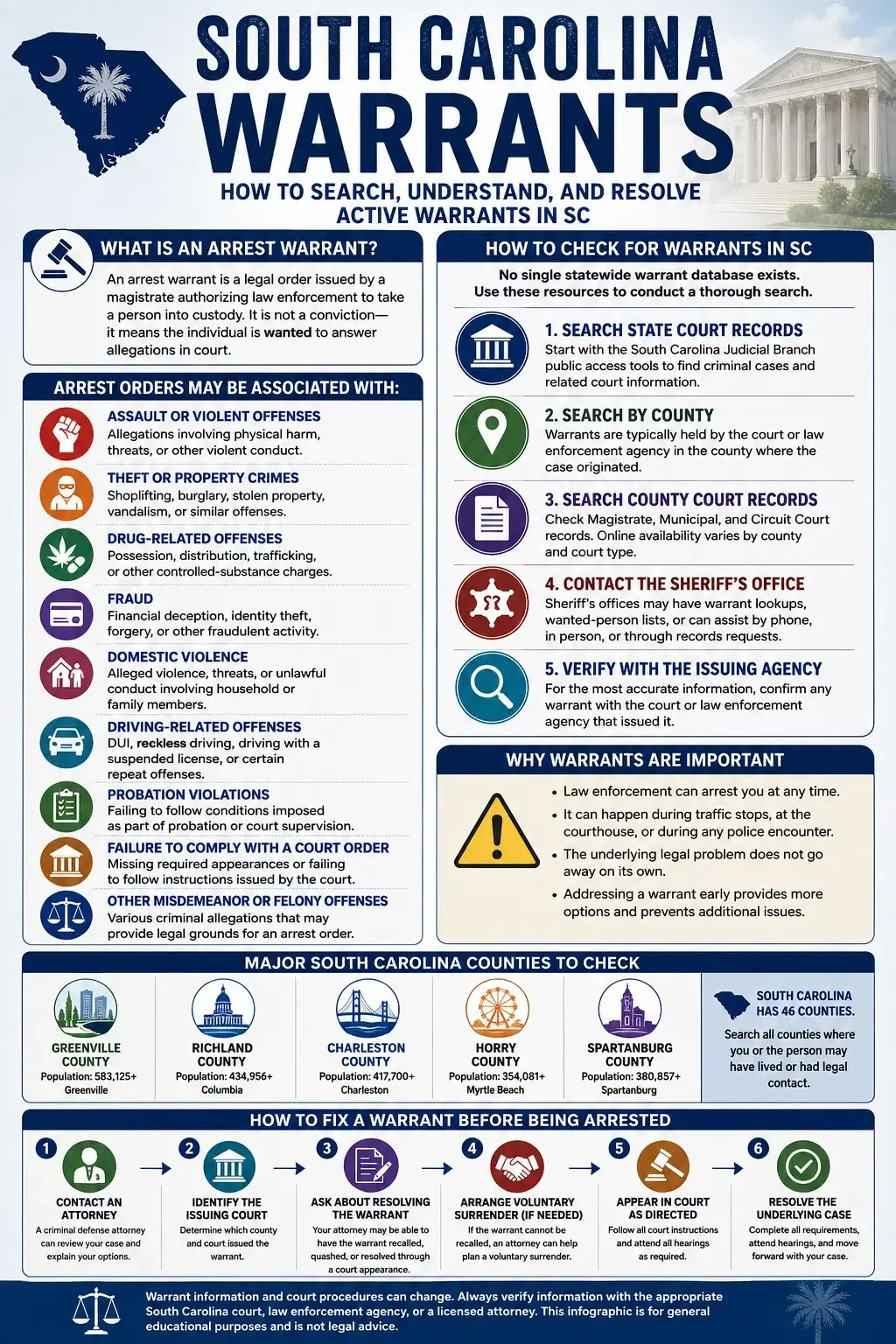
There are multiple methods to investigate whether a person may have an outstanding warrant in SC. Unlike states that maintain a single public-facing statewide database, South Carolina warrant information is commonly distributed among county and local court and law enforcement systems.
For that reason, a good search typically begins with the county court system and county sheriff department where the person lives or where the alleged offense occurred.
1). Search SC Court Records
The SC Judicial Branch provides public access to court information and county-specific resources. Its online tools can help the general public locate court records and determine whether a person has a criminal case that may be related to an outstanding arrest or bench order.
The Judicial Branch also provides a Public Index system for participating county courts. However, online court information should not automatically be treated as an official record, and sealed, confidential, or otherwise non-public information will not appear through public access systems.
Court records can be particularly useful because they may reveal:
a). Criminal charges – The specific misdemeanor or felony offenses associated with the case
b). Case numbers – The unique identifying case number assigned to a court case
c). Court dates – Scheduled court hearings, appearances, trials, or other important proceedings
d). Case status – Whether the criminal case is active, pending, closed, dismissed, or otherwise resolved
e). Filing information – Dates, documents, and other details associated with the court filing
f). Court events – Hearings, motions, appearances, and other recorded activity throughout the case
g). Disposition information – The final outcome of a case, such as a conviction, dismissal, or other legal resolution
h). Court handling a particular case – The specific county, courthouse, or judicial jurisdiction responsible for the proceedings
Finding a criminal case does not necessarily mean that an active arrest order exists. Likewise, the absence of an online case should not be interpreted as definitive proof that there is no court order. For definitive confirmation, it may be necessary to contact the appropriate court or law enforcement agency directly.
2). Search by County
A county search is one of the most accurate ways to find an active arrest or bench order. South Carolina has 46 counties, and since the large majority of warrants are issued on a county level, searching through the respective court or law enforcement agency is often the best method. A logical starting point is the county where the person currently resides.
However, online searches should also consider:
a). Previous counties of residence, including other states
b). The county where an alleged offense occurred
c). Counties where the person was previously arrested
d). Counties where the person had pending criminal cases
e). Counties where the individual was ordered to appear in court
The SC Judicial Branch provides a courthouse search covering counties across the state, which can help find the corresponding courthouse and contact information.
3). Searching County Court Records
Court records are another publicly accessible resource when researching possible outstanding judicial orders. The state’s judicial system includes several types of courts, the appropriate court will depend on the nature and severity of the underlying case.
SC Court Record Searches May Include:
1). Magistrate Courts - Handle a variety of lower-level criminal matters and have important responsibilities involving court ordered arrests and criminal trials and proceedings.
2). Municipal Courts - Generally handle offenses occurring within the jurisdiction of a municipality. Many municipal courts participate in the state’s trial court case-management system, although online availability can vary.
3). Circuit Courts - Deal with serious felony and misdemeanor criminal cases. Court records associated with these cases can offer useful information about active criminal charges and ongoing case information.
Because different courts may maintain different records, it can be worthwhile to search more than one court when the jurisdiction of the underlying criminal charges are uncertain.
4). Inquire With County Sheriff's Offices
Another option is checking with the sheriff's office for the county where an arrest order may have originated. Sheriff's offices are useful local law enforcement resources and may maintain information regarding wanted persons within their jurisdictions. For example, running a Charleston County warrant search can be performed by searching the Charleston County Sheriff Department website.
However, not every sheriff's office provides the same level of online access. A county that does not publish a searchable wanted person list may still be able to provide information through another method. For smaller counties, it may require a phone call or an in-person visit to inquire about active judicial orders.

Which South Carolina Counties Have the Most Warrants?
There is no readily available official statewide ranking showing exactly how many active warrants are outstanding in each SC county at a given time. Because of that, it would be misleading to claim that a particular county definitively has the most issued judicial orders without comparable data from every jurisdiction.
However, many searches are naturally concentrated in the state’s largest population centers. For example, Greenville County had an estimated population of approximately 583,125 in 2025, making it one of the state's largest counties. Richland County had an estimated 434,956 residents, while Spartanburg County had approximately 380,857. Larger populations generally mean greater volumes of court cases and law enforcement activity, but population alone should not be used to conclude that one county has a higher warrant rate than another.
Arrest Warrants vs. Bench Warrants
A SC arrest warrant is generally associated with an alleged criminal offense and gives law enforcement the legal authority to take the person named in the order into custody. A SC bench warrant, on the other hand, is typically issued by a judge when someone fails to comply with a court requirement, such as missing a court appearance, violating a judge’s order, or failing to meet certain probation or court-imposed conditions.
The distinction between these different court orders is important because the process for resolving them can vary depending on why the order was issued and which court has jurisdiction over the case. Identifying the type of warrant and the issuing court can help determine the appropriate steps for addressing the outstanding legal matter.
Search Warrants Are Different
A search warrant serves a different purpose than an arrest order. Rather than primarily authorizing the arrest of a person, a search order gives law enforcement the authority to search a specified person, location, or property when the legal requirements have been satisfied. State and Federal law provides procedures governing search orders, including requirements related to probable cause and the identification of the person, place, or property to be searched. State law also requires a person served with a search order to be furnished with a copy of the order and its supporting affidavit. Another key differentiating factor is that these types of orders have an expiration date and any search of a specified location must be completed within the allotted time, otherwise a new search order will need to be issued by a judge.
How to Find Out Why a Warrant Was Issued
If a search indicates that a warrant may exist, the next step is identifying the court or law enforcement agency that issued it. Useful details to collect include the person’s full legal name, date of birth, county, case number, criminal charge, issuing court, filing date, and law enforcement agency involved. The court handling the criminal or civil case may be able to provide additional information about the judicial order and what steps are required to address it. For older cases, contacting the courthouse clerk directly can be especially helpful since some records may be hard to find, or unavailable online.
The Significance of South Carolina Arrest Warrants
A South Carolina arrest warrant is a court issued arrest order authorizing law enforcement to take a person into custody. Throughout the state, judges and magistrates have authority in criminal matters involving arrests, examinations, and the handling of individuals charged with criminal offenses. State law also provides that an arrest order generally may not be issued unless it is sought by a law enforcement officer acting in an official capacity.
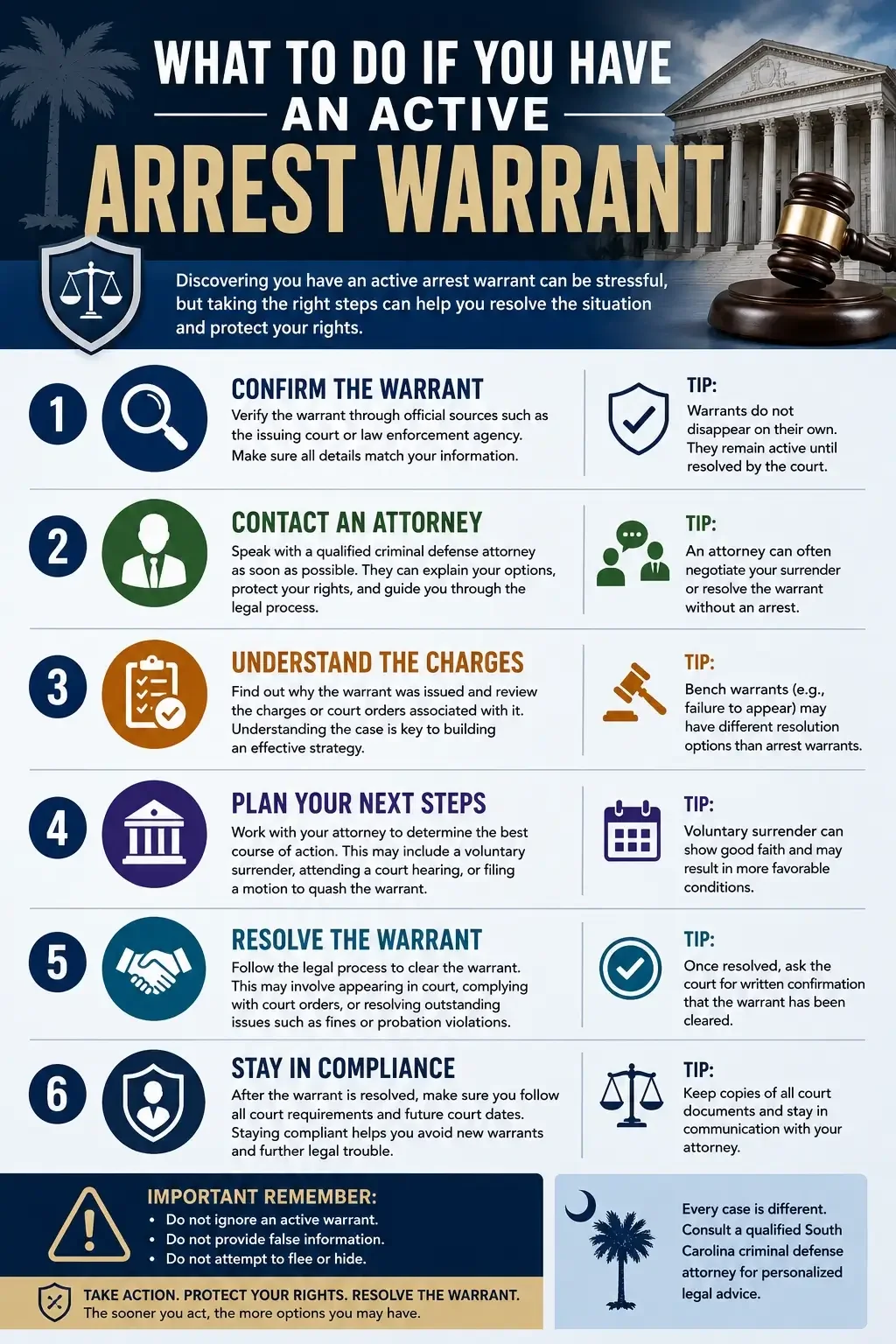
An arrest order may be associated with allegations involving:
1). Assault or violent offenses – Allegations involving physical harm, threats, or other violent behavior
2). Theft or property crimes – Shoplifting, burglary, stolen property, vandalism, or similar criminal offenses
3). Drug-related offenses – Possession, distribution, trafficking, or other controlled-substance charges
4). Fraud – Financial deception, identity theft, forgery, or other fraudulent activity
5). Domestic violence – Alleged violence, threats, or unlawful conduct involving household or family members
6). Driving-related criminal offenses – DUI, reckless driving, driving with a suspended license, or certain repeat offenses
7). Probation violations – Failing to follow conditions imposed as part of probation or court mandated supervision
8). Failure to comply with a court order – Missing required appearances or failing to follow instructions issued by the court
9). Other misdemeanor or felony offenses – Various criminal allegations that may provide probable cause, and legal grounds for an arrest order
An active SC arrest warrant is significant because it gives law enforcement the legal authority to take the person named in the order into custody so the underlying criminal matter can proceed through the judicial process.
However, the existence of an arrest order should not be confused with a criminal conviction. It may simply indicate that someone is wanted by law enforcement or the courts, but it does not establish guilt. The underlying criminal allegations must still be addressed through the appropriate legal proceedings.
Once an arrest order is issued by the courts, it should also be taken seriously because the legal issue generally does not disappear simply because enough time has passed. In many cases, the order can remain active indefinitely , or until the individual is apprehended, voluntarily surrenders, or the court recalls, or quashes it. For this reason, discovering an outstanding warrant early is very important. It may give the person named in the order an opportunity to seek leg al counsel, understand the allegations and available options, and develop a plan for addressing the matter proactively rather than risking an unexpected arrest at an inconvenient time.
How Can You Fix a Warrant Before Being Arrested?
Discovering an outstanding warrant does not necessarily mean you have to wait for law enforcement to arrest you and take you into custody. Depending on the circumstances, there may be ways to address the underlying legal matter proactively. Your options will depend on the type of order, criminal charges, issuing court, and circumstances of the case.
Contact a Criminal Defense Attorney
A seasoned criminal defense attorney can verify the outstanding order for you, review the case, and communicate with the court or prosecutor about possible options. Legal representation can be especially important for felony charges, probation violations, serious allegations, or older unresolved cases. These types of criminal cases can lead to significant jail or prison time so it may be worth while to consult with an attorney before handling these types of legal issues yourself.
Identify the Issuing Court
Determine which court or jurisdiction issued the arrest order and why. Once identified, you or your attorney can find out what procedures are required to address the case, even if the court is located in a different county from where you currently live.
Determine Whether It Can Be Recalled or Resolved
Depending on the case, an attorney may be able to request that the court recall, quash, or otherwise resolve the outstanding order, potentially through a scheduled court appearance. It’s recommended by most legal authorities to never assume that paying a fine or contacting the courthouse automatically clears it. Consider it active until the appropriate court or law enforcement agency confirms otherwise.
Arrange a Voluntary Surrender if Necessary
If the matter cannot be resolved beforehand, an attorney may be able to coordinate a voluntary surrender. Planning ahead can help you understand the booking process, possible bond requirements, and upcoming court appearances rather than facing an unexpected arrest. Being proactive about any type of arrest order will show that you’re addressing your legal situation and lets the courts know that you’re complying with court mandates.
Follow All Court Instructions
Attend required hearings, meet deadlines, and comply with all court-imposed conditions. Ultimately, the goal is not only to clear the active arrest order but also to resolve the underlying legal issue that caused it to be issued.

South Carolina Warrants - FAQs
Can a Warrant Be Removed From Your Record?
Resolving an active warrant and removing information from a criminal record are two separate legal matters. Once the underlying issue has been addressed, the arrest order should no longer remain active; however, records associated with the arrest, criminal charges, or court proceedings may still appear. Depending on the outcome of the case and state law, certain records may qualify for expungement or other forms of relief. Eligibility varies by the type of offense and case disposition, so it is important to verify your options with the respective court or an attorney.
How to Find Out Why an Arrest Order Was Issued
If a search indicates that an arrest order may exist, the next step is identifying the county court responsible for issuing it. Helpful information to gather includes the person’s full legal name, date of birth, county, case number, criminal charge, issuing court, filing date, and any law enforcement agency involved. The court handling the underlying case may be able to offer additional details about the judicial order, including why it was issued and what steps are required to address it. For older cases, contacting the courthouse clerk directly can be particularly helpful, as some records may be difficult to locate or unavailable online.
What If You Find an Arrest Warrant for Someone Else?
Many South Carolina court records are publicly accessible, which means you can research cases involving someone other than yourself. This may include looking into the public record of a family member, potential dating partner, someone involved in a legal dispute, or a person with whom you are considering doing business.
However, online records should be treated as a starting point rather than definitive confirmation of someone's current legal status. People can share the same name, case information can change, and online databases may contain delayed or incomplete records. Whenever possible, use multiple identifying details to verify the correct person and confirm important information directly with the court or government agency responsible for the managing the record.
What Is the Best Way to Search for SC Warrants?
The best way to conduct a SC warrant search is to use several official resources rather than relying on a single database. Begin with the SC Judicial Branch’s public court records to identify relevant criminal cases, then narrow your search to the appropriate county. From there, check county courts, magistrate or municipal courts, and the local sheriff’s office or law enforcement agency.
If the person has lived in multiple counties, each jurisdiction may need to be searched separately. A useful approach is state court records → county records → magistrate or municipal court → sheriff’s office → direct verification with the issuing agency. Checking multiple sources can provide a more complete picture and reduce the likelihood of overlooking an active judicial order or related court record.
Do Judicial Orders Show Up on a Background Check?
They can, depending on the type of judicial order and the information included in the background check. Court-related records connected to ongoing criminal cases, arrests, pending charges, and convictions may show up when public records are searched. However, what is reported can vary quite a bit depending on the source, type of screening, and whether the corresponding records are publicly accessible.
Will a Court Order Appear After the Case Is Resolved?
Possibly. Resolving a court order does not automatically remove the underlying case from public records. Information about an arrest, criminal charge, court proceedings, or outcome of a case may continue to appear even after the order itself is no longer active. Certain criminal records may qualify for expungement or other legal relief depending on the offense and the outcome of the respective case.