


Michigan Warrant Check
🔷
Michigan Warrant Check 🔷
Michigan Warrant Search Guide
Finding out whether you or someone else has an outstanding warrant in Michigan can sometimes be more complicated than running a single online search. Warrant information is commonly maintained by county courts, sheriff's offices, local police departments, and statewide law enforcement systems, and not all of these records are publicly searchable through one database.
If you are attempting to conduct a Michigan warrant search, one of the best approaches is to begin with the court or county where the original court order was issued. Depending on the circumstances, you may be able to locate information through online court records, a county sheriff's office, or by contacting the appropriate court directly if you know the county of origin.
This guide explains how to check for these active judicial orders in Michigan, where these records may be found, whether there is a statewide searchable database, and what to do if you discover an outstanding arrest or bench order.
Bench Warrant vs. Arrest Warrant
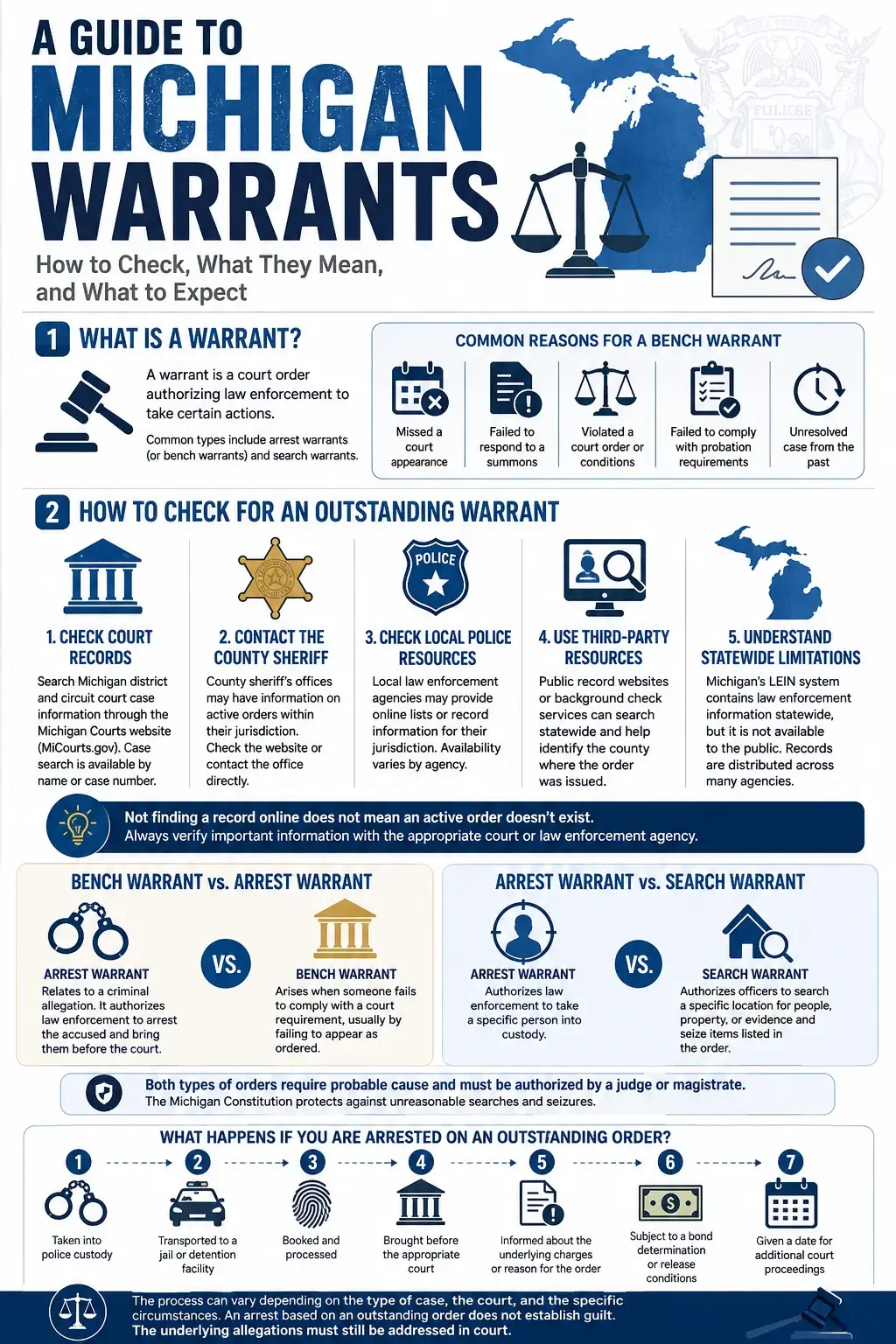
Although both can result in someone being taken into custody, bench and arrest orders serve different purposes. An arrest order generally relates directly to an allegation that someone committed a criminal offense. After the required legal standard is established, a judge or magistrate may authorize law enforcement to take the accused into custody and bring that person before the court. A bench order, on the other hand, typically arises from an existing court case when someone fails to comply with a judicial requirement, most commonly by missing a required court appearance.
Arrest Order: An arrest order generally begins with an alleged criminal offense rather than a missed court obligation. Law enforcement may investigate a suspected felony or misdemeanor, gather evidence, interview witnesses, and submit the case to a prosecutor for review. If criminal charges are filed and the required legal standard is established, a judge or magistrate may issue an order allowing officers to locate and take the accused into custody. The individual can then be brought before the court to address the allegations and begin the appropriate criminal proceedings.
Bench Order: A bench order typically arises from an existing court case or proceeding. For example, a defendant may already have been charged and instructed to appear for an arraignment, hearing, trial, or another required proceeding. If the individual fails to appear or does not comply with certain court requirements, the judge may issue an order authorizing law enforcement to take that person into custody and bring them before the court. Depending on the circumstances, these orders may also be associated with probation violations or other failures to comply with judicial requirements.
In either situation, an active warrant can result in an arrest, although the circumstances and subsequent legal process can vary considerably. The underlying offense, reason the order was issued, issuing court, bond conditions, and other factors can all affect what happens after the individual is taken into custody.
Arrest Order vs. Search Order in Michigan
Although both are issued through the judicial system, arrest and search orders serve very different purposes. An arrest order authorizes law enforcement to take a particular person into custody and bring them before the appropriate court. A search order generally authorizes officers to search a specific location for people, property, or evidence connected to an investigation and to seize items identified within its scope.
Under Michigan law, a search may be authorized for several categories of property or evidence, including stolen property, items used to commit a crime, evidence of criminal activity, and contraband. In certain circumstances, it may also authorize officers to search for and take into custody a person who is already subject to an active arrest or bench order. The court authorization generally identifies or describes the location to be searched and the property, evidence, or person being sought. This helps establish the scope of what law enforcement is permitted to search for and seize.
The Michigan Constitution also provides protections against unreasonable searches and seizures involving people, homes, papers, possessions, electronic data, and communications. Judicial authorization generally requires probable cause supported by oath or affirmation.
Simple Example
Suppose investigators believe John committed a burglary and that stolen property is located inside his residence. A court could potentially issue two separate orders. While both may originate from the same criminal investigation, one focuses on taking a person into custody, while the other focuses on locating and collecting evidence.
Arrest Order: Authorizes law enforcement to take John into custody in connection with the alleged burglary.
Search Order: Authorizes officers to search a specifically identified location for the stolen property or other evidence related to the investigation.

How to Check for Active Michigan Warrants
There is no single search method that will necessarily locate every outstanding warrant issued throughout Michigan. Instead, searches may involve multiple different local and county government resources. A good starting point is identifying the county where the judicial order was most likely issued. This could be where an alleged offense occurred, where a criminal case was filed, or where someone was scheduled to appear in court.
The Following Resources are Publicly Accessible:
1. Search County Court Records
County court records are often one of the most useful places to begin your search because arrest and bench orders are issued through the judicial system. These records can help identify an existing criminal case, determine which court is handling the matter, and provide important details about its current status.
Michigan's court system includes several levels with different responsibilities. District courts generally handle misdemeanors, preliminary proceedings in felony cases, arraignments, and other lower-level matters. Circuit courts handle felony trials and other more serious criminal proceedings. Knowing which court has jurisdiction over the case can significantly narrow your search.
When Reviewing Court Records, Look for Information Such As:
Full Legal Name: Use the person's complete first, middle, and last name whenever possible to distinguish between individuals with similar names.
Date of Birth: This is particularly helpful for confirming that a court record belongs to the correct person.
County: Identify the county where the alleged offense occurred, the individual was arrested, or the criminal case was originally filed.
Court Name: Determine which district or circuit court is responsible for the case and maintains its official records.
Case Number: A case number provides one of the most accurate ways to locate a particular proceeding and track subsequent court activity.
Criminal Charges: Review the alleged offenses associated with the case, including whether they are classified as misdemeanors or felonies.
Case Status: Look for indications that the matter is open, pending, closed, dismissed, or requires additional action by the defendant.
Court Dates: Review previous and upcoming hearings carefully. A missed appearance may help explain why a judge issued a bench or capias order.
Docket Entries: The docket provides a chronological history of the case and may show court appearances, filings, judicial decisions, bond information, or other important developments.
A case record may indicate that an arrest or bench order was issued, but an online docket does not always provide enough information to determine whether it remains active. The order may have subsequently been recalled, canceled, served, or otherwise resolved without the public-facing record immediately reflecting the change.
If the information is incomplete or unclear, contact the clerk of the court handling the case to verify its current status. For an outstanding criminal matter involving the possibility of arrest, consulting with a defense attorney can also help clarify the record and determine the appropriate next steps.
2. Check the County Sheriff's Office
County sheriff's offices are another valuable resource for locating information about outstanding arrest and bench orders in Michigan. Because these agencies are responsible for various law enforcement and detention functions within their jurisdictions, they may maintain records or public-facing tools that can help determine whether someone is currently wanted by local authorities. The amount of information available online varies considerably from one Michigan county to another.
Depending on the Jurisdiction, the County Sheriff's Website May Provide Access To:
Wanted-Person Lists: Some agencies publish lists of individuals currently sought by law enforcement, which may include names, photographs, alleged offenses, or other identifying details.
Online Record Searches: Certain counties provide searchable databases where users can look for active judicial orders using a person's name or other identifying information.
Inmate Lookups: County jail databases can help determine whether someone has recently been taken into custody and may provide booking dates, criminal charges, bond information, and custody status.
Arrest and Booking Records: Publicly available booking information may provide additional details about recent arrests and the underlying criminal case.
Contact Information: If records are not published online, the agency's website should provide a telephone number or records division that can explain what information is available to the public.
If an online search is unavailable or does not provide enough information, you may be able to contact the county sheriff's office directly. Before doing so, gather identifying details such as the person's full legal name, date of birth, and any known case number or court information. Providing accurate information can help distinguish between people with similar names.
Keep in mind that public-access policies vary by county. One sheriff's office may provide extensive information online, while another may require a telephone inquiry, records request, or verification through the court that issued the order. For example, Macomb County has a dedicated Warrant Division that manages the service of active arrest orders and provides public access to related inquiries.
3. Check Local Police or Law Enforcement Resources
Municipal police departments and other local law enforcement agencies can also be helpful when searching for outstanding arrest orders or wanted individuals in Michigan. Depending on the jurisdiction, an agency may provide online databases, wanted-person lists, arrest information, or instructions for requesting public records.
Keep in mind that local resources typically cover cases handled within that agency's jurisdiction rather than every active order issued throughout the state. The type and amount of information available can also vary considerably between cities and departments.
4. Search Third-Party Public Record Resources
Third-party public record websites can be useful when the county of origin is unknown or when you want to conduct a broader search across the state. Unlike individual county databases, these services may compile information from multiple courts, law enforcement agencies, and other public-record sources into a single statewide search. A background check may help identify active warrants, criminal cases, arrest records, court proceedings, and other related information associated with an individual. This can provide a helpful starting point for determining which county or court may hold the official record. However, third-party databases can contain outdated, incomplete, or inaccurate information, so any potential match should be verified through the appropriate county court or law enforcement agency before being considered current or official.
Is There a Statewide Michigan Warrant List?
Michigan has a statewide law-enforcement database known as the Law Enforcement Information Network (LEIN). The MI State Police offers LEIN as a statewide computerized information system used by criminal justice agencies to maintain and access criminal justice information. However, LEIN is not a public access website. Access is restricted to various government agencies and other entities specifically authorized by state law..
This means someone attempting to check for outstanding judicial orders should not expect to find a single official public database containing every active arrest or bench order. Instead, publicly accessible information is spread across district and circuit courts, county sheriff's offices, local police departments, court-record systems, and other government resources.
Because records are maintained across multiple jurisdictions, knowing the county where the case originated can make the search considerably easier. This may be the county where the alleged offense occurred, where the individual was required to appear in court, or where the criminal case was originally filed. If the county is unknown, a third-party public records website or background check service can provide a useful statewide search to help identify where the court order originated. Once the issuing county is located, verify the information through the corresponding court or law enforcement agency to confirm its current status.
How to Find Out if You Have a Bench Order
If you suspect a bench order may have been issued in your name, start by identifying the court and county connected to the underlying case. These orders are commonly associated with missed appearances or failure to comply with certain court requirements.
Some Common Reasons to Find Out Include:
1). Missing a scheduled court appearance, including a hearing, arraignment, or other required proceeding.
2). Failing to respond to a court summons or other official notice requiring your appearance.
3). Having unresolved criminal charges that still require action before the court.
4). Failing to follow a judge's instructions, including conditions imposed as part of an ongoing case.
5). Not complying with probation requirements, which may result in additional court proceedings.
6). Having an older unresolved case, even if several years have passed since the last court activity.
7). Learning that law enforcement is trying to contact you, particularly in connection with an existing criminal matter.
Once you identify the likely jurisdiction, search the appropriate court records and county resources for information about the court order. Pay particular attention to docket entries involving a failure to appear, missed hearing, or bench order.
If the record is unclear, contact the court clerk or consider consulting an attorney to determine its current status. This is especially important with older cases, as an order that appears in historical court records may have since been recalled, canceled, served, or otherwise resolved.
What Happens if You Are Arrested for a Criminal Allegation?
An allegation of a crime will likely lead to an arrest order when probable cause is established. These orders generally remain enforceable until it has been served, recalled, canceled, or otherwise resolved by the issuing court. As a result, someone with an unresolved criminal matter will likely be taken into custody following contact with police.
An active arrest order may be discovered during a traffic stop, unrelated police investigation, encounter with law enforcement, arrest on another charge, or certain court proceedings. In some situations, the person of interest may not have realized that the matter was still outstanding until that contact occurs. What happens next depends on several factors, including the criminal allegations, type of judicial order, issuing court, seriousness of the offense, bond conditions, and circumstances surrounding the case.
Once criminal charges are formally issued by the courts, the general legal process typically involves an arrest followed by an arraignment in District Court. During the arraignment, the defendant is formally informed of the allegations, advised of the right to an attorney, and provided information about the next stages of the case. The judge may also address bond and conditions of release.
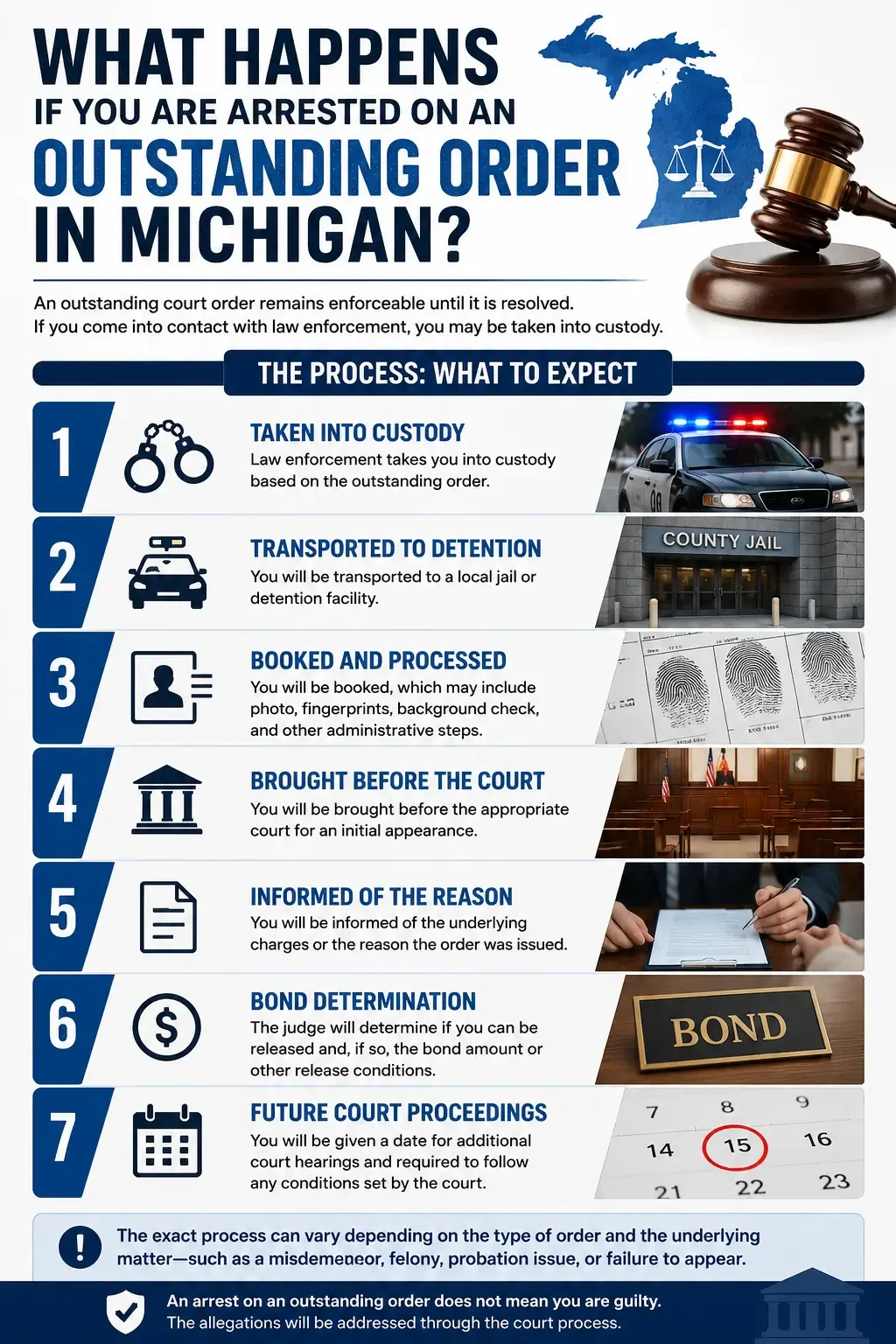
After Being Taken into Custody, the Process May Include:
Arrest and Detention: The individual is taken into police custody based on the outstanding court order.
Transportation and Booking: The person may be transported to a local jail or detention facility for identification, fingerprinting, processing, and other booking procedures.
Review of the Underlying Case: Authorities confirm the issuing court, alleged criminal offense, case status, and reason the arrest was authorized.
Court Appearance: The defendant is brought before the appropriate court, where the allegations and relevant proceedings can be addressed.
Bond Determination: Depending on the case, a judge may determine whether the defendant can be released and what conditions must be followed.
Legal Representation: The defendant may retain an attorney or, when eligible, request court-appointed counsel.
Additional Proceedings: The court may schedule future hearings or other proceedings necessary to address the criminal case.
The exact process can vary considerably depending on whether the underlying matter involves a misdemeanor, felony allegation, probation violation, failure to appear, or another unresolved court issue. An arrest based on an outstanding warrant does not by itself establish guilt; the underlying criminal allegations must still be addressed through the judicial process.

Michigan Warrants - FAQs
How Do I Find Out If I Have a Michigan Warrant?
If you suspect a warrant may have been issued in your name, start by identifying the court and county connected to the underlying case. These orders are commonly associated with missed appearances or failure to comply with certain court requirements.
Some Common Reasons to Find Out Include:
Missing a scheduled court appearance, including a hearing, arraignment, or other required proceeding.
Failing to respond to a court summons or other official notice requiring your appearance.
Having unresolved criminal charges that still require action before the court.
Failing to follow a judge's instructions, including conditions imposed as part of an ongoing case.
Not complying with probation requirements, which may result in additional court proceedings.
Having an older unresolved case, even if several years have passed since the last court activity.
Learning that law enforcement is trying to contact you, particularly in connection with an existing criminal matter.
Once you identify the likely jurisdiction, search the appropriate court records and county resources for information about the court order. Pay particular attention to docket entries involving a failure to appear, missed hearing, or bench order.
If the record is unclear, contact the court clerk or consider consulting an attorney to determine its current status. This is especially important with older cases, as an order that appears in historical court records may have since been recalled, canceled, served, or otherwise resolved.
Can an Arrest Order Expire?
It’s important to not make the assumption that an outstanding arrest order has disappeared or expired simply because several years have passed. The status of an older arrest order should be verified with the court or state agency responsible for it. Most orders are issued on a county level, commonly in the same county a person resides.
However, old judicial orders can be particularly difficult to research online because court systems and recordkeeping practices have changed over time. Some historical cases may not have complete information available through current public-facing databases. If an old criminal case appears in a court search, contact the issuing courthouse clerk to determine its current status.
Are Michigan Warrant Records Public?
Many court records associated with criminal cases and outstanding judicial orders are accessible to the public. However, this does not mean that every active arrest or bench order can be found through a single statewide public search.
Michigan maintains statewide criminal justice information through the Law Enforcement Information Network (LEIN), but access to this system is restricted to authorized agencies and entities. It is not available as a general public lookup tool.
As a result, individuals conducting their own research typically need to rely on district and circuit court records, county sheriff's offices, local police departments, and other official public resources. Availability varies considerably by county, with some jurisdictions offering searchable online databases while others may require contacting the appropriate court or agency directly.
Can I Look Up Someone Else’s MI Court Record?
Yes. Many MI court records are public, which generally means you can search for another person's case information without needing to get their permission. Depending on the court and type of case, publicly available records may include criminal charges, case status, court dates, dispositions, and other docket information.
However, not every record is publicly accessible. Certain cases or information may be sealed, confidential, restricted, or removed from public view under state law or by court order. Additionally, law-enforcement-only information available through systems such as LEIN is not accessible to the general public.
How Can I Run a Michigan Background Check?
You can run a Michigan background check using both official government databases and third-party public record services. Government resources may include Michigan court records, the MI State Police's criminal history search system, county sheriff's offices, and local court databases. These sources can be very helpful when you know the county or jurisdiction associated with the person being researched.
Third-party background check services can provide a broader search by compiling information from multiple public sources into one report. This can be helpful when the county of origin is unknown or when searching across multiple state jurisdictions. Depending on the service and available records, results may include criminal history, arrests, court cases, convictions, incarcerations, and outstanding judicial orders. Any important findings should be verified through the appropriate government agency or court, as third-party information may be incomplete or outdated.