

Utah Warrant Check
🔷
Utah Warrant Check 🔷
Utah Warrant Search Guide
If you're trying to determine whether an active warrant has been issued for you or someone else in Utah, there are several official and public resources available. Unlike many states, Utah provides a free statewide warrant search through the Utah Department of Public Safety, while county courts and sheriff's offices also maintain records relating to warrants issued within their respective jurisdictions.
Whether you're checking your own records, searching for someone else, or performing due diligence before a background check, understanding how Utah warrant records work can help you locate accurate information without the hassle of inquiring in person.
The Significance of Utah Arrest Warrants
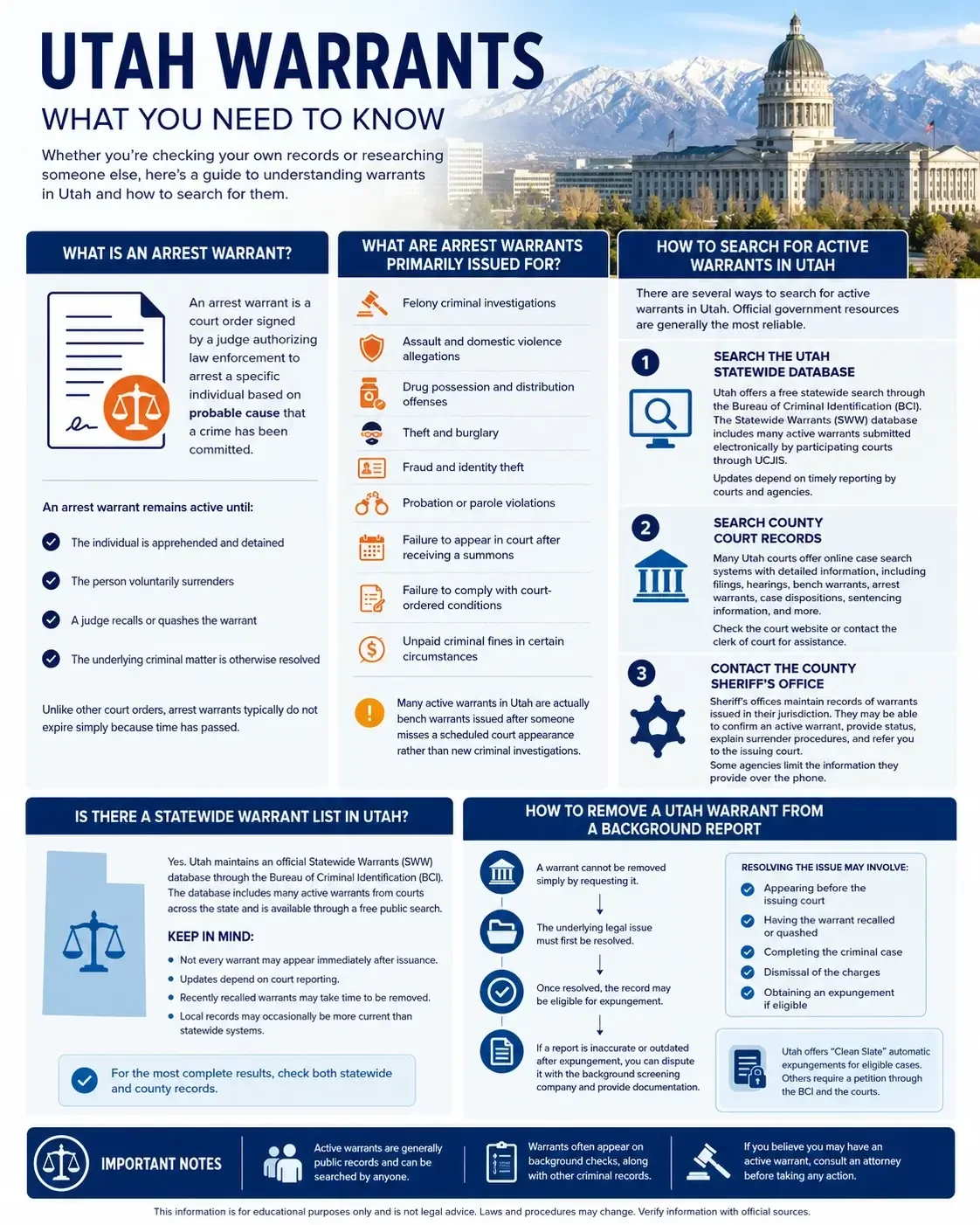
Arrest warrants are among the most serious types of court orders, issued only when there is sufficient evidence to establish probable cause that a person has committed a crime. Once a judge reviews the evidence and signs the warrant, law enforcement is authorized to locate and arrest the individual named in the order.
Once Issued, an Arrest Order Remains Active Until:
1). The individual is apprehended and taken into custody and/or arraigned in court
2). The person voluntarily surrenders to the appropriate law enforcement authorities
3). A judge recalls or quashes the warrant for various legal reasons
4). The underlying criminal case is otherwise resolved or dropped
Unlike other types of legal matters, arrest orders do not expire simply because time has passed, or have a statute of limitations. While other types of court orders may have expiration dates, the most serious criminal court orders typically do not.
Why Judicial Arrest Orders Are Issued
Judges throughout Utah issue court ordered arrests for a wide range of criminal offenses and court-related violations. While the specific circumstances vary from case to case, some of the most common reasons include:
1). Felony criminal investigations
2). Assault and domestic violence offenses
3). Drug possession, manufacturing, and distribution crimes
4). Theft, burglary, robbery, and unlawful entry
5). Fraud, forgery, and identity theft
6). Probation or parole violations
7). Failure to appear in court after being ordered to do so
8). Failure to comply with court-ordered conditions
9). Unpaid criminal fines or restitution in certain circumstances
It's important to note that not every active warrant in Utah stems from a new criminal investigation. In fact, many bench orders are issued after a person fails to appear for a scheduled court hearing or does not comply with a judge's order. Certain judicial bench orders have the potential to have law enforcement take someone into custody so the legal matter can be brought back before the court.

How to Run a Utah Warrant Search
There are several ways to search for active warrants in Utah, and official government resources are generally the best place to begin. Although Utah offers a convenient statewide search, county courts and sheriff's offices often maintain more detailed records, including a person's current status, alleged criminal offenses, court case information, and other details that may not appear in the statewide database.
1. Search the Utah Statewide Database
Utah is one of the few states that offers a free statewide warrant lookup maintained by the Bureau of Criminal Identification (BCI).
The Utah Statewide Database (SWW) allows public access for searching many active arrest orders issued throughout the state. The information is supplied electronically by participating county and state courts through the Criminal Justice Information System (UCJIS).
Although the database is extensive, its accuracy depends on timely reporting by participating courts and law enforcement agencies. As a result, recently issued, recalled, or updated records may not appear immediately. For the most current information, it's often a good idea to check with the county court or sheriff's office where the case originated.
2. Search County Court Records
Another effective way to search for court records and active judicial orders is through the county court where the case was filed. Many of the state’s courts offer public access to case search systems that allow the public to view information about criminal and certain civil proceedings. While not every county offers the same level of online access, these records are often more detailed than statewide databases and may include recent updates that have not yet been reported elsewhere.
Depending on the court and the type of case, county records may include:
Criminal case filings, dates, attorneys, and presiding judges
Scheduled upcoming and past court appearances
Bench orders issued for failure to appear or comply with a court order
Arrest orders authorized by a judge for criminal violations or allegations
Pending criminal charges, including dates, and locations
Case dispositions and final judgments issued
Conviction records, sentencing information, and incarcerations
Probation or parole conditions and violations
Court orders, motions, and hearing dates, dockets
County court records are often one of the best resources for obtaining detailed information about the status of a case, including the court that issued the order, the alleged criminal offenses, and upcoming hearing dates. If you are unable to find the information online, you can also contact the clerk of the court that handled the case, as some records may only be available upon request or through an in-person visit.
3. Contact the County Sheriff's Office
The majority of county sheriff's offices are tasked with maintaining and executing arrest orders issued within their jurisdiction. Many agencies provide information about active cases through online search tools, while others may require you to contact the records division by phone or visit the office in person. The level of information available varies by county and local policy.
Depending on the sheriff's office, they may be able to:
Confirm whether an active arrest order exists
Verify the current status of the judicial arrest record
Explain the next steps for voluntarily surrendering
Provide general information about the issuing court
Direct you to the appropriate clerk of court or judicial office for additional assistance
Keep in mind that some sheriff's offices limit the information they provide over the phone for privacy, safety, or ongoing investigation reasons. In certain types of criminal cases, they may require an in-person inquiry or refer you directly to the court that issued the order. If you believe there may be an active arrest order in your name, it's generally advisable to consult with an attorney before contacting law enforcement or appearing in person, especially if you are uncertain about your legal situation.
How to Remove a Utah Warrant From a Background Report
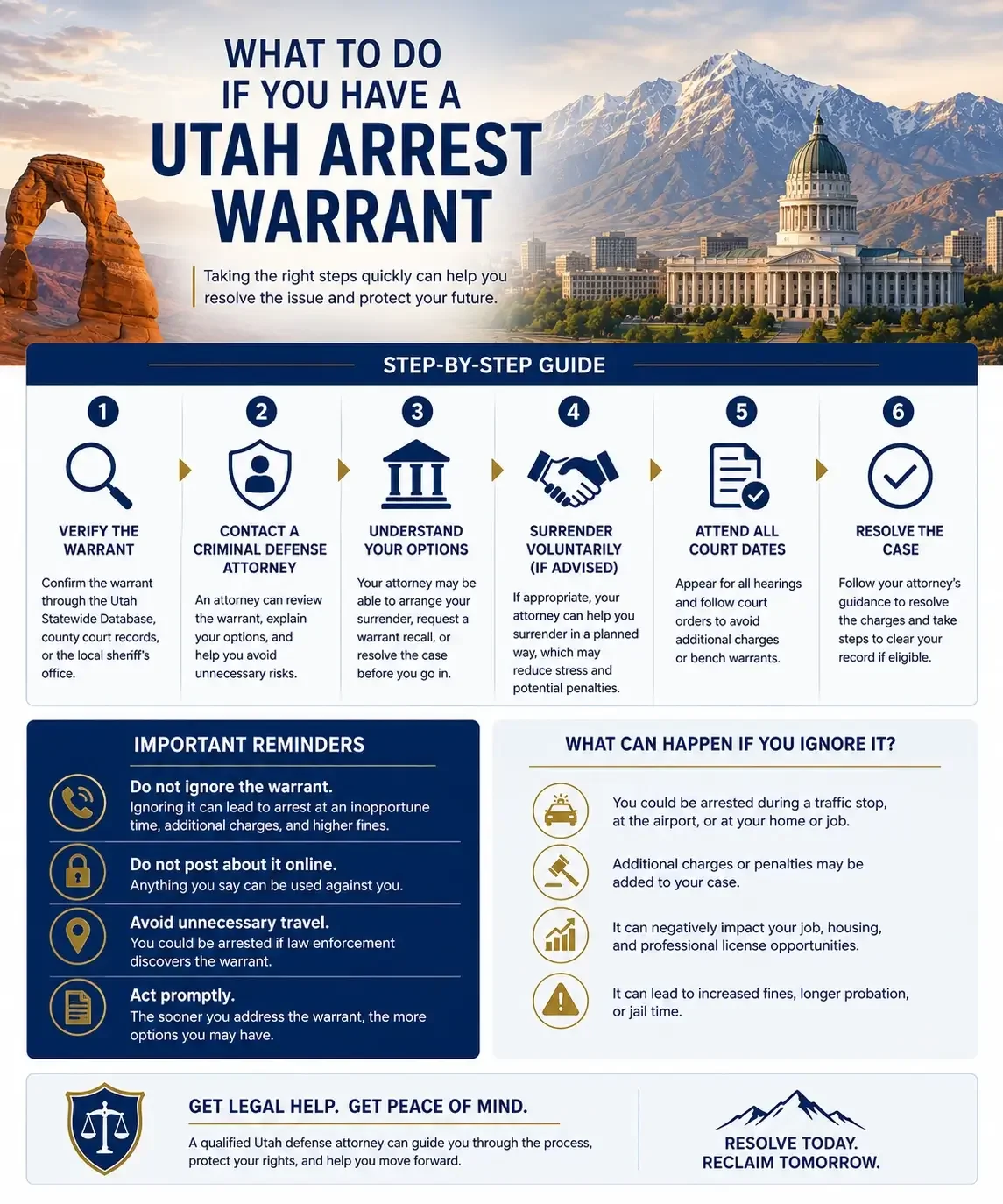
An active warrant generally cannot be removed from a background report simply by requesting its removal. In most cases, the underlying legal matter must first be resolved through the court before the record can be quashed or, if eligible, removed from the public record.
Depending on the circumstances, resolving the matter may involve:
1). Appearing before the court that issued the order
2). Having the order recalled or quashed by a judge
3). Addressing the underlying criminal charges
4). Having the criminal allegations dismissed
5). Qualifying for an expungement under state law
Once the outstanding legal matter has been resolved and the issuing court is satisfied, some criminal records may become eligible for expungement. Utah's Clean Slate law allows certain qualifying records to be automatically expunged after specific waiting periods, while other cases require the respective person(s) to file an official petition through the state’s Bureau of Criminal Identification, and obtain approval in writing from the court.
It's important to understand that a person’s expungement eligibility depends on multiple factors, including the type of offense, the final disposition of the case, their prior criminal history, and any required waiting periods set by the state.
If a background screening company continues to report inaccurate or outdated information after a record has been expunged or a court order has been issued, you have the right to dispute the information directly. Most consumer reporting agencies have specific procedures for correcting inaccuracies once supporting documentation is filed. This might be a court order or expungement certificate from an issuing judge.
Utah Warrants - FAQs
Is There a Statewide Utah Warrant List?
Yes, Utah maintains an official statewide database through the state’s Bureau of Criminal Identification. The database contains many active warrants, mostly criminal arrest orders, submitted electronically by county courts across the state and is available through a free public-access search portal.
However, users should understand:
Not every arrest order may appear immediately after issuance
Updates depend on court reporting may be delayed
Recently recalled orders may take time to be fully removed
Local records may occasionally contain newer information than statewide systems
For that reason, checking both statewide and county records often provides the most complete picture.
Can Someone Else Lookup My Utah Warrant?
Generally, yes, as these are considered public records that are widely available online for anyone to search. However, in certain circumstances these records may be sealed by law or restricted by the court for privacy or security reasons. In most cases, anyone may search publicly available warrant-information using official state resources or county court records.
Will Utah Arrest Records Show Up on a Background Check?
Yes, if that arrest led to a criminal conviction in court it will show up as part of a person’s criminal history. However, if an arrest was made and the criminal charges were dropped, or the person was found innocent, these records can potentially be removed from public view.
Can I expunge my Utah criminal record?
Yes, the state allows for eligible criminal records to be expunged after specific waiting periods and other legal requirements are met. A petition will likely need to be made to the courts through the appropriate channels. Expungement generally seals records relating to: arrests, criminal investigations, jail and detention records, and eligible criminal convictions. However, eligibility for expungement depends upon multiple factors, including the offense, criminal history, and applicable waiting periods. The Bureau of Criminal Identification reviews eligibility before petition-based expungements, while certain qualifying criminal cases may be processed automatically under the state’s Clean Slate law.