

Colorado Warrant Check
🔷
Colorado Warrant Check 🔷
Colorado Warrant Search Guide
A Colorado warrant is more than a piece of court paperwork, it can give law enforcement the authority to arrest someone, search a location, seize evidence, or bring a person before the court for failing to comply with an order. Understanding what a warrant permits and how it can affect you is an important first step toward responding appropriately.
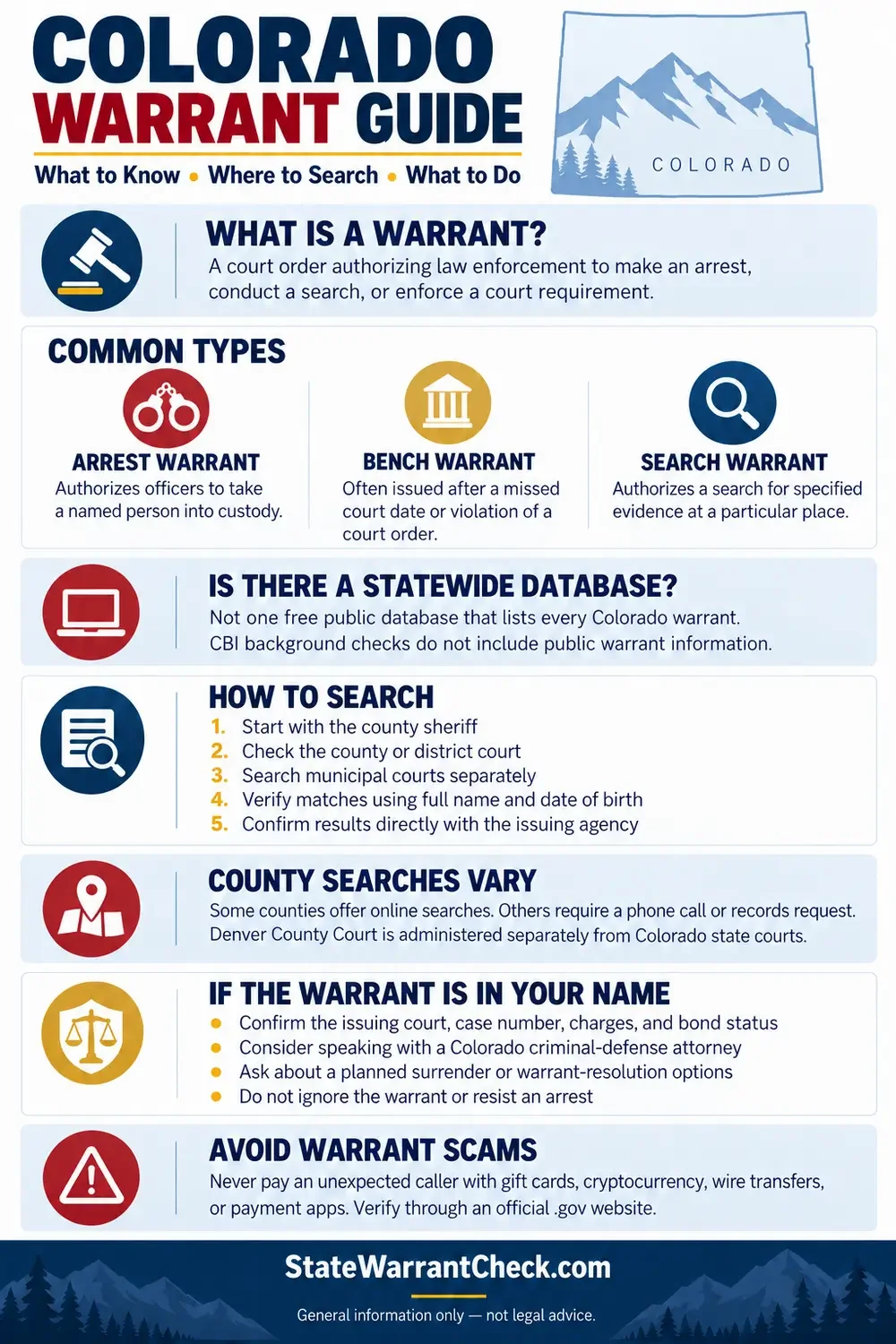
Finding reliable warrant information in Colorado can be challenging because there is no single free public database that displays every active judicial order issued throughout the state. Records may be maintained by a county sheriff, state court, county court, or another law-enforcement agency. As a result, an effective records search may require checking more than one official source.
This guide examines the most common court orders issued in Colorado and explains how each one may affect the person involved. You’ll learn how to search for active records through state, county, and local resources, as well as the steps to take if you discover that an order has been issued for your arrest. It also covers common limitations within public databases and why information should always be verified through the appropriate court or law enforcement agency.

What It Means to Have a Colorado Arrest Warrant
An arrest warrant is a written court order for someone’s arrest that directs law enforcement to take a named person into custody. A judge or magistrate generally issues this order after determining there is probable cause to believe that person committed a criminal offense.
This differs from a search order, which permits officers to examine a specified person, location, vehicle, or item for evidence of a crime. A judge may also authorize an arrest after a criminal case has begun, such as when a defendant misses a required court appearance or violates a court order.
According to the Jefferson County Sheriff’s Office, a person with an active arrest order may be apprehended and detained at any time. Even a bench order arising from a missed court date or relatively minor charge can create serious complications during a traffic stop, employment screening, travel, or another encounter with law enforcement.
Common Types of Warrants Issued in Colorado
Although the term “warrant” is often used broadly, Colorado courts issue several types of these judicial orders with different purposes and legal consequences. Some authorize an arrest, while others permit a search or direct law enforcement to take action after a person violates a court or supervision requirement.
Arrest Warrants
An arrest order gives law enforcement the authority to immediately take a named person into custody. A judge may issue one after reviewing a criminal complaint, affidavit, sworn testimony, or other evidence establishing probable cause to believe the individual committed an offense.
These orders may be issued in connection with felonies, misdemeanors, and certain traffic violations such as DUIs. Depending on the underlying charges, the court may:
Set a bond amount in advance, allowing the person to know what may be required for release
Require a judge to determine the bond amount and conditions after the arrest
Impose release conditions, such as travel restrictions, pretrial supervision, or no-contact orders
Direct the defendant to appear in a specific court on a scheduled date
Require the person to remain in custody until a judge reviews the case at an additional hearing
The existence of an arrest order does not prove guilt. It allows law enforcement to take the named person into custody so the case can proceed through the court system.
Bench Warrants
A Colorado bench warrant is generally issued when someone fails to comply with a court requirement. Common reasons include:
Missing a scheduled court appearance without first obtaining permission to reschedule
Failing to respond to a summons or appear in court as directed
Violating a condition of bond, such as a travel restriction or no-contact order
Failing to complete court-ordered counseling, treatment, community service, or another required program
Not paying a fine or complying with an established payment order when legally required
Disregarding another court order or failing to complete an obligation imposed by the judge
This type is most commonly associated with a “failure to appear,” often abbreviated as FTA. However, not every missed appearance results in immediate enforcement action by the courts. A judge may consider the type of case, the person’s history, and the circumstances surrounding the absence.
A bench order may still potentially result in an arrest, depending on the seriousness of the legal situation. It should not be treated as a routine reminder to reschedule a court date.
Search Warrants
A search order permits law enforcement to examine a specified place, person, vehicle, or item for evidence connected to a suspected crime. The order generally identifies where officers may search and describes the property or evidence they are authorized to seize for an ongoing investigation.
A search by police officers may involve:
A house, apartment, or business where evidence is believed to be located
A motor vehicle connected to an alleged offense or suspected evidence
A mobile phone, computer, or other electronic device containing potentially relevant data Brighton
Online accounts, cloud storage, emails, or other electronically stored records
Financial or business documents related to the investigation
A person, personal belongings, or another specifically identified item
Unlike an arrest order, this authority is primarily directed at a location, object, or source of evidence. However, officers carrying out the search may also make an arrest if they have independent legal grounds to do so.
Probation or Parole Violation Arrest Orders
A person accused of violating probation or parole may be subject to a judicial order for their arrest. Alleged violations may include failing to report to a supervising officer, leaving the state without permission, not completing required treatment, possession of controlled substances, committing a new criminal offense, or disregarding specific conditions of supervision.
Violation proceedings often differ quite a bit from a new criminal case. Bond and release options are usually more limited as well, making it important to consult an attorney who understands the state's probation or parole procedures.
Municipal and Traffic Bench Orders
Colorado municipal courts handle violations of city ordinances, while county courts commonly oversee state traffic cases and misdemeanors. Both may authorize an arrest when permitted by law, including after a defendant fails to appear or comply with a court requirement.
Municipal records are not always included in county or state court searches. If a case begins with a citation from a city police department, the individual may need to contact that city’s municipal court separately to obtain accurate information.
How to Run a Colorado Warrant Search
The most dependable way to search for a Colorado warrant is to work from the issuing jurisdiction. If you know where the alleged offense occurred, where the ticket was issued, or where the court case was filed, begin with that county or municipality.
1. Check the County Sheriff’s Office
The county sheriff is generally responsible for maintaining and executing arrest orders issued by county and district courts within its jurisdiction. Some county sheriff departments provide a searchable online database, while others require people to call the appropriate office or submit a public-records request.
Begin on the county’s official website and look for sections covering outstanding court orders, records, jail information, inmate searches, or individuals being sought by law enforcement. A “Most Wanted” page may provide useful information, but it generally features only selected individuals and should not be considered a complete list.
2. Contact the Court That May Have Issued the Judicial Order
If you know the court or case number, contact the clerk of that court. The clerk may be able to confirm the case status, explain how to request the public case record, or direct you to the correct office. However, some records may be restricted, sealed, confidential, or unavailable online. A court clerk may also be limited in the legal advice the clerk can provide.
The CO Judicial Branch public-records guide allows people to submit an online request for records connected to a specific person or court case. Records may also be requested directly from the court where the case was filed.
3. Review Available Colorado Court Records
Colorado’s public Docket Search can help locate scheduled proceedings by county, judicial district, court, date, case number, or party name. However, it is a docket-search tool, not a comprehensive statewide warrant database. The state’s Judicial Branch states that limited online court-record access is available through approved commercial vendors, including county courts. These services provide access for many county and district court cases and generally charge a fee.
Court-search results can help identify an underlying criminal or traffic case, but they should not be treated as final proof that a court order is currently active. The Judicial Branch informs the public that commercial search information is not an official court record, may contain errors or omissions, and does not include every case or case type.
4. Check Municipal Courts Separately
If the matter involves a city ticket or municipal ordinance, search the city’s municipal court website or call the court clerk. Municipal orders may not appear in searches covering county and district courts.
Denver, for example, requires particular attention because Denver County Court is administered separately from the state court system. The Denver County Court Bonding and Warrants Division directs users to its Public Portal to check for active orders.
5. Search Using Accurate Identifying Information
When contacting an agency, provide as much accurate information as possible. This may include the person’s full legal name, date of birth, previous names or known aliases, and the approximate date and location of the case. A court or case number can help narrow the search, while a citation number may be useful if the matter began with a traffic ticket or municipal citation.
Because multiple people may share the same name, a name-only match should never be assumed to identify the correct person. Compare the date of birth, case location, identifying details, and other available information before drawing any conclusions.
Is There a Statewide Colorado Database?
Colorado does not provide the general public with a single free, official, statewide court-order database covering every county, state court, and municipal court. The CO Bureau of Investigation offers an official name-based criminal-history service, but it is not a warrant search. The CBI Internet Criminal History Check specifically states that arrest orders are not available to the public through its database. It also warns that arrests unsupported by fingerprints may not appear.
Likewise, the state’s Judicial Branch does not provide full online court-record access directly through its website. Instead, it refers the public to inquire with county courts, records requests, and fee-based commercial vendors for limited access.
A search that returns no results does not guarantee that no judicial order exists. One may have been issued recently, entered under a different name, sealed from public view, maintained by another jurisdiction, or omitted from the particular database being searched.
How to Search for Warrants by County
Public-access procedures vary considerably among the different counties throughout the state. Some sheriff’s offices provide searchable online records, while others require a phone call or formal request. Always begin with an official county, court, or law enforcement website rather than relying solely on advertisements or unofficial people-search services.
Adams County
TheAdams County Sheriff’s Office search tool provides online access to active arrest orders maintained by the agency. According to the website, its records are updated daily. Because the database is limited to information held by the sheriff’s office, it may not include certain legal matters originating in a municipal court or another county.
Denver
TheDenver County Court Public Portal allows users to check whether an active order has been issued through the court’s bonding and address-search features. Denver County Court handles state misdemeanors, municipal violations, traffic cases, and other matters, while Denver District Court records are maintained within the state court system. Anyone investigating a possible Denver case should first determine which court handled the underlying charge or citation.
Jefferson County
Jefferson County does not provide an online form for submitting personal information and checking active records. Instead, theJefferson County Sheriff’s Office directs people to call its Warrants Unit at 303-271-6475 with their full legal name and date of birth. The office can confirm only those court orders issued within Jefferson County. Cases originating elsewhere must be verified with the appropriate local agency.
Larimer County
TheLarimer County Sheriff’s Office instructs people seeking information about outstanding arrest orders to call 970-498-5100. Its inmate-search tool can show whether someone is currently confined in the Larimer County Jail. However, the absence of a person from the jail database does not confirm that no active court order exists.
Douglas County
TheDouglas County Sheriff’s Office Warrants Unit serves arrest orders issued by Douglas County courts. According to the agency, these matters may arise from a criminal investigation, a failure to appear, or noncompliance with court-imposed conditions. Individuals seeking information should contact the sheriff’s office or the court that handled the underlying case to verify its current status.
Other Colorado Counties
For another Colorado county, begin with the official county government or sheriff’s website and locate the section covering court services, active arrest orders, public records, or jail information. Determine whether the agency offers an online search or requires a phone inquiry or records request.
If the sheriff’s information is unavailable or inconclusive, contact the appropriate county or district court clerk. Municipal courts should also be checked separately when the matter involves a city ordinance, local citation, or municipal traffic case. The state’s Judicial Branch provides acounty court directory containing official court websites, addresses, and contact information throughout the state.
What to Do If an Arrest Order Has Been Issued in Your Name
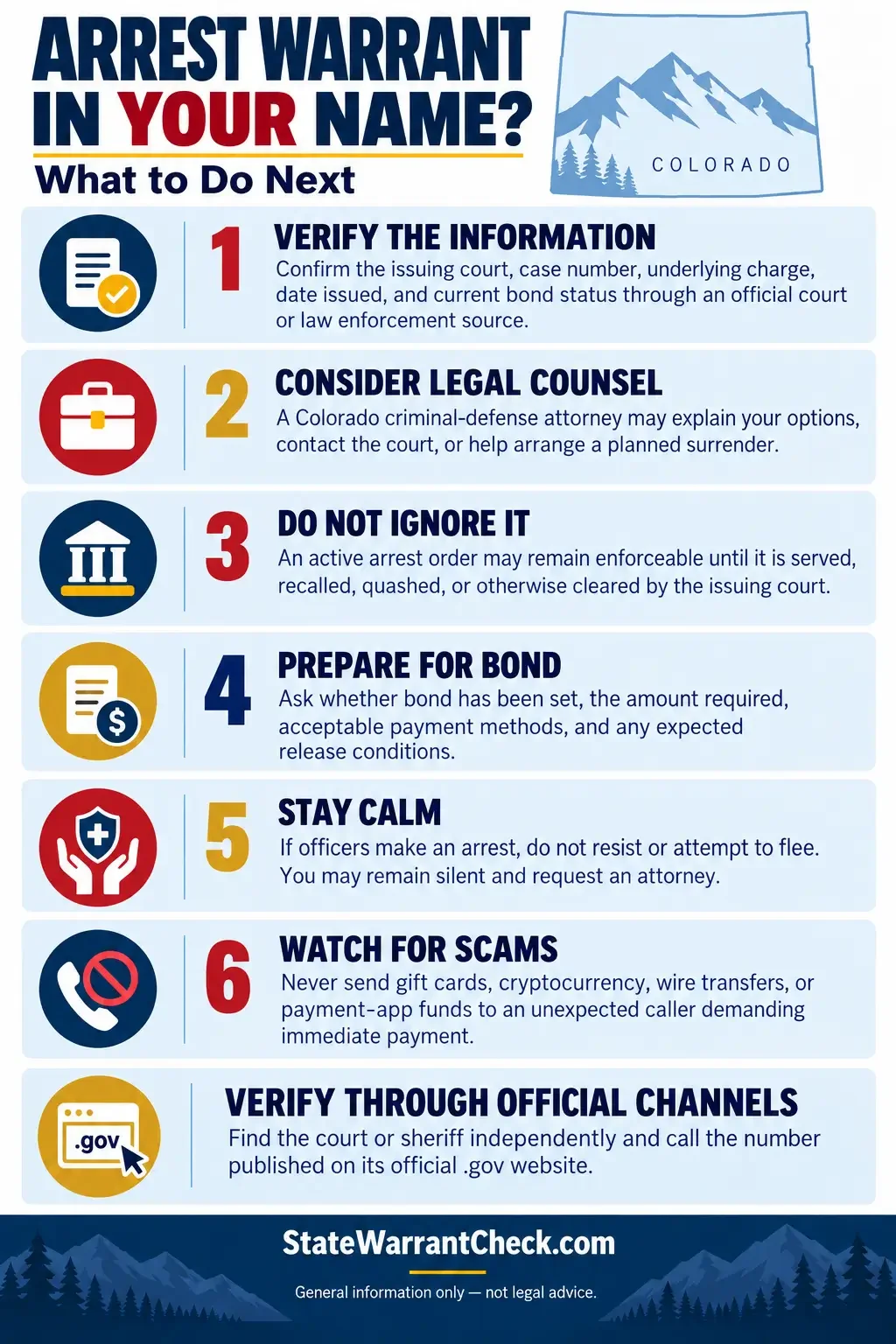
Discovering that you may be subject to arrest can be very alarming, but ignoring the situation significantly increases the risk of being taken into custody unexpectedly. Address the matter promptly, verify the information through official channels, and consider obtaining legal guidance before deciding how to proceed.
Verify That the Order Is Real and Current
Contact the issuing court or responsible law enforcement agency to confirm the record. Ask for any publicly available information concerning:
1). The issuing county court and judge
2). The specific court case number
3). The date of issuance of the judicial order
4). The underlying criminal charge or alleged violation
5). The specific type of court order
6). The bond amount and type, if one has been set
7). Any available procedure for resolving the legal matter
It’s important to be careful with using privately run databases and not rely solely on a third-party search result. Commercial databases may contain outdated information, confuse individuals with similar names, or fail to show that an order has been recalled or cleared.
Consider Contacting a Criminal-Defense Attorney
An attorney can review the court record, confirm its current status, explain the likely arrest and bond process, and communicate with the court or prosecutor when appropriate. Depending on the allegations and local procedures, legal counsel may be able to request a hearing, file a motion to recall or quash a bench warrant, or help arrange a planned surrender. These outcomes are not guaranteed, and the available options will depend on the court and circumstances of the case.
The State Public Defender can represent qualifying defendants who cannot afford private counsel on their own. Eligibility and when representation becomes available depending on the person’s financial circumstances and legal procedural status.
Do Not Assume the Order Will Disappear
An outstanding arrest order may remain enforceable until it is served, recalled, quashed, or otherwise cleared by the issuing court. Moving to another county does not necessarily prevent law enforcement from taking the person into custody.
If the person is located outside Colorado, the decision to detain and return that individual may depend on the underlying charges and the issuing jurisdiction’s extradition instructions. Only the responsible court or agency can reliably confirm that the matter has been resolved.
Prepare for Bond and Release Conditions
If bond has already been set, determine the amount and acceptable form of payment before arranging a surrender. The court may authorize a personal recognizance bond, cash bond, property bond, or surety bond. In other situations, a judge must decide the amount and release conditions after the arrest.
Bond is intended to help make sure that the defendant returns for future proceedings. It is not a fine or a finding of guilt. Release may also be subject to travel restrictions, monitored sobriety, no-contact orders, pretrial supervision, or other court-imposed requirements.
Do Not Resist or Attempt to Flee
If officers carry out the arrest order, remain calm and do not physically resist or attempt to escape. A person can exercise the right to remain silent and request an attorney without arguing with officers or interfering with the arrest. Questions about whether the arrest or a related search was lawful should be addressed through legal counsel and the court, not through physical resistance at the scene.
Watch for Arrest-Related Payment Scams
Scammers may falsely claim that someone is facing arrest for missing jury duty, failing to appear, or committing another offense. They often create a sense of urgency and demand immediate payment through gift cards, cryptocurrency, wire transfers, prepaid cards, or payment apps.
The Jefferson County Sheriff’s Office warns that scammers may copy official websites, badges, photographs, and agency names to appear legitimate. The department states that it does not demand online payment to cancel an arrest order or prevent someone from being taken into custody.
If someone contacts you about an alleged court matter, do not call the number or follow any payment link included in the message. Never disclose banking information, identification photographs, or your Social Security number. Instead, locate the court or sheriff’s official website independently, call the number published on the government site, and confirm the case directly with the responsible court or law enforcement agency.

Colorado Warrant Search - FAQs
How can I find out if I have an active arrest warrant in Colorado?
Begin your search with the sheriff’s office and court in the county where the case or alleged criminal offense originated. Some counties provide an online search that is publicly accessible, while others require a phone call or public-records request. Municipal courts should be checked separately when the matter involves a city citation or ordinance.
Can I run a Colorado warrant search for free?
Many county sheriff and court resources are free and publicly available, although access varies by jurisdiction. Colorado also authorizes commercial vendors to provide limited court-record searches for a fee, but those results may not represent the complete or official court record.
Does a “Most Wanted” list include everyone with an active arrest order?
No, a most wanted does not include every arrest order in the state. These pages generally feature only selected individuals whom an agency has chosen to publicize. The absence of someone’s name does not confirm that no active record exists.
Can missing a court date lead to an arrest?
Yes, it is possible depending on the type of court case. A judge may issue an arrest order allowing law enforcement to take someone into custody after a failure to appear. However, the response to a missed date can depend on the type of case, the court’s procedures, the person’s history, and the circumstances surrounding the missed appearance.
How can I find out whether bond has been set?
The most accurate way to find out if bond has been set is by contacting the issuing court, county sheriff, detention facility, or your attorney. Ask about the bond amount, acceptable form of payment, and any release conditions. Some cases require a judge to make the bond decision after the arrest.
Can someone be extradited from another state?
It may be possible for someone to be detained outside the state and returned through the extradition process. Whether that occurs can depend on the underlying charges and instructions from the issuing jurisdiction. An attorney can help determine how the court intends to handle an out-of-state arrest.