

Illinois Warrant Check
🔷
Illinois Warrant Check 🔷
Illinois Warrants: How to Search and Quash Them
Warrants in the state of Illinois are legal court orders issued as a result of criminal allegations or civil violations that require immediate legal compliance. Depending on the circumstances, a warrant may authorize law enforcement to take specific legal action against an individual.
Regarding criminal matters, warrants may authorize law enforcement to arrest a person of interest, search a property, seize evidence, or compel an individual to surrender themselves to authorities. Criminal arrest warrants are generally issued when a judge determines there is probable cause to believe that a person has allegedly committed a crime.
For civil matters that are not directly tied to criminal activity, courts may issue a bench warrant requiring an individual to comply with a non-criminal court order. Bench warrants are commonly issued due to missed court appearances, unpaid court fines, failure to comply with court-ordered obligations, or other violations of civil court requirements.
The Significance of Having a Warrant
Many people do not realize they may have an active warrant until they are stopped during a traffic stop, denied employment after a background check, or contacted by the courts for a missed court appearance. Because these judicial orders can remain active for years, it is important to understand how these legal instruments work, and how to check for Illinois warrants if you believe you may have one.
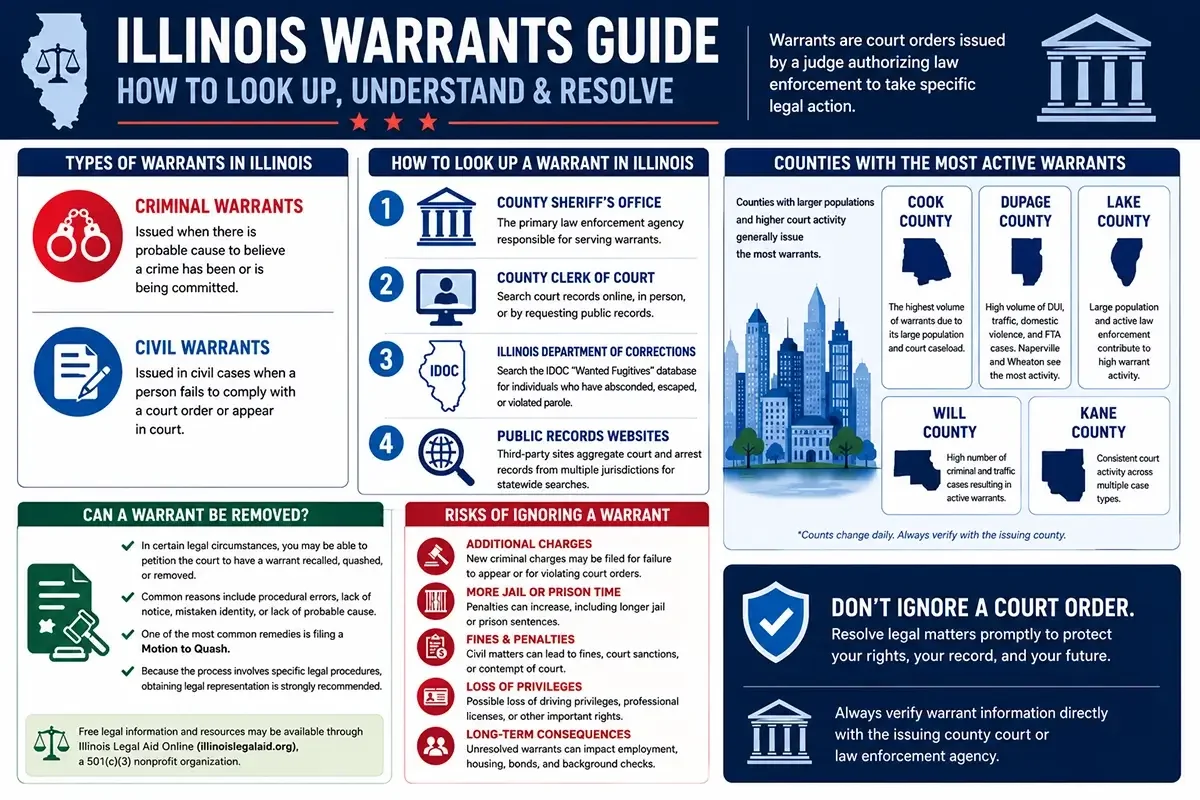
The majority of warrants issued in the state are done at the county level, meaning each county court system maintains its own records and procedures. Larger counties such as Cook County, DuPage County, Lake County, Will County, and Kane County issue a substantial number of these judicial orders due to their larger populations and higher court activity.

How to Run an Illinois Warrant Search
There are several ways to conduct an Illinois warrant search depending on the county, type, and the information available. There are both official government databases and third-party public records resources to search for warrant-related information. Below are several publicly accessible online resources that may assist with locating these public records.
1). Search County Court Records
Most counties in Illinois provide online access to court records and active judicial court orders through the respective county court clerk’s office. These systems allow users to search by:
First and last name - The majority of court and public record databases allow searches using a person's full legal name. Because many people share the same name, additional identifying information, such as a date of birth, is necessary to verify that the correct record has been located.
Date of birth - DOB is often required to verify the identity of a person, especially with people that share the same first and last names. Providing this information will significantly improve the accuracy of a search and filter-out records that belong to someone else.
Case number - This is the most accurate way to lookup records because each case is assigned a unique identifier. Unlike name-based searches, a case number points directly to a specific legal case, eliminating incorrect results.
Citation number - Traffic tickets, citations, and certain traffic-related court matters can often be located quickly by searching with the citation number listed on the original ticket issued by law enforcement.
However, not all civil and criminal court orders are publicly accessible online. Some counties restrict access to protect ongoing investigations, or are sealed for privacy reasons.
For example, the Clerk’s Office in Winnebago County offers access to warrant-related court information issued within the county. Since these are considered public records, anyone can access records through the county’s online court system or contact the Clerk’s Office directly by phone or in person for additional assistance.
2). Contact the County Sheriff’s Office
Another common method is contacting the county sheriff’s office directly. The majority of Illinois sheriff departments maintain online records divisions or “most wanted” databases that list active arrest orders, felony and misdemeanor cases, and fugitive investigations.
Keep in mind that if an active arrest order exists in your name, by appearing at a sheriff’s office in person could potentially result in your immediate arrest. A more pragmatic approach is to conduct an online records search first, and then consult with an attorney who can help explain the allegations, criminal charges, and available legal options.
3). Check the Illinois Department of Corrections
For those wanted in connection with parole violations, absconding, escape, or fugitive-related cases, the Illinois Department of Corrections (IDOC) maintains a public access database for “Wanted Fugitives”. This resource includes convicted criminals who have failed to report to parole, escaped custody, or are otherwise being actively pursued by correctional authorities. These records typically include criminal offense information, physical descriptions, identifying marks and tattoos, and mugshots when available.
4). Access via Public Records Websites
Because IL warrants are considered public information, anyone can search for active civil and criminal court orders through third-party public records websites. These are convenient alternatives to official channels, and offer much more detailed information that include criminal history reports, and background checks from multiple jurisdictions. One of the primary advantages of using these platforms is the ability to conduct broader statewide or multi-jurisdictional searches, which can be especially helpful when someone is unsure where an order may have originated.
However, because court and law enforcement data can change frequently, it is important to verify any information directly with the issuing government agency. While these services are convenient and comprehensive, official county agencies generally remain the most authoritative source for confirming active legal records.
How Warrants Are Issued
The majority of civil and criminal warrants are issued through county court systems after law enforcement or prosecutors present evidence to a judge. Once there is sufficient evidence, or probable cause, a court order is issued for the respective civil violation or criminal allegation.
The judicial court order process follows these general steps:
An officer of the law, prosecutor, or government agency submits evidence or a sworn affidavit
A judge reviews the evidence, probable cause or legal basis
The judge signs and authorizes the civil or criminal court order
The court order is entered into local and national law enforcement databases and is activated
Because Illinois primarily operates through county-level court systems, judicial orders are often tied directly to the county where the alleged offense occurred.
For example:
A missed court date in Chicago may result in a civil court order issued through Cook County courts
A DUI offense in Naperville could result in a criminal court order through DuPage County
A probation violation in Joliet may originate from Will County courts
Each county may have different procedures regarding:
Bond requirements - Eligibility, bond amounts, and pretrial release conditions are considered when determining if someone can be released from custody while awaiting their trial.
Recall hearings - Requesting that a court order be recalled or quashed, depending on eligibility
Court appearances - Determination whether an individual must appear in person before a judge, or if an attorney can represent them in their stead
Warrant notification policies - Procedures regarding the advanced notice of sending notices to active judicial orders related to missed hearings or criminal allegations
Online access availability - What case information is accessible online, what is sealed for privacy reasons, and if in-person requests are necessary for certain records
Risks of Ignoring a Warrant
Ignoring an active IL warrant, whether criminal or civil in nature, can result in serious legal and personal consequences. Although civil matters do not always lead to immediate arrest, failing to comply can trigger additional penalties, increased fines, suspension of driving privileges, or further enforcement actions by the court.
In criminal matters, ignoring an active arrest order may lead to additional charges, enhanced penalties, extended probation, higher bond amounts, or increased jail or prison time. By ignoring the unresolved legal issues employment opportunities may be affected, as well as housing applications, and traveling outside the country.
Potential risks include:
Arrest during a traffic stop when law enforcement conducts a records check
Driver’s license suspension for unresolved traffic violations, including DUI cases
Increased fines and court costs for unresolved legal matters that incur penalties and interest
Employment background record problems for outstanding criminal charges
Housing application denials for background checks that show unresolved legal issues
Travel complications for leaving the state or country for those with outstanding warrants
Additional criminal charges for failure to address outstanding legal matters
It is important to understand that most criminal and civil judicial orders, whether stemming from a minor offense, missed court hearing, or civil violation, which do not disappear on their own. In many cases, unresolved legal matters can become much more complicated over time, potentially affecting a person’s livelihood, financial stability, and legal rights.
Depending on the circumstances, failing to address an active court order may impact a person’s ability to renew a driver’s license, possess firearms, travel internationally, secure employment, or pass criminal background checks. Because these legal matters can carry serious long-term consequences, taking prompt action is often the best course of action.
If you are uncertain how to respond to a judicial order or unresolved court matter, consulting with a qualified attorney may help clarify your legal options. Individuals who meet certain income requirements may also qualify for free or low-cost legal assistance through nonprofit legal aid organizations.
Common Types of Warrants
The state’s county courts commonly issue these legal orders depending on the circumstances involved, whether related to alleged criminal activity, civil violations, or failure to comply with an existing court directive.
While judicial orders are commonly issued at the county level, they are searchable through statewide court systems, and also public record databases.
Illinois Arrest Warrants
Arrest orders are among the most common types of court orders issued. An arrest order authorizes law enforcement to arrest an individual suspected of committing a crime. These can be a result of a criminal allegation, violating a parole or probation order, or absconding from an ongoing investigation.
Illinois Bench Warrants
Bench orders are issued directly by a judge, for a civil violation, usually because someone failed to comply with a court order. These are not criminal in nature, as they are not tied to a criminal act. Rather, these legal orders are issued for missing a court hearing, failure to pay court fines, or violating a court mandate. These often stem from minor traffic or misdemeanor matters that escalate over time.
Illinois Search Warrants
Search warrants are criminal legal orders issued for law enforcement to search a specific property, residence, vehicle, or electronic device for evidence connected to a criminal investigation. Judges generally require probable cause before approving a search order, which is required by the Fourth Amendment of the Constitution.
Failure to Appear (FTA) Warrants
Failure to Appear orders are issued when someone misses a scheduled court appearance. These are most commonly issued in traffic court, misdemeanor cases, and probation hearings. Even a relatively minor citation can eventually result in a FTA court order if ignored for long periods of time.

How to Petition to Have a Warrant Removed
In certain legal circumstances, it may be possible to petition the court to have an active order recalled, quashed, or removed by a judge. Courts may consider granting a recall for several reasons, including procedural errors, lack of proper notice, mistaken identity, or situations where there was insufficient probable cause supporting the original issuance.
The process depends heavily on:
1). The county it was originally issued in - Each county has it’s own procedures, filing requirement, and judicial procedures which determine how a petition is handled in court. Hiring an attorney will often expedite this process and fast-track the process.
2). The type of court order and underlying charges - The type of petition, whether civil, criminal, probational, or FTA, will determine the type of legal process to follow
3). Whether the case is misdemeanor or felony - Felony cases usually receive greater scrutiny than misdemeanor cases and are usually quite a bit more difficult to have recalled by a judge, unless there are extenuating circumstance.
4). Prior criminal history of the individual - Considerations are taken into account about a person’s prior convictions, their overall risk, and previous court compliance
5). Whether bond forfeiture occurred - If there was a previous bond posted and then later forfeited for a missed court appearance or non compliance, the court may assess additional penalties that will need to be handled before applying for a petition of a current court order.
Filing a Motion to Quash a Warrant
One of the most common legal remedies is filing a “Motion to Quash”, as outlined by the Illinois Legal Aid Online nonprofit organization, which is a formal legal request asking the courts to recall or cancel an active court order. Because there are specific legal procedures, filing requirements, and court appearances often involved, seeking legal representation from a criminal defense attorney is highly recommended to help navigate the process effectively.
This process generally involves:
1). Hiring an attorney or appearing in court - An attorney can help explain the available legal options, prepare the necessary court filings, and advocate on a person’s behalf throughout the petitioning process.
2). Filing the motion with the issuing court - A formal motion will need to be submitted to the same courthouse that originally issued the order.
3). Requesting a hearing before the judge - The respective court will schedule a petition hearing where a judge can review the facts, consider the circumstances, and determine the eligibility for the request to recall.
4). Explaining the legal circumstances - A judge will commonly want to understand the reasons behind the missed court appearance, non-compliance, criminal allegations, or other events that led to the judicial action being issued.
Judges may consider:
1). Accidental missed court appearance - A Judge will determine whether a failed court appearance resulted from an honest mistake, a scheduling conflict, notification issue, or another extenuating circumstance
2). Medical emergencies - Certain medical situations such as serious health emergencies, hospitalizations, medical procedures, or other health-related emergencies may be considered if documented and verified by a doctor
3). Lack of proper notice - If the person of interest did not received proper notice of a court date, hearing, or summons, a judge may take that into consideration
4). Voluntary compliance - Courts may look favorably upon those who take the initiation to resolve their legal matters head-on, such as appearing voluntarily or surrendering to the courts without being arrested
5). Prior criminal history - A judge may also take into consideration a person’s prior criminal convictions, or any outstanding legal matters that exist
6). Risk of flight or fleeing - A judge will consider if there is a likelihood of someone fleeing before their trail or hearing, also known as ‘flight risk’
Resolving the Underlying Court Order Issues
A court order will generally remain active until the underlying legal matter has been addressed and resolved. This may involve appearing in court, paying outstanding fines, completing probation requirements, or resolving pending criminal or civil issues. Once the court determines that all obligations have been satisfied, the order may be recalled, quashed, or otherwise removed. Conversely, allowing the matter to remain unresolved will likely increase the odds of enforcement actions, additional financial penalties, and more serious legal consequences over time.
Resolving the case may involve:
1). Paying court fines or overdue legal fees - In many situations, outstanding fines, court legal fees, restitution payments, or other financial obligations must be satisfied before the court will consider the matter resolved. Once a judge signs off on this, the respective court order can be removed.
2). Rescheduling and attending missed court hearings - If the issue stems from a missed appearance or hearing, the court will typically require the individual to reschedule and attend a future hearing to address the underlying legal matter. Then, once compliance is demonstrated with the judicial requirements, the order can be recalled.
3). Completing all probation requirements - If the order is regarding probation, that person will be required to satisfy all court-ordered conditions, including reporting obligations, counseling programs, community service, alcohol or drug treatment programs, or any other terms imposed by the court.
4). Resolving any pending criminal charges - When unresolved criminal allegations are the basis of the judicial action, the case must proceed through the Illinois legal system before the matter can be completely addressed. This typically involves court appearances, negotiations with prosecutors, or additional legal proceedings.
5). Negotiating plea agreements - In certain criminal cases, attorneys and prosecutors may negotiate a plea bargain that can essentially resolve the underlying charges, and satisfy the courts, without proceeding to trial. Depending on the circumstances around the criminal charges, a plea agreement can bring the matter to a conclusion without a lengthy trial.
Risks of Ignoring a Court Order
Ignoring an active IL court order, whether criminal or civil in nature, can result in serious legal and personal consequences. Although civil matters do not always lead to immediate arrest, failing to comply can trigger additional penalties, increased fines, suspension of driving privileges, or further enforcement actions by the court. In criminal matters, ignoring an active arrest order may lead to additional charges, enhanced penalties, extended probation, higher bond amounts, or increased jail or prison time. By ignoring the unresolved legal issues employment opportunities may be affected, as well as housing applications, and traveling outside the country.
Potential risks include:
1). Arrest during a traffic stop - If pulled over for a traffic violation, if a police officer runs a check on the driver and there is an outstanding arrest order, they will be taken into custody and their vehicle impounded.
2). Driver’s license suspension - Multiple unresolved traffic citations, including DUI offenses, can lead to a court order that effectively restricts that person’s driving privileges until the traffic violations are handled.
3). Increased fines and additional court fees - Delinquencies of paying any overdue court fees will often lead to additional financial penalties, interest charges, and court costs that increase the overall expense of resolving the matter. Court fines can typically be handled online without having to appear in person.
4). Employment background check problems - Any type of criminal conviction or unresolved criminal charges can be flagged by a potential employer when running a background check, which may lead to fewer job opportunities.
5). Housing application denials - If a property management company runs a background report on a person prior to renting to them, that may flag that person as being ‘high-risk’ and impact their eligibility.
6). Travel complications - Traveling outside of the state, or another country can potentially be problematic if there are pending criminal charges that are flagged during screening. This can lead to denial into another state or country, and potentially lead to that person’s immediate arrest.
7). Additional criminal charges - Failure to address an outstanding criminal matter may result in additional criminal charges, enhanced penalties, jail time, or further judicial actions by the court.
Illinois Counties With the Most Active Warrants
The highest concentration of active warrants in Illinois generally comes from larger metropolitan counties with dense populations, heavier court caseloads, and increased law enforcement activity. The following jurisdictions are among the most active in the state.
Cook County
Cook County, which includes Chicago, consistently processes one of the largest criminal court caseloads in the United States. Due to its population size, Cook County issues a substantial number of arrest orders for felonies, misdemeanors, DUIs, and probation violations
DuPage County
DuPage County is among the most active jurisdictions in the state for court-issued legal actions involving DUI offenses, traffic-related violations, domestic violence matters, and failure-to-appear (FTA) cases. Much of this activity is concentrated in cities such as Naperville and Wheaton, which experience heavier court caseloads due to their relative population size and local law enforcement activity.
Will County
Will County, one of the fastest growing counties in the state, also has a rapidly increasing volume of criminal filings and arrest order issuance. The most common criminal cases the county deals with are; drug offenses, criminal traffic citations, probation violations, and domestic violence and battery cases.
Lake County
Lake County courts frequently issue judicial orders connected to; DUI offenses, FTA cases, misdemeanor and felony offenses, and juvenile-related offenses.
Kane County and McHenry County
These smaller counties also generate a significant number of active criminal charges and arrest orders due to the fast-growing suburban populations and expanding respective court systems.

Illinois Warrants - FAQs
What is the difference between a bench and arrest warrant?
While both are judicial court orders, a bench order is generally issued by a judge because someone violated a specific court order, which is a civil violation. While an arrest order is an allegation of a crime that has been committed, which is typically issued after law enforcement presents evidence or submits a sworn affidavit. A civil violation will normally result in fines, rescheduling of a missed court hearing, or the mandatory completion of the original judicial order. Where a criminal violation, will result in criminal charges being filed against the person of interest, commanding law enforcement to arrest and detain that person until they can be arraigned in court.
Do I have an active warrant in Illinois?
IF you suspect you have a warrant issued in your name you can check online through the various official and unofficial channels. Since these are considered public record, you may search county court records, contact the sheriff’s office directly, review public case databases, or use public records search websites to identify active civil and criminal bench orders.
Can a lawyer petition to have an arrest order removed?
Yes, there are many situations where an attorney can file motions to recall or quash an arrest order and represent a client during court proceedings. While not all legal circumstances will result in an arrest order being removed, by working with a defense attorney your odds of accomplishing this greatly improve.
Are court orders considered public record in Illinois?
Yes, for the most part all bench and arrest orders are part of the public record system throughout the state. The only exceptions are those records that are sealed for ongoing investigations or for privacy reasons.
What happens if I miss my court date in Illinois?
Missing a scheduled court appearance can potentially result in a judge issuing a bench order requiring you to appear before the court. Depending on the circumstances, this may lead to additional fines, license suspensions, or further legal consequences if left unresolved. However, if you are proactive about the missed appearance and reschedule quickly, the bench order will likely be removed.
Do active warrants show up on background checks?
Yes, they certainly can. Unresolved criminal matters, arrests, and court orders may appear during background screenings depending on the type of check being conducted and whether the records remain publicly accessible. These can be limiting factors for job opportunities, housing applications, academic pursuits, and traveling outside the US.