

Cook County Warrants
🔷
Cook County Warrants 🔷
How To Check For Active Warrants in Cook County
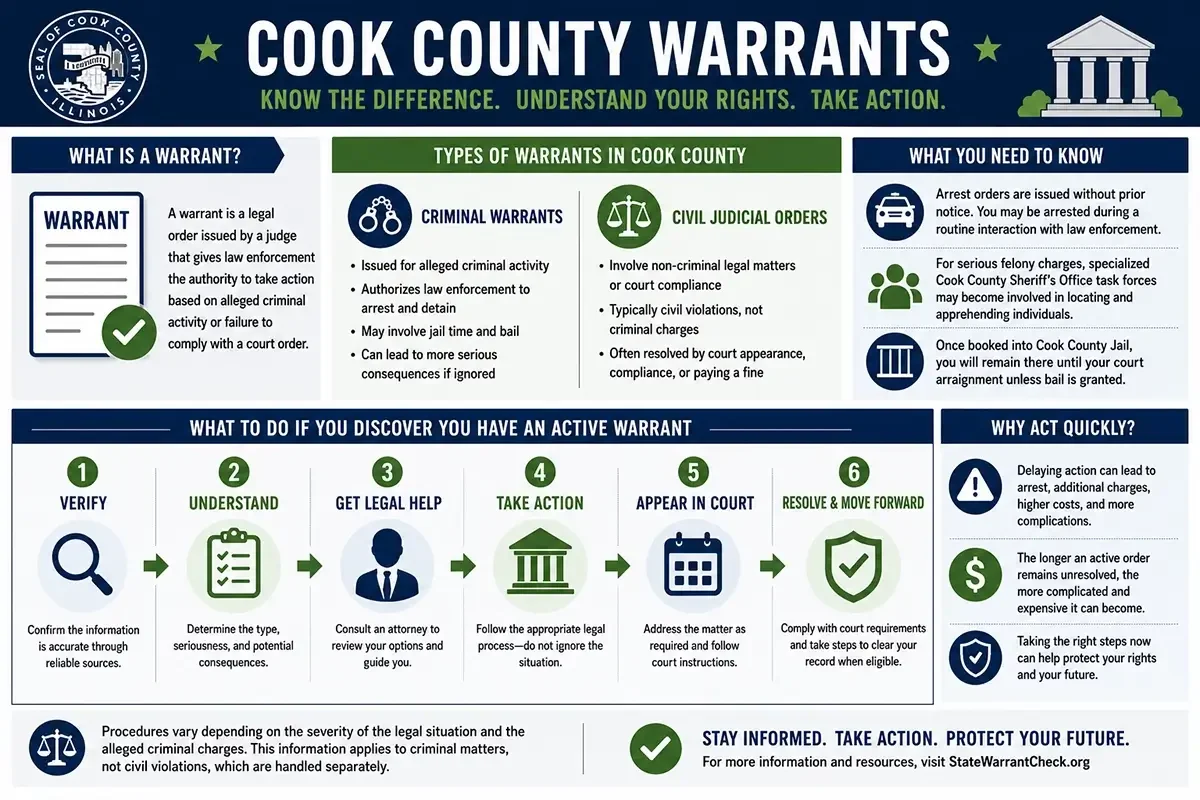
A warrant is more than just a judicial order, it’s a legal mandate ordered by a judge that must be followed. It can result in fines, penalties, and even arrest and jail time. In Cook County, Illinois, these legal court orders are most commonly issued for criminal offenses, missed court appearances, probation violations, unpaid fines, or failing to comply with a court directive.
Because warrants are generally considered part of the public record system, anyone can search for these judicial orders online through official court systems, sheriff’s offices, or public record databases. Understanding the difference between criminal and civil judicial orders, how they are enforced, and what steps should be taken after discovering an active warrant can be instrumental in navigating the legal process.
Cook County is the largest county in Illinois and includes the city of Chicago along with numerous surrounding municipalities. Due to the size of the county and the large volume of court activity, thousands of judicial orders are issued each year through the criminal and civil court systems.
Cook County Illinois Warrants Explained
Cook County warrants are court-authorized judicial orders directing either law enforcement or other government agencies to take a legal action against a person. The most common types include:
Arrest Orders - Issued when there is probable cause that a crime was committed
Bench Orders - Given out missed court appearances, overdue legal fees, or failed court orders
Failure-To-Appear (FTA) Orders - Issued when someone fails to make their own court hearing
Civil Compliance Orders - For non-criminal civil violations that result in fines and penalties, and community service
Probation Violation Orders - Result in arrests or extensions of probation terms
Search Warrants - Issued for ongoing investigations for collecting relevant evidence
Child Support Enforcement Orders - Demands to pay child support and can potentially result in wage garnishment, or arrest if ignored
In most situations, these judicial court orders are issued because a judge believes there is probable cause that a law has been violated, failure to comply with a court directive, or because someone failed to comply with a specific legal order.
Depending on the type issued, whether civil or criminal, the consequences can range from additional fines and court penalties to being arrested and detained in county jail.
How To Run a Cook County Warrant Search
There are a multitude of online platforms that are publicly accessible to search for active warrants in Cook County, Illinois. Some are official government channels, while others are third-party public record databases.
1. Search Cook County Court Records
One of the most reliable methods is searching court records through the Cook County court system. Criminal case information may reveal pending arrest orders, missed hearings, bond forfeitures, or bench warrant activity.
Official Cook County court systems may provide:
Criminal case status - View the current status of a case, whether it’s active, pending, resolved, dismissed, or awaiting a future court hearing
Upcoming court dates - Displays scheduled hearing dates, arraignments, status conferences, motion hearings, or trial dates
Failure to appear notices - Check for a missed court hearing, where the public case information may indicate a failure-to-appear notice
Bond information - Provides limited information regarding bond amounts, eligibility for release, and bond conditions
Judicial order actions - Reflect actions taken by a judge, including bench orders, recalls, quashed judicial orders, probation modifications, or continuances
Typical search criteria:
Full legal name - Common names may generate multiple results and require additional identifying details
Case number - The most accurate ways to locate court information, as it directly links to a specific case
Date of birth - DOB helps to distinguish between individuals with similar names and improve accurate results
Citation number - Traffic matters, ordinance violations, and lower-level court cases are searchable using a citation or ticket number
Because county court systems are updated daily, records typically appear within hours after a warrant is issued. It’s also possible to contact the clerk of the courts directly for assistance @ 312-603-5030
2. Contact the Cook County Sheriff’s Office
The County Sheriff’s Office maintains a database of active civil and criminal warrants and is tasked by the courts to serve them.
The general public can contact the sheriff’s office to:
Verify active arrest orders - Confirmation whether an active criminal judicial order exists and is active
Confirm booking information - Access information regarding recent arrests, and booking dates
Check jail custody status - Inmate lookup system to find out if and where someone is currently jailed
Surrender procedures - To understand voluntary surrender procedures, booking expectations, and bond requirements
However, those who believe they have an active criminal arrest order should exercise caution when directly contacting law enforcement, especially if the order involves a felony offense. This will most likely result in an immediate arrest and detainment in county jail. In these types of serious legal situations, it can be helpful to first consult with a criminal defense attorney before contacting the authorities directly.
3. Search Illinois Public Court Databases
The Illinois judicial system also provides access to certain public court systems for both state and county level judicial records that offer public access to criminal proceedings connected to active criminal and civil orders
Public databases may include:
Felony case filings - Includes serious allegations such as assault, drug offenses, theft, fraud, firearm violations, and other major crimes
Misdemeanor cases - Includes disorderly conduct charges, petty theft, trespassing, minor drug offenses, and other municipal violations
Probation violations - Includes probation violations, missed check-ins, non-compliance with court-ordered conditions, failed drug testing
Civil enforcement actions - Includes contempt proceedings, child support enforcement, court compliance issues or other judicial efforts
Traffic citations & DUIs - Includes unpaid citations, license-related issues, reckless driving allegations, and driving under the influence (DUI) cases
It’s important to note that not all judicial orders are publicly displayed online. Certain sensitive information may remain sealed, restricted, or unavailable for public safety reasons.
4. Use Public Record Search Websites
Many people now use public record websites to conduct broader warrant-related searches across multiple counties and jurisdictions. These sites have become very popular as they offer quick and robust access to billions of records with just a few clicks.
These databases may aggregate:
Criminal court records - Aggregate criminal court filings, case activity, hearing information, judicial decisions, and procedural updates
Arrest records - Includes information related to prior arrests, booking dates, arresting agencies, charges filed
Jail booking records - Provides booking information, incarceration dates, custody status, release information, or inmate housing details
Bench and arrest orders - Includes information regarding active or historical bench orders, FTA actions, and criminal arrest orders
Judicial filings - Court related documents, motions, case updates, procedural filings, and certain judicial actions
Convictions & sentencings - include criminal convictions, plea agreements, sentencings, probation requirements, and incarceration details
Liens, Bankruptcies & judgments - Certain financial or civil court matters, including tax liens, bankruptcies, and monetary judgments
Driving records, traffic citations & DUIs - Traffic violations, unpaid citations, license suspensions, reckless driving charges, DUIs & DWIs
Prison, parole, and probation records - Includes incarceration history, parole eligibility, and probation details
Marriage, divorce & vital records - Contain marriage records, divorce filings, birth records, death records, and public vital records
Comprehensive background checks - Include criminal history, court activity, addresses, aliases, civil matters, and public record abstracts
Third-party websites can sometimes provide faster access to a multitude of public record searches, although official government sources are generally considered more authoritative. If you find what you’re looking for with a public record site, it’s usually a good idea to verify the accuracy via official government channels.
The Difference Between Criminal Warrants vs Bench Warrants
One of the biggest misconceptions people have is assuming that all judicial orders involving warrants are criminal in nature. In reality, judicial orders may fall into either criminal or civil categories, depending on the circumstances and the purpose of the court order.
Criminal Judicial Orders
Criminal court orders are issued when law enforcement or prosecutors allege that a criminal offense has occurred. There must be substantiated evidence that supports “probable cause” where a judge can issue a criminal arrest order.
Examples include:
Felony criminal charges - Most serious category of criminal allegations
Misdemeanor criminal charges - Less severe than felonies but still quite serious
Drug-related offenses - Involves possession, manufacture, distribution, and trafficking
Theft & burglary charges - Includes stealing another person’s property, or unlawful entry with intent to commit a crime
Assault and domestic violence - Allegations of physical harm, violence, and abusive conduct
Probation and parole violations - Failure to comply with court ordered terms
Criminal arrest orders authorize local law enforcement to locate, arrest, and detain the person of interest named in the order. Once taken into custody and booked into county jail, the individual will generally remain detained until their court arraignment unless bail is granted or they are able to post bond.
These criminal legal orders often involve:
Fingerprinting - For validating the identity of a suspect & verifying criminal history
Booking into jail - Formal criminal charges are officially recorded along with mugshots, fingerprints & personal information
Pretrial hearings- Review evidence, discuss motions, & establish criminal trial timelines
Bail proceeding - Determine if the person of interest can be released while awaiting trial
Criminal prosecution - Prosecutors review evidence to pursue the criminal case trial
Civil Judicial Orders
Civil judicial orders generally involve non-criminal legal disputes or court compliance matters. Unlike criminal charges, these are considered civil violations and can often be resolved through a court appearance, complying with a previous judicial order, paying outstanding fines, or otherwise satisfying the court’s requirements.
Examples include:
Failure to pay child support - Falling significantly behind in court ordered payments
Contempt of court - Ignoring or disobeying a direct court order or judicial requirements
Non compliance with subpoenas - Failing to appear in court or compliance with a legal request
Traffic judicial actions - Unresolved traffic citations or failure to appear in court as required
Civil violations generally do not carry the same criminal penalties as felony or misdemeanor charges, although ignoring civil court orders can still result in serious legal consequences.
How Arrest Orders Are Enforced
Once an arrest order becomes active, law enforcement agencies will begin attempting to locate the individual named in the order. They have the authority to arrest someone at home, at work, or when pulled over for a traffic stop.
Enforcement Methods
Law enforcement enforce arrest orders through:
Routine vehicle traffic stops
Visits to home or residence
Contact at place of employment
Airport security or travel screenings
ID verification & background checks
Routine law enforcement encounters
Because arrest orders are often issued without prior notice to the individual involved, many people are unexpectedly taken into custody during routine interactions with law enforcement.
Warrant Task Forces
In more serious felony cases, specialized sheriff’s department task forces or fugitive apprehension units may become involved in locating and taking into custody those named in active arrest orders, especially when there is a significant public safety concern.
These investigations may include:
Database searches
Surveillance operations
Coordination between agencies
Interstate extradition efforts
Those that are charged with felony crimes often receive higher enforcement priority than low-level misdemeanor crimes. Felony convictions typically result in mandatory jail or prison time where many misdemeanors only result in fines and penalties.

How Can a Warrant Be Recalled or Quashed?
In certain circumstances, a court may agree to recall, quash, or withdraw an active warrant. However, such requests are not automatically granted and typically require specific legal grounds or compliance with conditions established by the court. In many cases, the likelihood of a successful petition increases when the underlying issue has been addressed, such as appearing in court, satisfying outstanding obligations, resolving pending charges, or otherwise complying with the court's requirements.
Filing a Motion To Quash
A motion to quash is a formal request to the courts to cancel or invalidate the existing court order. However, there are only a handful of reasons this will likely be granted. A judge will ultimately decide whether to grant the request for the specific reason outlined in the petition.
Judges may consider:
1). Whether the person missed court accidentally - Did the missed appearance result from an honest mistake, scheduling conflict, or other extenuating circumstance
2). Certain medical emergencies - Document medical emergencies, serious illnesses, hospitalizations, or other serious health related issues
3). Lack of appropriate notice - There was insufficient notice to respond, or the person of interest did not receive proper notification that lead to a failure to appear
4). Clerical errors in naming the wrong person - Administrative mistakes naming the wrong person, which can occasionally happen with people having the same first and last name
5). Compliance with outstanding requirements - Judges may look favorably on those that fully comply with the court’s requests by paying any fines, rescheduling missed court dates, or resolving the respective legal issue
Resolving the Underlying Issue
The majority of criminal and civil orders will remain active indefinitely, or until the original issue is resolved. This means there is no statute of limitations, or expiration date on judicial orders. Only once compliance occurs, the court may recall the order.
Examples include:
1). Appearing in court for a missed appearance - Resolving and rescheduling a missed court hearing or appearance will likely have the court order removed
2). Paying all outstanding legal fines - Compliance with paying all of the delinquent court fines and fees in full, will show the civil issue has been resolved
3). Completing probation conditions - Successfully completing all probation requirements, community service work, and other conditions will show the courts that the individual has complied with the court’s directives
4). Providing required documentation - Certain legal matters can be resolved by showing the proper documentation to the courts that was originally missing or necessary for the completion of the legal requirements
5). Addressing pending criminal charges - For criminal cases, resolving the allegations and criminal charges through court proceedings, plea agreements, or dispositions can help to remove the corresponding judicial order
Attorney Representation
In certain lower-level cases, an attorney can appear in court on behalf of the person of interest to request a recall without that person being arrest. However, serious felony cases usually require direct court appearances and commonly lead to a person’s arrest and detainment until their trial.
This is more common with:
1). Traffic citations and DUIs - The most serious traffic violations, such as DUIs / DWIs and reckless driving, are often represented in court by an attorney that can help to resolve the charges in court, or plea bargain a more favorable outcome for their clients.
2). Minor misdemeanor cases - Some, but not all, lower level misdemeanor cases allow legal counsel to make initial court appearances, file motions, or communicate with the court without requiring the immediate presence of the defendant.
3). Certain procedural bench orders - Judicial orders that are issued for administrative or procedural reasons, such as missing a court appearance or failing to complete a court requirement, may sometimes be addressed through attorney representation
What To Do If You Discover an Active Warrant
Finding out there is an active warrant can be stressful, but delaying action often increases the legal risk.
1. Verify The Warrant Information
The first step is confirming:
1). What type of warrant is active - Find out if it’s civil or criminal in nature and when it became active and filed with the courts
2). Who is the listed person of interest - There are occasionally administrative errors where people with the same first and last name are mistaken for one another
3). The issuing court - Find out when and where it was filed, in the specific courthouse and the issuing judge’s name
4). The underlying charges or judicial action - Review the criminal charges or civil violations, which will determine what course of action to take
2. Contact a Criminal Defense Attorney
In legal situations where there are felony or misdemeanor criminal charges, consulting with an attorney before contacting law enforcement is one of the most important steps to take before being arrested or surrendering oneself. Having a strong legal representation can significantly improve how the situation is handled and can potentially result in a more favorable outcome.
An attorney may help:
1). Confirm details of the court order - A legal professional can help review the court records, criminal charges, or civil violations. They can also help to explain the underlying allegations and what your legal options are moving forward
2). Communicate with the court - Legal counsel can help communicate with the courts to obtain any relevant information about the criminal case, as well as clarifying court procedures and requirements
3). Arrange voluntary surrender - An attorney can help with the voluntary surrender an individual to law enforcement, which can look favorably upon the defendant during their criminal trial
4). Request bond hearings - An attorney can petition the court for a bond hearing and advocate for release conditions based on the criminal charges and the defendant’s prior criminal history
5). File motions to recall or quash - If there are grounds for a recall or removal, a lawyer can assist in the preparation for this type of petition, and file any required motions on their client’s behalf
3. Avoid or Ignoring The Warrant
The longer an outstanding court order remains unresolved, the more challenging the situation may become. Continued delays often result in additional penalties, increased legal costs, stricter court requirements, and a greater risk of enforcement actions, making it much more difficult to achieve a favorable resolution.
Ignoring an active court order can lead to:
1). Arrest during inconvenient times - Ignoring an arrest order can lead to an immediate arrest at work, at home, or being pulled over and arrested during a traffic stop
2). Additional criminal charges - failing to comply with court requirements or knowingly avoiding them may result in additional criminal charges being added
3). Higher bond amounts - If a person has a history or missed court appearances or ignoring judicial orders, a judge may deny their ability to bond out of jail, or significantly increase the bond amounts
4). Driver’s license consequences - Unresolved traffic violations, DUI offenses, or failures to appear, may lead to driver's license suspensions or restrictions
5). Extended Jail time - failing to address outstanding court matters can result in additional incarceration times, especially when the underlying allegations involve criminal offenses and probation violations
6). Negative impacts on job opportunities - Unresolved legal issues can impact employment prospects, professional licensing, background checks, security clearances, and other job opportunities
4. Arrange Voluntary Surrender If Necessary
In some criminal cases, attorneys have the ability to coordinate voluntary surrender arrangements with the county court or sheriff’s office. Procedures vary depending on the severity of the criminal charges and prior criminal history.
Voluntary surrender may sometimes:
1). Reduce the likelihood of aggressive arrest actions - By proactively arranging to turn oneself into the authorities will demonstrate a willingness to address the criminal matter head-on. This will likely reduce the need for unexpected enforcement actions at home, work, or being pulled over while driving.
2). Improve bond considerations - By voluntarily addressing the issue without law enforcement intervening, it will help to demonstrate responsibility and reduce concerns about absconding or flight risk.
3). Cooperation with the court - Taking the initiative to resolve an criminal legal matter by attending hearings, surrendering, and working towards resolving the underlying legal issues will show the courts that the individual is intending to comply with the respective judicial requirements.
Cook County Warrants - FAQs
How do I check if I have an active warrant in Cook County?
While there are many options when running a check, it’s often more reliable to start with official channels. You can search with the Clerk of the Cook County Courts, contact the Cook County Sheriff's Office, or consult with an attorney to determine whether an active judicial order has been issued in your name. Third-party public record website are also a convenient alternative to the official channels, and often offer more detailed information, however these are not always as reliable as government resources.
Will I automatically go to jail if I have a warrant?
Not necessarily. The outcome depends on the type of judicial order, whether criminal or civil in nature, and the circumstances surrounding the charges against you. If you’re facing criminal charges, then yes it’s likely that you’ll be arrested or need to surrender yourself to the courts. However, the majority of civil violations do not result in any jail time. Civil violations can often be resolved by paying any overdue legal fees, complying with a court order, or rescheduling a missed hearing.
Can I search for someone else's warrant in Cook County?
Yes, since these are considered public records, anyone has the ability to look them up without needing special permission. You can typically search for these via the Cook County Circuit Court website, by contacting the County Sheriff Department, or through a public records or background check websites.
What is a failure to appear notice?
A failure to appear notice (FTA) means that someone has missed a required court hearing. This often results in additional judicial action and may lead to a bench order being issued, and sometimes arrest if the legal conditions are serious.
Should I turn myself in voluntarily?
It can be a wise decision to voluntarily turn yourself in, rather than being arrested. This tends to look favorably by the courts, and can potentially lead to a more favorable outcome as you are showing your compliance and willingness to resolve the underlying criminal charges against you.
What are the most common reasons warrants are issued in Cook County?
The most common reasons include missed court appearances, probation violations, unpaid legal fines, criminal allegations, failure to comply with court orders, and unresolved traffic violations.