

Ohio Warrant Search
🔷
Ohio Warrant Search 🔷
Ohio Active Warrant Guide
An active warrant in Ohio indicates that a court has issued a legal order requiring immediate action. Whether it’s a criminal allegation that results in a person’s arrest, or the less punitive bench order that requires a person’s presence in court, warrants are important legal tools that force compliance of the state’s citizens.
The most serious warrants are criminal in nature and authorize law enforcement to arrest an individual, conduct a search, or carry out another action approved by a judge. These court orders are issued only after a judge or magistrate determines there is sufficient legal justification, such as probable cause that a crime has been committed or the need to obtain evidence for an ongoing criminal investigation.
If you believe a warrant may have been issued in your name, or if you are conducting research on behalf of an attorney, employer, or family member, it is important to understand how Ohio's Criminal Justice System works. Unlike other states, Ohio does not maintain its own statewide warrant database. Instead, these records are maintained by the county court or sheriff's office where the warrant originated.
How to Run an Ohio Warrant Search
Because Ohio does not maintain a centralized public warrant database, conducting an active Ohio warrant search typically requires checking records at the county level. Search methods and available information can vary by jurisdiction, and each county may use a different court or sheriff's office database. While search criteria differ slightly between counties, most courts and law enforcement agencies require one or more of the following pieces of information listed below to look up active records.
1. Search County Court Records
Many Ohio County Courts provide searchable online case records. If a criminal case exists, court documents will likely indicate whether an active arrest or bench order has been issued. You can also contact the clerk of the respective courts to assist you with your inquiry.
Search Criteria:
A). First and Last Name - It’s helpful to know the middle name since many people share the same first and last names.
B). Case Number - This is the most accurate way to perform a court record search as each case number is unique.
C). Date of Birth - Some counties make this a mandatory field for inquiries. It’s a good way to make sure you’ve got the correct person
2. Contact the County Sheriff's Office
Each county sheriff's department maintains criminal records and judicial orders issued within its jurisdiction and is often one of the most reliable sources for verifying whether an active arrest order exists. Depending on the county, you may be able to search through the sheriff's website, contact the warrant division by telephone, visit the office in person, or submit a public records request. For example, to run a Hamilton county warrant search, you can visit the Hamilton County Sheriff Department website and run a search through their public access portal. Because each county establishes its own policies regarding public access, some sheriff's offices publish searchable active warrant lists online, while others limit access or require requests to be made directly through their office.
3. Review Municipal Court Records
If the alleged offense occurred within city limits, the judicial order may have been issued by a municipal court rather than a county court. Many municipal courts maintain searchable online case management systems. For example, if you want to search warrants in Columbus Ohio, you can either contact the municipal police department, or contact the Franklin County Sheriff Department, where the city of Columbus is located.
4. Use Public Records Websites
Public records websites compile information from court records, law enforcement agencies, correctional facilities, and other government sources into a single searchable database. These services can be a convenient way to conduct a statewide search when you are unsure which Ohio county may have the records you are looking for. However, they should generally be used as a preliminary research tool rather than a definitive legal source.
These Services Can Help Identify:
A). Criminal Records - Including a person’s criminal history, prior convictions, pending criminal charges, and open judicial orders.
B). Arrest Records - If a person has been arrested, jailed, and convicted of a crime or DUI.
C). Court Records - Civil and criminal court records, court filings, hearings, judgments and convictions
D). Vital Records - Including birth records, marriage & divorce records, and death records
E). Driving Records - Traffic violations, driving record points, driver history, DUIs/DWIs, vehicle records
It’s important to note that many private databases do not update in real-time, therefore information should always be verified with the issuing legal entity. Many third-party providers are intended for reference and research, and should not be relied upon for legal purposes.

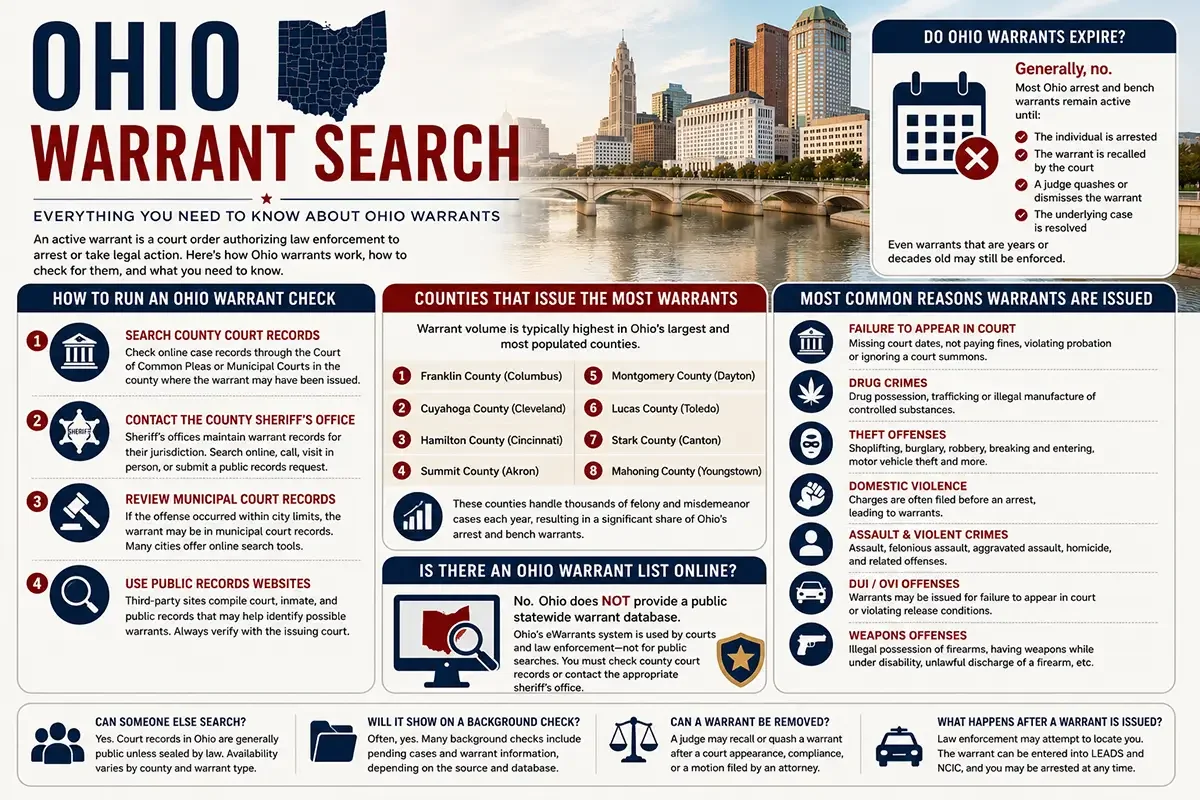
Most Common Reasons Criminal Court Orders Are Issued
Ohio courts issue judicial orders for virtually any alleged violation of state law when there is enough legal justification to proceed. While these court-authorized actions cover a wide range of criminal offenses, there are several categories that consistently account for the majority of arrest orders issued throughout the state. In many cases, a judge will authorize the order after reviewing the available evidence, determining if probable cause exists that a crime has been committed. These orders can also be issued if a defendant has failed to comply with a previous court directive. The following are the most commonly issued criminal orders in the state.
Failure to Appear in Court
One of the leading reasons criminal court orders are issued in Ohio is a defendant fails to appear for a scheduled court proceeding. Rather than stemming from a criminal allegation, these bench orders are issued after a person fails to comply with an existing judicial obligation. Common examples include missing: an arraignment, pretrial conference, motion hearing, or trial date. A judge may also issue an order when someone fails to pay court-ordered fines or restitution, violates the conditions of probation, or ignores an official court summons. Because courts rely on defendants appearing as scheduled to keep cases moving through the judicial system, these enforcement actions are among the most frequently issued throughout Ohio.
Drug Crimes
Drug-related offenses also account for a significant percentage of arrest orders issued across the state. These cases often involve allegations of: possessing controlled substances, trafficking illegal narcotics, manufacturing illegal drugs, or participation in the organized distribution or narcotics. In recent years, Ohio has upped their drug enforcement efforts targeting: fentanyl, methamphetamine, heroin, cocaine, and prescription drug abuse. This has resulted in thousands of criminal investigations each year. When investigators gather enough evidence, prosecutors will then seek judicial authorization giving law enforcement the authorization to take the accused into custody.
Theft Offenses
Property crimes are another top reason state and county courts authorize criminal arrest orders. These offenses range from relatively minor theft allegations to serious felony crimes involving substantial financial losses or violence. Theft cases frequently include shoplifting, burglary, breaking and entering, robbery, motor vehicle theft, identity theft, and financial fraud. Depending on the circumstances, investigators might spend weeks or months collecting surveillance footage, witness statements, forensic evidence, and other evidence before presenting the case to a judge for approval.
Domestic Violence
Domestic violence allegations also result in a high frequency of judicial orders. This is particularly true when criminal charges are filed before law enforcement has located or arrested the accused. Because these incidents often involve concerns about victim safety and the potential for continued violence, courts will move quickly once probable cause is established. Depending on the available evidence, additional protective orders or conditions of release might also be imposed after an arrest has been made.
Assault and Violent Crimes
Assault and other violent offenses represent some of the most serious criminal charges handed out in the state. Arrest orders are commonly issued for allegations of: simple assault, aggravated assault, battery, homicide, kidnapping, armed robbery, and other felony crimes involving bodily injury or the threat of violence. Violent crime investigations usually require extensive evidence gathering, witness interviews, surveillance, forensic testing, and/or medical reports before judicial approval will be granted.
OVI and Impaired Driving Offenses
Impaired driving offenses, commonly known as Operating a Vehicle Impaired (OVI) or DUI, often lead to Ohio arrest warrants being issued. While many OVI cases begin with a traffic stop and arrest, court-authorized enforcement actions may later be issued if the offender fails to appear for a scheduled hearing, violates the terms of pretrial release, and ignores sentencing requirements. In these situations, a judge might authorize law enforcement to locate and return the individual to court so the criminal proceedings can continue.
Weapons Offenses
Violations involving firearms and other illegally obtained weapons also account for a significant number of criminal arrest orders issued throughout the state. These cases commonly involve unlawful possession of a firearm, having weapons while under disability, carrying a concealed weapon illegally, unlawful discharge of a firearm, or the use of a weapon while committing a crime. Given the significant public safety concerns with these types of allegations, judges will usually authorize prompt enforcement once prosecutors establish sufficient legal grounds to proceed.
Do Ohio Warrants Ever Expire?
Generally they do not. Generally they do not. Most arrest warrants and bench warrants issued in Ohio remain active indefinitely until the underlying legal matter has been resolved. Unlike many criminal offenses that are subject to statutes of limitations before charges are filed, a judicial order that has already been issued does not typically expire simply because a certain amount of time has passed. In many cases, these orders remain enforceable for years, or even decades, until the person of interest is taken into custody or the court formally withdraws the order.
Most Ohio Warrants Remain Active Until One of the Following Occurs:
The individual is arrested and taken into custody by an officer of the law.
The warrant is recalled, or quashed by the issuing court judge.
A judge quashes or dismisses the judicial order via legal petition .
The underlying criminal matter is resolved to the court’s satisfaction.
One important exception involves search warrants. Unlike other court orders, these are subject to strict execution deadlines established by the issuing court. The general rule is they need to be executed within the time period authorized by the judge, after which they expire if they have not been served. If investigators still need more time after that deadline has passed, they must go through the process and obtain a new judicial authorization before proceeding with their search.
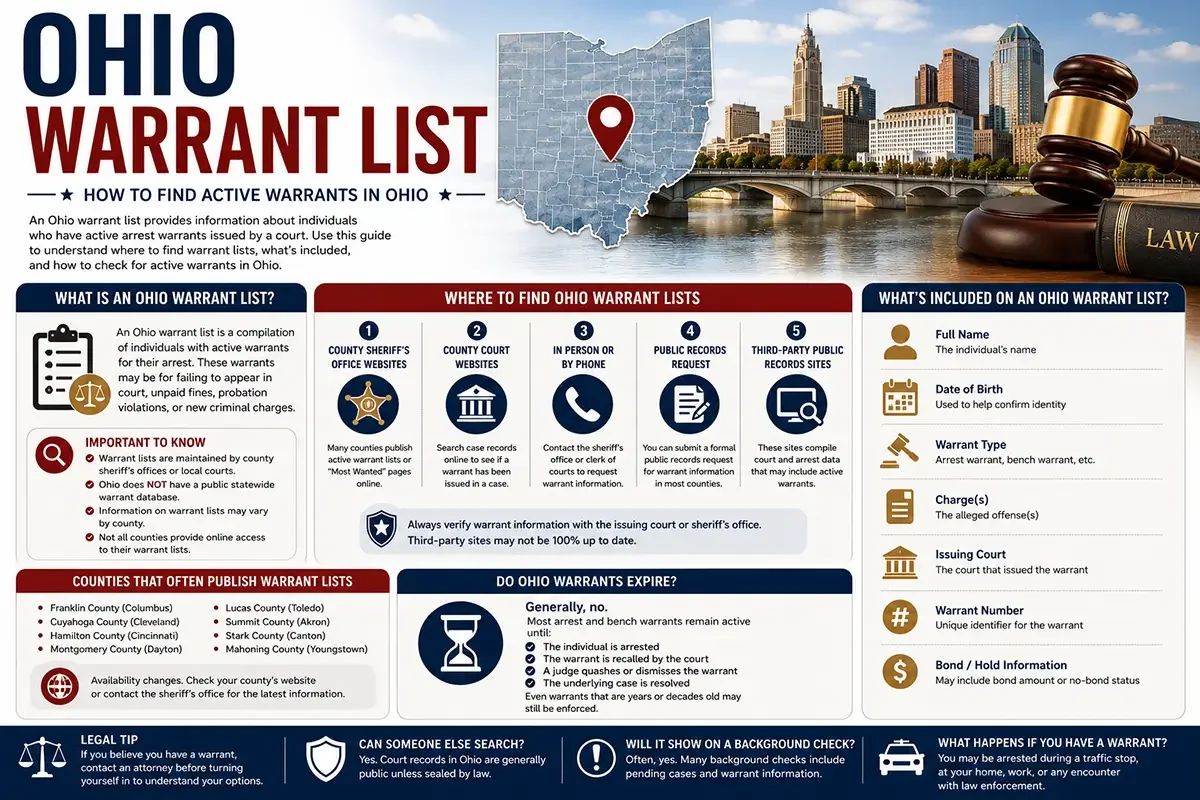
Does Ohio Have a Statewide Warrant List?
Ohio does not provide a public statewide warrant database where residents can search every active criminal or civil judicial order. These records usually need to be researched through the respective county or municipal district.
Although Ohio operates an electronic real-time system (eWarrants) which is designed for courts and law enforcement agencies, is not publicly accessible. The system greatly improves communication between county and state courts, LEADS, as well as the National Crime Information Center (NCIC). However, citizens of the public cannot perform statewide searches through it.
Counties That Issue the Most Warrants in Ohio
Ohio does not publish annual statewide rankings of active warrants issued by each county. However, because the volume of criminal court orders generally follows population size and criminal caseloads. The largest counties consistently process the greatest number of criminal cases and, consequently, issue many of the state's criminal judicial orders.
These Counties are the Largest Counties By Population:
Franklin County (Columbus) - Over 1.3 million residents
Cuyahoga County (Cleveland) - Over 1.2 million residents
Hamilton County (Cincinnati) - Over 800 thousand residents
Summit County (Akron) - Over 500 thousand residents
Montgomery County (Dayton) - Over 500 thousand residents
Lucas County (Toledo) - Over 400 thousand residents
Stark County (Canton) - Over 300 thousand residents
Mahoning County (Youngstown) - Over 200 thousand residents
These counties handle thousands of felony and misdemeanor criminal cases each year, resulting in a significant share of Ohio's arrest and bench orders. While these numbers do fluctuate, this list of counties processes the majority of the state’s criminal convictions.

Ohio Warrants - FAQs
Will an Ohio Warrant Show Up on a Background Check?
Typically yes. The majority of criminal background checks will show arrest records, court records, active warrants, convictions, sentencing records, incarcerations, and various other public records. However, the information included in a background screening may vary depending on the screening company, and the reporting database that is used.
Is there a free Ohio warrant search?
Some county courts and sheriff's departments provide free online case searches or warrant information. Because Ohio does not maintain a statewide public record database, searches typically must be performed through the county court where it was originally issued.
Can an arrest order be removed without being arrested?
Sometimes. A judge may recall or quash an arrest order after a court appearance, compliance with court orders, or a petition filed by an attorney. Whether this is possible depends on the type of criminal allegations, and the facts of the case.
How long does a bench order remain active in Ohio?
A bench order generally remains active indefinitely, until a judge recalls it, the individual appears before the judge, or the underlying legal matter has been fully resolved. Simply waiting for time to pass will not cause the order to expire, as they are not bound by statutes of limitations.
What happens after a judge signs an arrest order?
After the judge signs the order, it is entered into local and state law enforcement databases and, or national criminal justice systems for felony crimes. Officers will then attempt to locate the individual at their residence, workplace, or any place they might be located. The person of interest will then be detained and jailed until their arraignment in court.