

South Dakota Warrants
🔷
South Dakota Warrants 🔷
South Dakota Warrant Guide
If you believe there may be an active warrant issued in your name, or you're searching for public information about someone else, it's important to understand how South Dakota's warrant system works. Arrest warrants can remain active for years, and in many cases they do not expire until the underlying criminal matter has been resolved.
This guide explains how warrants are issued in South Dakota, how to search for active arrest orders, what counties execute the most arrests, and what steps you should take if you discover that a warrant has been issued in your name.
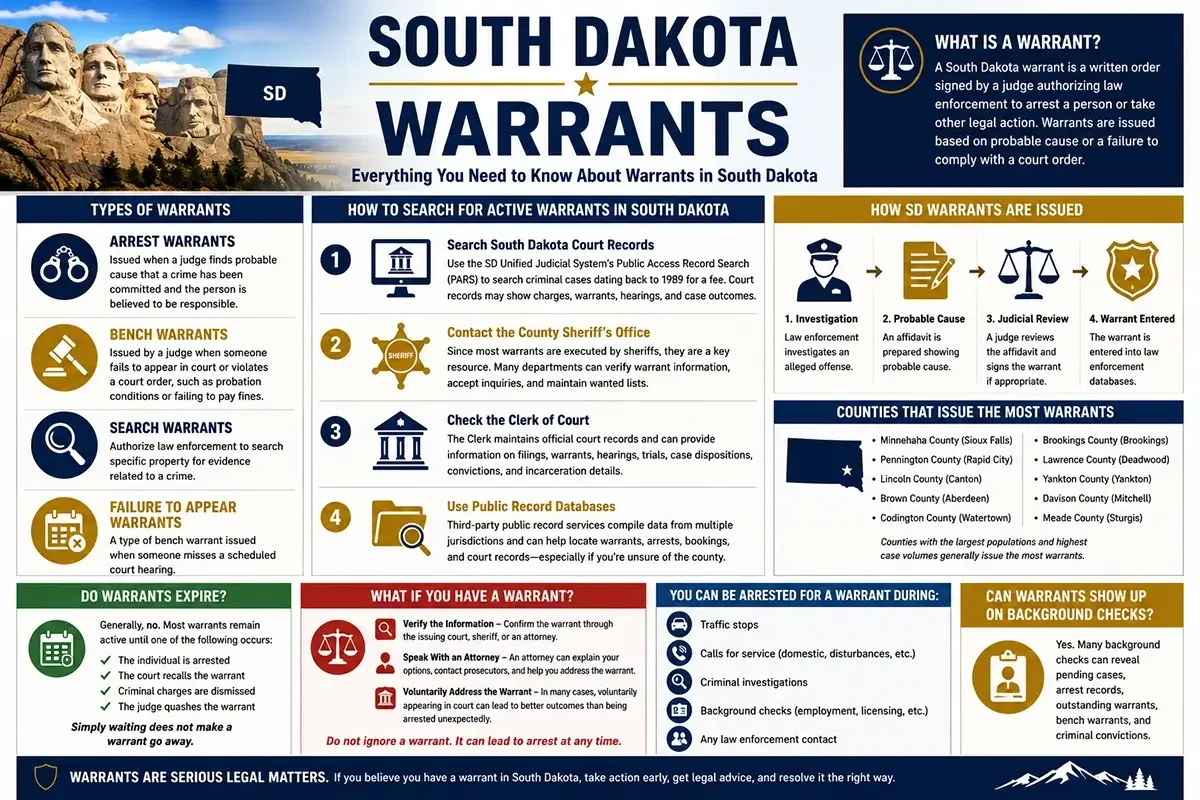
How SD Warrants Are Officially Issued
In South Dakota, arrest and bench warrants are only issued by a judge or magistrate after certain legal requirements have been met, as the state follows constitutional requirements.
A judicial arrest order is only issued when a law enforcement officer or prosecutor presents sufficient evidence to clearly establish probable cause that a crime has been committed and that the accused person was involved. The judge reviews a sworn complaint, affidavit, or other supporting evidence, and if probable cause exists, will sign the order authorizing law enforcement to take that person into custody. Once issued, the judicial order is entered into law enforcement databases and often served anywhere within the state and, in some circumstances, in other states.
A bench order follows a different process because it originates directly from the court rather than a criminal investigation. A judge may issue a bench order when someone fails to appear for a scheduled court hearing, violates the conditions of probation, fails to comply with an existing court order, or has overdue court-ordered fines. Unlike arrest orders, these are often based on civil violations rather than new allegations of a criminal offense. Both types of judicial orders generally remain active until the individual is arrested, voluntarily appears before the court, or the issuing judge recalls or quashes the order.

How to Search for Warrants in South Dakota
Because South Dakota does not maintain a free statewide database of active arrest warrants, the best way to search is through the appropriate county court or county sheriff's office where the court issued arrest order may have been issued. Many counties provide online case searches or can verify warrant information by phone or in person.
If you're unsure which county to begin your search in, consider starting with a reputable third-party public records website. These services allow you to perform a statewide search, which may help identify the county where an active arrest order or related court case exists. Once you know the issuing county, you can verify the information through the corresponding court or law enforcement agency.
1. Search South Dakota Court Records
The SD Unified Judicial System provides access to criminal court information through its Public Access Record Search (PARS). For a nominal fee, users can search criminal case records dating back to 1989, offering one of the most comprehensive public resources for researching court activity throughout the state. If you're trying to determine whether an arrest order may have been issued, this statewide database is often the best place to begin your search.
Court Records May Indicate:
Criminal Charges – View the criminal offenses filed against a defendant, including felony, misdemeanor, and traffic-related cases.
Pending Criminal Cases – Determine whether a criminal matter is still active and awaiting future court proceedings.
Bench Warrants – Identify bench orders issued by a judge after an individual fails to comply with a court order, such as missing a scheduled hearing.
Arrest Orders - In some cases, court records may indicate that a judge has issued an order for someone’s arrest based on probable cause or criminal allegations.
Court Hearings - Review scheduled court dates, hearing history, and other judicial proceedings associated with the case.
Case Dispositions - See how a case was resolved, including dismissals, guilty verdicts, plea agreements, sentencing, or other final judgments.
Because it searches court records from counties throughout the state, the PARS system is often the most effective starting point when researching criminal-related court activity.
2. Contact the County Sheriff's Office
Since the majority of court ordered arrests are executed by county sheriff's offices, these are excellent starting points for your research. You’ll need to know the person of interest’s full name and date of birth for most county searches. Availability of public access to records may vary by jurisdiction.
Since most court-issued arrest warrants are executed by county sheriff's offices, contacting the respective sheriff's department is another way to verify whether an active arrest order exists. If you know the county where the alleged offense occurred or where the case was filed, the sheriff's office can provide guidance on the availability of criminal related information.
Most departments will require the person's full legal name and the date of birth to run a search. Public access policies vary by county, which means the amount of information available may differ between jurisdictions.
Many South Dakota Sheriff's Departments:
Verify Arrest Information by Phone – Many sheriff's offices will confirm whether a judicial order for arrest exists, although they may limit the details they provide.
Accept In-Person Inquiries – Members of the public can visit the sheriff's office to request warrant-information or inmates currently jailed in their detention facility.
Maintain Online Wanted Lists – Some counties publish online lists of persons who are currently wanted by the state and county for alleged criminal offenses.
Publish "Most Wanted" Fugitives – The state’s Department of Corrections, and many sheriff departments will publish “Wanted Fugitives”, sought for serious crimes, or those with outstanding felony warrants.
3. Check the Clerk of Court
Each South Dakota county has a Clerk of Court that’s responsible for maintaining official court records and assisting the public with access to judicial documents. If criminal charges have already been filed, the Clerk of Court may be able to provide information regarding the status of the case and related court documents.
The Clerk's Office May Assist With Access To:
Criminal and Civil Court Records – Search case files, docket information, convictions, sentencings, and publicly available court documents.
Court Filings – Review complaints, motions, affidavits, and other legal documents filed with the county court.
Arrest and Bench Orders – Determine whether judicial orders have been issued as part of a civil or criminal case.
Court Hearings and Trial Dates – Confirm upcoming hearings, scheduled trials, and other court appearances.
Case Dispositions – View the final outcome of criminal proceedings, including convictions, dismissals, sentencing, or probation orders.
Incarceration Information – In some cases, court records may make public the sentencing information for various state and county correctional facilities.
The Clerk of Court can also assist in finding the appropriate court division or agency if additional records are maintained in another jurisdiction.
4. Use Public Record Databases
Public records databases can be another convenient starting point when researching active judicial orders, criminal cases, or arrest records. These services compile publicly available information from multiple courts, correctional facilities, and government agencies into a single searchable database, allowing users to search statewide or even nationwide using only a person's name.
They are particularly useful if you are uncertain which county or state issued an arrest order, as they can help identify the correct jurisdiction before contacting the issuing court or sheriff's department for verification.
These Services Commonly Provide Access To:
Criminal Court Records – Locate criminal records, court cases, and related judicial filings from multiple jurisdictions.
Outstanding Warrants – Search for publicly available records indicating active arrest, bench, or capias orders.
Arrest Records – Access to a person’s arrest history, booking dates, arresting agencies, and criminal charges.
Booking Records – Access jail booking information, SD mugshots, inmate records, and release status when available.
Court Dispositions – View the outcome of criminal cases, dismissals, convictions, plea agreements, and sentencing.
Background Records - From vital records including birth, marriage and divorce records, to criminal records, driving records, property records, and some financial records.
Although public record databases are convenient research tools, the information they contain may not always be current. Any information obtained should be verified directly with the issuing government agency before relying on it for legal, employment, or personal decision-making.

Counties That Have the Most Warrants in South Dakota
While the state does not publish a statewide ranking of warrants by county, those with the largest populations, highest criminal case volumes, and busiest court systems generally issue the greatest number of arrest and bench orders each year. While the exact number fluctuates over time, the following counties consistently handle the largest volume of criminal filings in the state.
Minnehaha County (Sioux Falls)
With an estimated population of approximately 220,000 residents, Minnehaha County is the state’s most populous county and home to the largest city, Sioux Falls. As a result of this large population, it processes the highest volume of criminal cases, making it one of the counties most likely to issue the largest percentage of judicial orders in the state.
Pennington County (Rapid City)
Pennington County has an estimated population of around 117,000 people and includes Rapid City, the second-largest city in the state. The county's active court system and significant law enforcement presence contribute to a significant number of criminal filings and bench orders each year.
Lincoln County (Canton)
Home to roughly 81,000 residents, Lincoln County is one of the fastest-growing counties. Its rapid residential and commercial growth has led to an increasing number of court cases and court order issues, particularly in communities bordering the Sioux Falls metropolitan area.
Brown County (Aberdeen)
Brown County has an estimated population of approximately 39,000 residents and is a regional hub for the northeastern part of the state. Its circuit court regularly handles felony, misdemeanor, and traffic-related criminal matters.
Codington County (Watertown)
With a population of around 29,000 people, Codington County is home to Watertown which has a very active judicial system also serving the northeastern area. The county processes a steady volume of criminal prosecutions and court proceedings throughout the year.
Brookings County (Brookings)
Brookings County has around 37,000 residents and is home to SD State University. Along with permanent residents, the county has a large student population, resulting in a busy court docket for criminal, traffic, and municipal cases.
Lawrence County (Deadwood)
Lawrence County, with a population of approximately 28,000 people, includes the historic communities of Deadwood and Spearfish. Tourism, gaming, and seasonal fluctuations in it’s population lead to a steady caseload handled by the county's courts.
Because they have the largest populations and the busiest criminal court systems, these counties consistently issue the highest number of judicial orders in the state. Together, they account for a significant percentage of the SD warrants issued across all 66 counties statewide.
What It Means to Have an Arrest Warrant?
A South Dakota arrest warrant is a written order signed by a judge that empowers law enforcement to arrest and detain a person accused of committing a criminal offense or violating a court order. These judicial orders are only issued after a probable cause has been determined by a judge that a crime has been committed. While these are still allegations until the person of interest is found guilty in court, there is a high likelihood that person will be convicted.
An Arrest Order Typically Includes:
1). The person's full name, including middle and any aliases
2). The alleged criminal offense, including the location, date and time if available
3). The county or state court that issued the arresting order
4). The judge's name, respective court, signature and date
5). Instructions authorizing law enforcement to take the individual into custody
Once issued, the court order is entered into state and county law enforcement databases and may be served anywhere within the state, and in felony cases, outside the state. Since they are considered public records, these are searchable by anyone without needing permission, or having to divulge personal information for an inquiry.

South Dakota Warrants - FAQs
Do South Dakota Arrest Warrants Expire?
Generally, they do not. As there are no expiration dates or limitations on arrest orders, they stay in effect indefinitely, or until they are effectively removed by a judge.
Most Remain Active Until One of the Following Occurs:
The person of interest is arrested or voluntarily surrenders
The issuing judge recalls or quashes the order
Criminal charges are dismissed or dropped for various reasons
The underlying legal issues have been resolved to the satisfaction of the court.
What Happens If an Arrest Order is Issued in Your Name?
If law enforcement discovers that an active arrest order has been issued in your name, you may be taken into custody during virtually any interaction with police. This commonly occurs when an officer comes to look for you at home, work, or runs your license plate number while driving.
What happens after your arrest depends on the type of judicial order that was issued and the circumstances surrounding the case. Police may apprehend and transport you directly to the county jail for booking, or hold you in custody until you appear before a judge for a bond or initial appearance hearing. The procedures can vary quite a bit depending on whether the court order involves a felony, misdemeanor, or bench warrant, as well as the policies of the issuing county.
Can South Dakota Warrants Show Up on Background Checks?
Yes. In many cases, an active SD warrant may appear on a criminal background check, depending on the type of screening being conducted and the reporting practices of the background check provider. Employment, licensing, housing, and security screenings often include publicly available criminal justice information such as pending criminal cases, arrest records, outstanding judicial orders, and criminal convictions. However, the exact information reported can vary based on the background check service, the databases they search, and any applicable state reporting laws.
Can You Be Arrested Outside South Dakota?
Yes. Many of the state’s arrest orders are entered into state and national law enforcement databases, allowing officers in other states to identify wanted persons during enforcement encounters. Whether a wanted person is arrested and extradited back to South Dakota depends on several factors, including the seriousness of the alleged criminal offense, the extradition request, and interstate extradition laws. In general, felony arrest orders are more likely to result in extradition than minor misdemeanor offenses, although each case is evaluated on its own circumstances.
Can I clear a warrant without being arrested?
In some cases, yes. Depending on the type of judicial order and the circumstances surrounding the legal situation, an attorney may be able to arrange a court appearance or request that the judge recall or quash the arrest order without the individual being arrested. While it is possible, the percentages are relatively low when there are serious criminal allegations.
Are judicial orders considered public record?
In many cases, yes. Judicial orders and related court records are generally considered public information unless they have been sealed by the court or are otherwise protected from disclosure under state or federal law. Public access allows anyone to review public criminal and civil court proceedings, although the availability of specific records may vary by county.