

Pennsylvania Warrant Check
🔷
Pennsylvania Warrant Check 🔷
Pennsylvania Warrant Search Guide
If you’re trying to find out whether you have an active warrant in Pennsylvania, start with the court that handled the case. If you don’t know which court that was, use the PA Judiciary’s free Case Search to look up the case by name, docket number, or citation number. Once you find the right record, you’ll have a court and a case number to reference when you call to confirm the current status.
There’s a difference between finding an old docket entry and finding an outstanding judicial order. Say you missed a hearing, then went to court a week later. The case docket may still show the original bench warrant alongside a later entry showing what happened to it. Here’s how to find those PA court records, what to look for, and when it makes sense to call the county.
Is There a Statewide Warrant Database in Pennsylvania?
Yes. The Unified Judicial System has a Statewide Warrants service that requires an approved secure login. The public can use the same judiciary website to look up court cases for free. Public docket sheets cover Magisterial District Courts, criminal cases in the Courts of Common Pleas, Philadelphia Municipal Court, and the appellate courts. For most people, the public case search is the best statewide starting point.
A public docket is a timeline of activity in a court case. You may see an entry for an arrest order or a bench warrant, along with later court activity. Recent filings can take time to appear, and some cases or entries are restricted. The state’s criminal procedure rules also allow temporary delays in releasing certain arrest warrant information for good cause. If a deadline or court date is involved, follow up with the court even if your online search comes back empty.
How to Run a Pennsylvania Warrant Search for Free:
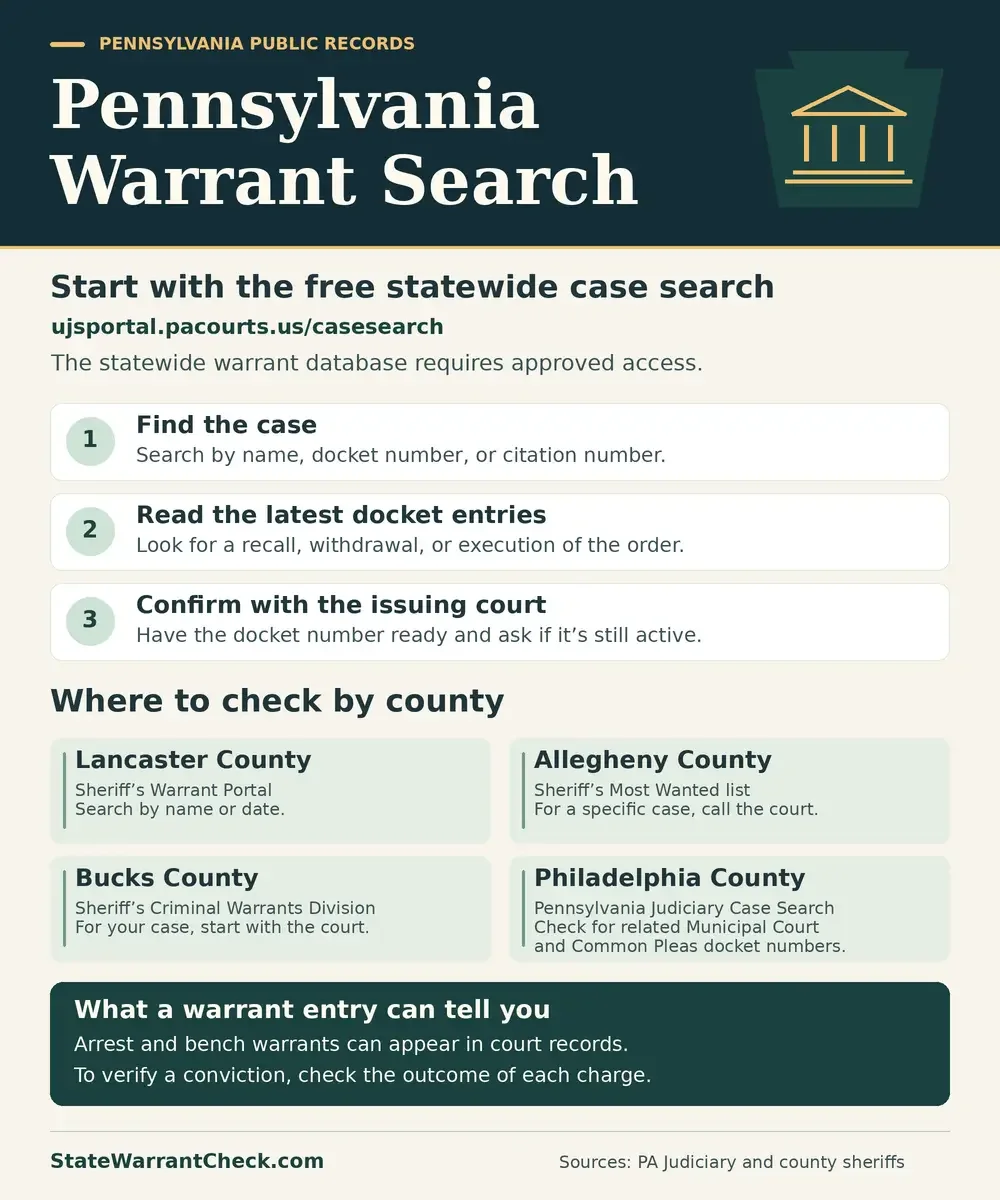
1). Open the PA Case Search: If you have court paperwork, start with a docket number and enter the number as printed. For a ticket, using the citation number.
2). Search by Name if You Don’t Have a Case Number: Select person’s name and enter the first and last name. Add a date of birth if you know it. If you’re sure where the case was filed, use the county filter to narrow the results.
3). Open the Docket Sheet and Verify the Match: Compare the county, court office, filing date, and any criminal charges against what is known. If multiple people share the same name, use the case or citation number to pin down the right record.
4). Read Past the first Warrant Entry: Look for any later entries about a recall, withdrawal, or execution. If the document says the court order was executed, that means it was carried out, or executed. Check whether later entries refer to the same order or a new one.
5). Ask the Issuing Court to Confirm the Current Status: Have the docket number ready. Ask whether the order is still active, what triggered it, and whether there’s an upcoming hearing or another step the court requires.
If all you have is a first and last name, start with a broader search before narrowing it down. You may remember getting a ticket near a particular city, while the paperwork lists a different municipality or court office. It’s also possible that a criminal case can have both a municipal court docket and a related common pleas docket. Check the cross court docket number field to see whether the two records refer to the same PA court case.

How to Look Up Warrants by County in Pennsylvania
Start with the county where the ticket was issued or the case was filed. If the paperwork names a Magisterial District Court, call that office. For a Common Pleas criminal case, the county Clerk of Courts is a good starting point for finding the record and identifying whom to contact. The sheriff’s office may have a separate warrants division, especially if the county publishes wanted notices or maintains its own public lookup. When you call, you can keep it simple. “I’m checking on docket number [case number]. The docket shows an order was issued on [date]. Can you tell me whether it’s still active and which office handles the next step?” If the court says it was recalled, ask how to get a copy of the order or an updated docket for your records.
Examples of Where to Search by County:
Lancaster County — Search by name using the Sheriff’s Warrant Portal. You can also filter by date or limit the search to local warrants.
Allegheny County — The sheriff’s Most Wanted list highlights selected fugitives. For a specific case, check the court record and follow up with the issuing office.
Bucks County — The sheriff’s records search page lists contact information for the Criminal Warrants Division. If you’re checking the status of a warrant in your own case, start with the issuing court.
Philadelphia County — Start with the state’s Judiciary’s Case Search and check for related Municipal Court and Court of Common Pleas docket numbers.
Common Types of Outstanding Judicial Orders
The type of judicial order can tell you why the county court or law enforcement agency is looking for someone. Here are the main categories to look for in court records and county resources.
PA Arrest Warrants on Criminal Charges
An issuing authority can authorize an arrest order based on probable cause supported by sworn affidavits. This is the kind of order you may encounter when police file a criminal complaint and seek to take a person into custody. The complaint identifies the allegations, and the case proceeds through the courts after the arrest. Pennsylvania Rule of Criminal Procedure 513
PA Bench Warrants for Missing Court
A bench order often comes up after a missed appearance in an existing case. For example, a person who receives a summons for a preliminary hearing and fails to appear may have an order issued for their arrest. In certain summary cases, failing to respond to a properly served citation can also trigger one. Once the order is executed in a court case, PA court procedures provide procedures for a bench warrant hearing.
Judicial Orders Involving Fines or Court Costs
Some outstanding judicial orders trace back to a summary case, including certain traffic cases. Rule 430 allows a bench order in specified situations involving unpaid fines, costs, or restitution. For the payment-related situations covered by the rule, the court must first give the required notice and allow 10 days for a response. If you find an entry tied to a balance due, ask the court whether it requires a hearing, a payment arrangement, or another step to clear the order.
Probation or Parole Violation Orders
A person who is already under supervision can face an arrest or a detainer for an alleged criminal violation of their probation or parole, such as failing to report in. A detainer can affect whether someone is held while the alleged violation is addressed. If this points to probation or parole, check with the office supervising the case or with the attorney handling it.
You may also hear the term search warrant, which authorizes law enforcement to search for evidence. For a lookup about whether a person can be taken into custody, focus on arrest warrants, bench warrants, and any supervision-related orders tied to the person’s case. This is thoroughly outlined in the Pennsylvania Rule of Criminal Procedure 203
Do PA Warrants Show Up on Criminal Background Checks?
Sometimes a bench or arrest order, or the court case behind it, may appear in a background report built from publicly available court records. It really depends on the records the provider background checks and how recently it pulled them. A report might show an open charge or an old warrant entry with little context. Use the docket number to pull the case directly, then ask the court clerk about the status if the report leaves any question. Pennsylvania Judiciary Case Search Notes
The Pennsylvania State Police run the official state criminal history check through Pennsylvania Access to Criminal History, also called PATCH. It checks information against the State Police’s criminal history repository. PA law limits what the State Police disclose in these checks, including some older arrest entries without a disposition or indication of a pending prosecution, as well as records subject to certain limited-access orders. A PATCH result answers a criminal history question. For confirmation that an arrest order is currently active, check with the issuing court or agency.
How Does an Arrest Warrant Lead to a Criminal Conviction?
A warrant for someone’s arrest can bring a person into court to answer charges. In a typical misdemeanor or felony case that starts with an arrest, the person goes before an issuing authority for a preliminary arraignment, where they receive the complaint and bail may potentially be addressed. At a preliminary hearing, if one is held, the court decides whether the prosecution has presented enough evidence for the criminal charges to move forward. A conviction can follow if the court accepts a guilty plea or if a judge or jury finds the person guilty beyond a reasonable doubt. Charges can also be dismissed or withdrawn, and a trial can also potentially end in acquittal.
A bench warrant for missing a court appearance can show up at a different point in the process. For example, a person could already have a guilty disposition in a summary case, then have a bench order issued after failing to pay court-ordered costs and failing to respond to the required notice. In that specific situation, the guilty disposition and the later judicial order are two separate events. When you’re trying to find out whether someone was convicted, look at the disposition for each charge. A single case can contain several charges with different outcomes.

Pennsylvania Warrant Check - FAQs
Can I run a Pennsylvania warrant search for free?
Yes. Pennsylvania’s public Case Search lets you look up court cases and view available docket sheets for free. You can search by name, docket number, or citation number. If you find an active warrant entry, check the later court activity and contact the issuing court to check whether it’s still active.
Is there a statewide list for warrants in Pennsylvania?
Yes. The Pennsylvania Judiciary has a Statewide Warrants service, but access requires an approved secure login. For a public search, start with the statewide court case lookup. Once you find the case, you can follow up with the court or county agency handling it.
Can I look up PA court records with just a name?
Yes. Select the “Participant Name” and enter the person’s first and last name. If you know their date of birth or the county where the case was filed, use those details to narrow things down. Compare the results carefully, especially when searching for someone with a common name.
What if I don’t know which county to search?
If you don’t know what county to search, start with the statewide public case lookup and leave the county filter open if the search allows it. When you find a matching case, write down the county, court office, and docket number. That gives you a starting point for checking the record and contacting the right office.
What is the difference between an arrest and a bench warrant?
An arrest order on a criminal allegation generally allows officers to take someone into custody based on probable cause that is established with the courts. A bench order often comes up after someone misses court or fails to follow a requirement in an existing case. The docket and the actual order can help you find out why it was issued.
Who can issue an arrest order in Pennsylvania?
A judicial issuing authority, such as a district judge, can issue an arrest order. When it’s based on a criminal allegation, the application generally needs sworn information establishing probable cause. Orders tied to a missed appearance or failure to follow a court directive follow different procedures.
Can missing a court date lead to a bench warrant?
Yes. Depending on the case, missing a required appearance can lead to a judicial bench order. If you missed a hearing, contact the court with your docket number and ask what happened. Find out whether an order was issued and what steps the court requires to address it.
Can unpaid fines or court costs lead to a warrant?
Yes, in certain situations. Pennsylvania’s summary case rules include notice requirements and procedures for reviewing a person’s ability to pay. If you’re having trouble making a court payment, contact the office handling the case. Ask about a payment arrangement or a hearing to explain your financial situation.
How can I tell whether a court order is still active?
Start with the docket entry showing when the order was issued, then read the activity that follows. If the status is unclear, call the issuing court with the docket number and date of the order. If it was recalled or vacated, ask how to get a copy of that document for your records.
What does “warrant executed” mean on a court record?
It generally means the arrest order was carried out. Read the entries that follow to see what happened afterward, including any hearing, release conditions, or additional orders. The underlying case may still have charges or other requirements to resolve.
Does an empty online search mean I have no outstanding criminal records?
An empty search can happen for several reasons. Recent activity may not be posted yet, some criminal records might have restricted access, or the search details may need adjusting. If you received court paperwork that says differently, contact the court listed on those documents to check.
What is PATCH, and how do I request a PA criminal record check?
PATCH stands for Pennsylvania Access to Criminal History. It’s the State Police system for requesting a criminal history check against the state’s criminal records repository. You can submit a request through the official PATCH website. There’s also a mail-in option if you prefer to send the application.
Why would PATCH show “No Record” when I found a court case online?
PATCH and the public court lookup pull information from different database systems, so their results can differ. First, make sure to double-check the name and other identifying details you entered. If you still have questions, contact PATCH about the background check and the court about the case you found.
Does a “Request Under Review” mean someone has a criminal record?
That response typically means PATCH needs to review the information before issuing a final result. An initial match can require a closer look to determine whether the record belongs to the person you searched. Check the request status again once the review is complete.
How can I find out whether an arrest led to a criminal conviction?
To find a resulting conviction from an arrest, look up the specific criminal court case and check the disposition for each charge. You may see a guilty plea, a finding of guilt, a dismissal, withdrawn charges, or an acquittal. Read through all the charges because they can have different outcomes, even when they’re part of the same case.
Can I view sealed, expunged, or Clean Slate records online?
These cases generally won’t appear in the state’s public Case Search once the access restriction is applied. Access depends on the record and who is requesting it. If you need information about your own case, contact the court that handled it and ask how to request the documents available to you.
Why does a Philadelphia criminal case have two docket numbers?
Some Philadelphia cases start in Municipal Court and continue in the Court of Common Pleas. Each court can assign a docket number for criminal proceedings connected to the same incident. Check the “cross court docket number” field on the docket sheet to find the related record and follow the case’s later activity.
Where can I find the actual court order behind a docket entry?
Use the public case search to identify the court, docket number, and date of the order. Then contact that court’s filing office and ask how to get a copy. Depending on the document, there may be access restrictions or a fee for copies, especially if you need a certified copy.