

Pennington County Warrants
🔷
Pennington County Warrants 🔷
Pennington County Warrant Guide
Finding out that you may have a warrant in Pennington County can leave you wondering what happens next. Can you check the information online? Does a missed court date mean you could be arrested? And where do you start if you want to get the matter resolved?
The first step is to find out what the court issued and which case it belongs to. A judicial order connected to a criminal allegation serves a different purpose from one issued after a missed hearing, even though both can potentially lead to an arrest. An online public records search can help you begin that process of finding out, but the court and Sheriff’s Office are the places to confirm the details before deciding what to do.
This guide explains the main types, where to look for local warrant records, and practical steps to take when an active judicial order needs attention. Make sure once you find any information to verify it from the original source, as some third party resources may not have the most accurate or up to date information.
What Does it Mean to Have a Warrant?
A warrant is a court’s authorization for a person’s compliance in a civil legal matter, or for an arrest order, the courts authorize law enforcement to take a specific action, such as arresting someone or searching a particular location. What officers are allowed to do depends on the type of court order and its terms. The state’s Judicial System uses this distinction in its legal glossary.
For someone named in an arrest order, the immediate concern is that officers may take them into custody. However, being wanted in connection with a criminal case does not establish guilt. Defendants retain rights that include legal representation, remaining silent, and being presumed innocent until proven guilty. South Dakota criminal law questions.
Pennington County belongs toSeventh Judicial Circuit, with court offices in Rapid City. The reason the order was issued matters more than where you currently live: if the underlying case is in another county, you will need to follow up with that court. Seventh Judicial Circuit.

Arrest and Bench Warrants Explained
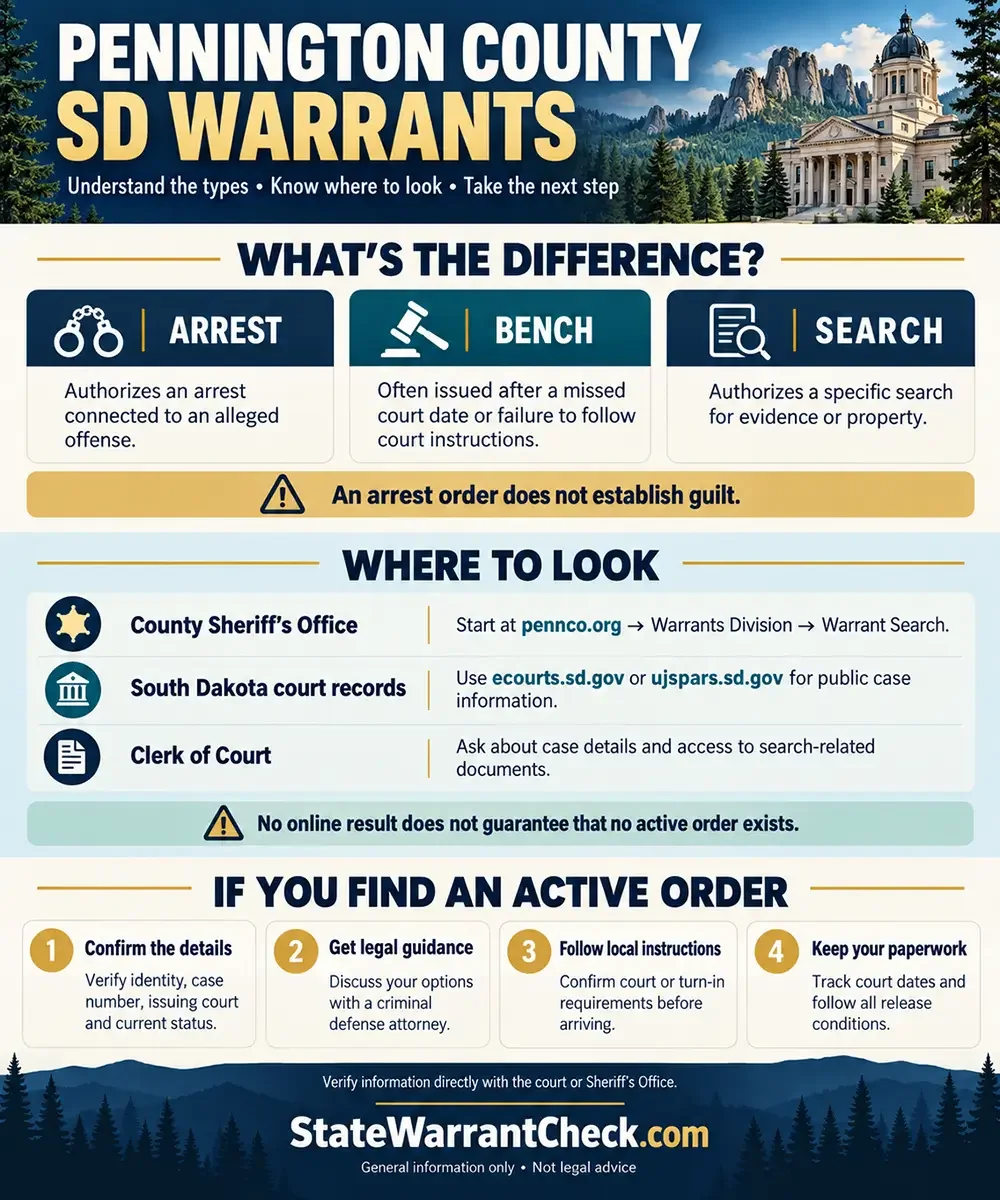
Arrest Warrants Usually Concerns an Alleged Crime
A Pennington County arrest warrant is most commonly connected to a criminal complaint generally following a finding of probable cause. In everyday language, that means there is a reasonable factual basis to believe a crime occurred and the person identified was involved. It is a lower standard than the proof needed for a criminal conviction.
State law provides for either an arrest order or a summons for circumstances described by its criminal procedures. A summons directs someone to appear in court; failing to respond can lead to an order for their immediate arrest. South Dakota law on complaints, warrants and summonses.
Bench Warrants Usually Concerns an Existing Court Matter
A bench order is issued by a judge, often because someone missed a required appearance or failed to follow a court’s instructions. The word “bench” refers to the judge’s position in court. It does not mean the order is merely a warning.
For example, someone who has already been released in a criminal case may miss the next hearing. The judge can respond by revoking release and authorizing an arrest under the applicable rules. South Dakota law expressly addresses arrest orders following a breach of release conditions. South Dakota bail provisions.
The practical difference is why the court wants the person brought in. One commonly starts with an alleged offense; the other commonly stems from something that happened while a case was already underway. A bench warrant can still be an arrest authorization, and neither label alone tells you whether immediate release will be available.
Missing court can also create a separate problem beyond the original charge. Under South Dakota law, failing to appear after release can result in forfeited security and an additional criminal charge, depending on the circumstances. SDCL 23A-43-31.
Search Warrants Serve a Different Purpose
A search warrant authorizes a search within the scope approved by the court. Its purpose is generally to locate evidence or property described in the order, rather than to bring someone before a judge. South Dakota’s search-and-seizure laws address probable cause, the contents of the specific authorization, and the records officers must return after carrying it out. South Dakota search-and-seizure provisions.
These documents are not something to expect in an ordinary Pennington County warrant search. To find a particular search authorization, start with the court handling the matter and ask which filings are available for public inspection.
How to Search For Pennington County Warrants
Start with the Sheriff’s Office
Open the Pennington County Warrants-Division page and expand “Warrant Search.” The county describes a name-searchable active list updated daily. For specific questions or a search that does not produce results, call the division directly @ 605-394-6117.
Check all identifying details carefully. A matching name alone is not enough to conclude that a record belongs to you or someone you know. Many people share the same first and last name. Write down any case number and issuing-court information shown so you can ask about the correct file.
Treat an online result as a starting point. A missing entry does not establish that no active order exists, particularly if the case originated elsewhere or the information has recently changed. Likewise, an older listing should be confirmed before you rely on it.
Use eCourts to Understand the Underlying Case
South Dakota eCourts provides summaries of most public cases. The UJS says that users can search by party name or case number after registering for a free account. This can help you connect a local listing to the court matter behind it. UJS court record access.
When reviewing a case, look at the dates and sequence of entries. An old reference to an arrest authorization does not, by itself, tell you its current status and if it’s still active. You can also inquire with the clerk to explain which records are available and how to obtain the relevant order if the summary leaves that unclear.
Consider PARS for a broader criminal record search
The state’s Public Access Record Search, commonly called PARS, provides public criminal case information and certain protection-order records. Its instructions ask for a person’s name and date of birth. At the time of research, each submitted search cost $20, including searches that returned no records.
PARS also cautions that the latest filings may not yet appear in the online docket. It should not be treated as a guaranteed, real-time clearance check. PARS instructions and disclaimer.
UJS states that unsealed criminal cases from 1989 onward are available through this service. Earlier records must be requested from the relevant clerk. The state also offers a no-fee records request form for qualifying applicants, including named parties to a case; that is a separate route from paying for a PARS search. Court records search options.
Ask the Court Clerk about Related Documents
If you need to lookup a search order, a supporting affidavit, or a list of seized property, ask the clerk about access to those specific documents. An affidavit is the written, sworn explanation supporting the request.
State law allows a court to seal a supporting affidavit under specified circumstances. That does not automatically make every related document unavailable: the statute also separately addresses the contents of the order, its return, and the inventory. The clerk can explain what is open for inspection in the particular matter. SDCL 23A-35-4.1.
Use the Correct Local Contact Information
The official Pennington County court directory lists the Clerk of Court at 315 St. Joseph Street, Suite 5, Rapid City. The Criminal Department number is 605-394-2570; the Civil Department is 605-394-2575.
A jail roster answers a different question: whether someone is currently listed in custody. It should not replace a check of an outstanding court order, that should be done separately. Similarly, a criminal background check should be verified against official records before you draw any conclusions about someone’s current legal situation.
What to Do If You Have an Active Arrest Order
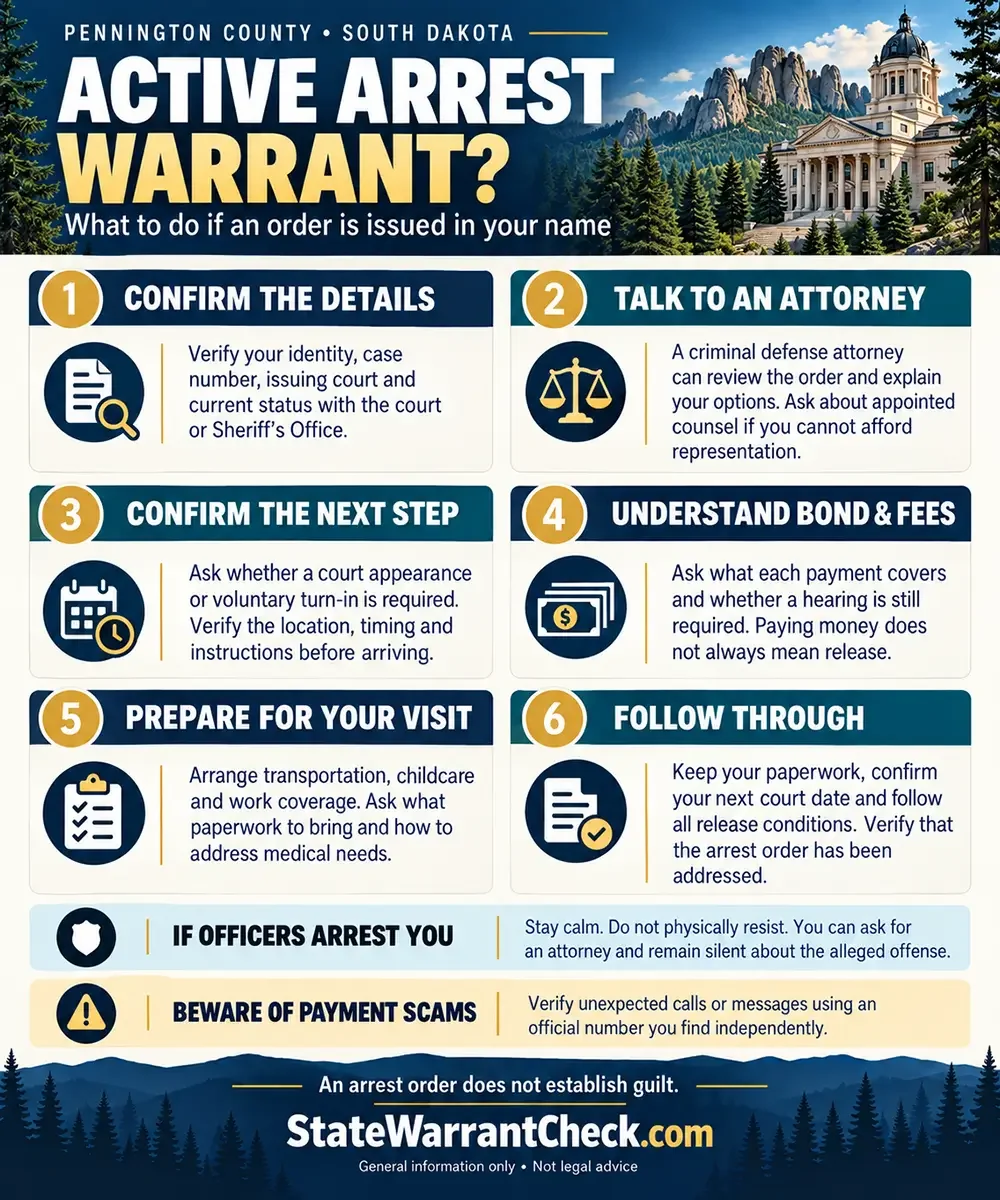
Confirm the Details Before Making Arrangements
Start by gathering all the relevant information you or an attorney will need to discuss the case:
1). All personal identifiable information and the specific case number.
2). The court that issued the order and the date it was issued.
3). The alleged offense, missed appearance, or other reason for issuance.
4). Whether it is still active and whether a bond has been set.
5). The required next step, including any appearance or turn-in instructions.
Keep copies of all notices, payment receipts, and previous court paperwork. If you believe there is a mistake, explain the discrepancy to your attorney and ask the court how to have the record reviewed. Avoid assuming that a receipt, a new hearing date, or a conversation with an office has automatically canceled the arrest authorization.
Talk With a Criminal Defense Attorney
A seasoned attorney can review the actual order and advise whether to request a hearing, seek withdrawal of the authorization, or arrange a voluntary surrender. If you missed court because of an emergency or a notice problem, gather supporting records for that discussion. Those facts may matter, but they do not guarantee a particular result.
If paying for representation is a concern, ask about applying for court-appointed counsel. Pennington County explains that eligibility depends on the type of proceeding and applicable right to counsel. Appointment is tied to particular files or violations, so do not assume an attorney from an older case automatically represents you in a new matter.
Confirm whether the local turn-in program applies
The Sheriff’s Office describes a weekday program with sign-up from 7:30 to 8:00 a.m., excluding holidays, for 10:00 a.m. court. Its published instructions list a cash-only, nonrefundable service fee per order and direct participants to the Warrants window at 300 Kansas City Street. It’s recommended to call first to confirm eligibility, timing, fees, and any additional requirements for your case. Participation should not be read as a promise of release. County turn-in instructions.
The jail separately says its scheduled self-turn-ins must be court ordered and arranged with jail staff. Because these are different sets of instructions, verify which process applies rather than choosing an arrival time yourself. Jail self-turn-in guidance.
Understand What a Payment Will Accomplish
Before paying, ask whether the amount is a bond, a fine, or a service fee, and whether a court appearance remains necessary. These payments serve different purposes.
The county notes that some payment-based resolutions involve authorizing a guilty plea and forfeiting the bond. Understand the consequences of any actions before signing. Warrants-Division guidance.
Pennington County Jail also explains that a “PSA” bond designation means no monetary bond is currently available for that charge. The booking assessment may lead to release on personal recognizance or detention for judicial review. If there are multiple charges, satisfying one bond does not necessarily allow release. County bail information.
Prepare for Your Appointment and Follow Through
Once you have confirmed the legal procedure, arrange for transportation and any necessary childcare or work coverage. Ask staff what identification and paperwork to bring and how to address any prescription medications or medical needs. It’s recommended to allow for the possibility that processing may take longer than expected.
If officers make an arrest, remain calm and do not physically resist. You can ask for an attorney and exercise your right to remain silent about the alleged offense. Legal objections are best raised through counsel and the court. UJS explanation of defendants’ rights.
After the appearance, keep the paperwork, confirm the next court date, and make sure you understand every release condition. Ask how to verify that the original order has been addressed. Resolving the immediate arrest issue may leave the underlying case still pending.
Be Careful With Court Scam Calls Demanding Payment
If someone is calling about an alleged court matter it may sound convincing, especially if they know your name or provide a case number. That does not establish that the call is legitimate.
The UJS warns about impersonators who threaten arrest or demand payment over missed jury duty or traffic matters. Do not send any money, reveal any sensitive information, or use unsolicited payment links. Find the court’s official contact information independently and verify the claim yourself. South Dakota court scam guidance.
Taking the Next Step
If you think a Pennington County warrant may involve you, begin with the official county search and the underlying court record. Confirm what is active, the type of court order, get advice about your options, and follow the procedure that applies to your case. A clear understanding of the paperwork can help you address the immediate issue and avoid missing another requirement along the way

Pennington County Warrant - FAQs
How can I check for an active warrant in Pennington County?
Start with the Pennington County Sheriff’s Office website and go to the “Warrant Search” section. You can search by first and last name, then confirm that any identifying details match the person you are checking. For questions about a listing, contact the division at 605-394-6117. It’s important to verify as many details as possible with your results as some people share the same name.
Do no results for a court records search mean I don’t have an active warrant?
Not necessarily. Online records may not reflect the latest filings, and the case could be in another jurisdiction. If you have received a notice or know you missed a hearing, follow up with the court handling that matter rather than relying on an empty search result.
What should I do if an active arrest order is issued in my name?
Confirm the case number, issuing court, and current status. It’s usually advisable to discuss your legal options with a criminal defense attorney who can help you understand the order and discuss the appropriate next step. Before appearing in person, verify the court or turn-in instructions that apply to your case.
Can I arrange to turn myself in voluntarily?
Pennington County publishes a morning court self-turn-in program. Contact the Sheriff’s Office directly to confirm whether your case qualifies and what the current requirements are. The jail also has separate instructions for scheduled, court-ordered reporting, so make sure you follow the correct legal procedure.
Can I resolve a bench warrant by paying a fine?
Sometimes, but payment does not have the same effect in every case. Ask whether you are paying a fine, or covering a service fee. Some county payment procedures involve submitting a guilty plea, so understand the consequences and any remaining appearance requirements before signing. Once you sign you may effectively limit your legal options. If you are uncertain, it may be advisable to consult with a legal professional or attorney.
Where can I search Pennington County court records online?
South Dakota’s eCourts system provides public access summaries of publicly available cases. The website allows searches by party name or case number. You must first register your name and email address to use it. It is a useful place to start when you want to follow a case or identify the court handling it.
Can I lookup court records for free?
Some access to certain records is free. Registration for eCourts is free, and public access terminals are available at county courthouses. UJS also provides a no-fee records request form for qualifying applicants, including named parties in a specific case. Other searches and document services may carry charges, especially for certified copies.
How much does a PARS criminal record search cost?
South Dakota’s Public Access Record Search, or PARS, currently charges $20 for each submitted search. Prices can change at any time for these services. The fee applies even when no records are found. Check the person’s name and date of birth carefully before submitting a request.
How far back do online criminal court records go?
UJS states that PARS provides publicly available, unsealed criminal case information from 1989 online. For an older court records that have not been digitized, request records directly from the local clerk. An online search should not be treated as a complete account of someone’s history before that date, older records may not be available online.
Does an arrest record mean the person was convicted?
No, an arrest and a conviction are different events legally. Someone may be arrested or charged without ultimately being found guilty in court. When reviewing an arrest or criminal record, check the case outcome rather than drawing conclusions from the original allegation alone. Defendants are presumed innocent until proven guilty throughout the United States.