

Maricopa County Warrants
🔷
Maricopa County Warrants 🔷
How to Search For Active Maricopa County Warrants
Running a Maricopa County warrant search has become a simplified process through both official and unofficial channels as these are considered public records throughout Arizona. Since these are deemed public information, it’s not necessary to get permission, or submit a special request to access these records. They can be accessed by anyone.
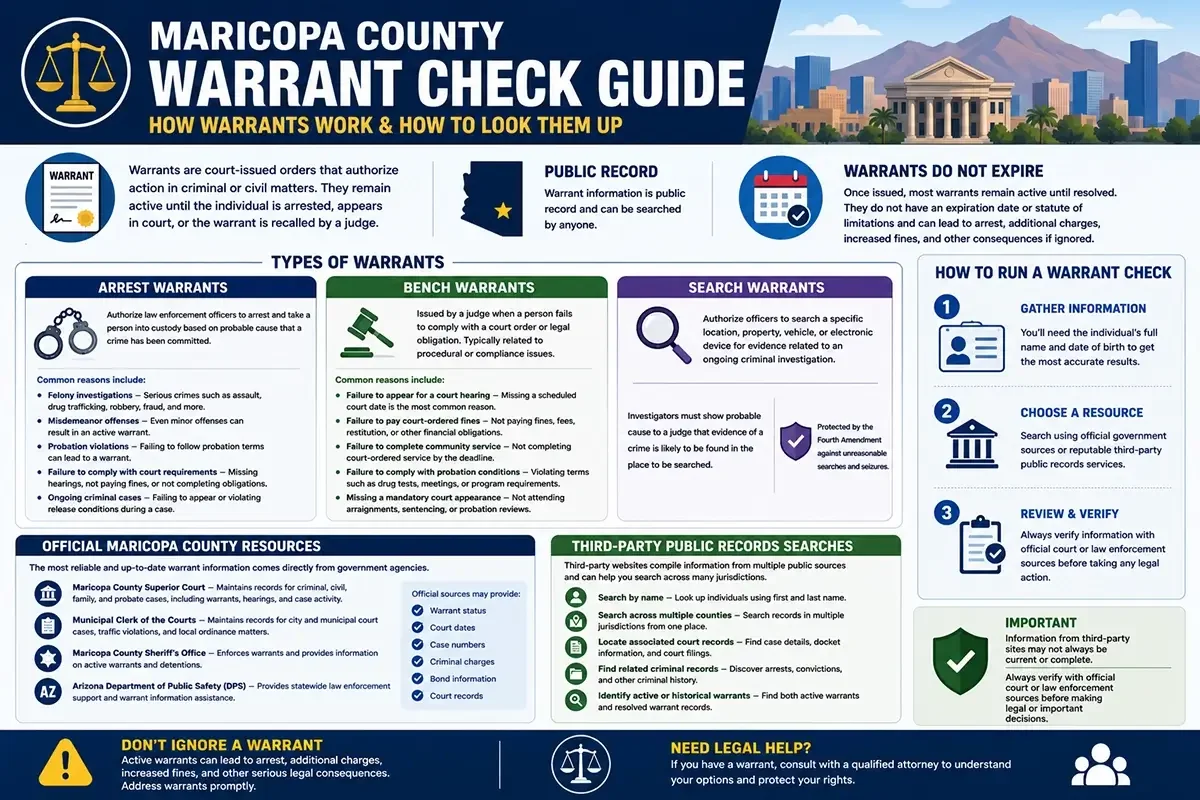
Warrants are essentially court orders issued by a judge that authorizes specific legal actions, such as making an arrest, conducting a search, or compelling an someone to appear before in court. In Maricopa County, Arizona, warrants are commonly issued when a person is suspected of committing a crime, fails to appear in court, violates the terms of probation, or neglects to comply with a court order. For the most part these are all publicly accessible, except for those sealed for privacy reasons or ongoing sensitive investigations.
Because warrants can lead to unexpected arrests and serious legal consequences, understanding how they work and how to conduct a Maricopa County warrant check can help people stay informed about their legal status and address outstanding issues before they escalate. Fortunately, performing a warrant search is a relatively simple process that can often be completed online in just a few minutes.
To begin, you'll typically need the individual's full name, date of birth, or court case number. Using official government resources or reputable third-party public records providers, you can quickly access available warrant information and determine whether any active warrants may exist.

What Are Warrants and Why Are They Issued?
A warrant is a court-issued order that authorizes a specific legal action in either a criminal or civil matter. Generally, these judicial orders fall into two broad categories: criminal orders and civil orders. Criminal orders, which are the most serious of the two, grant law enforcement the authority to take actions such as arresting an individual, conducting a search, or seizing property. Civil orders are generally less punitive and often involve matters such as compelling a court appearance, enforcing compliance with a court order, or collecting unpaid fines and fees.
Before a court ordered warrant is issued, a judge must review the facts, evidence, or legal circumstances presented and determine that sufficient grounds exist. In criminal cases, a judge must typically find probable cause that a crime has been committed and that the person or property named is connected to that criminal offense. This requirement is rooted in the Fourth Amendment of the United States Constitution, which protects individuals from unreasonable searches and seizures. Civil warrants and court orders are often administrative in nature and are generally issued when a person fails to comply with a legal obligation or court directive.
Arrest Warrants
A Maricopa County arrest warrant is a court-issued order that authorizes law enforcement officers to locate, arrest, and detain an individual who is suspected of committing a criminal offense. Before a judge can issue an arrest order, investigators or prosecutors must present sufficient evidence establishing probable cause that a crime has occurred and that the named individual was involved. Once approved, the arrest order grants law enforcement the legal authority to take the person into custody and bring them before the court to answer for their criminal allegations.
Most arrest warrants may stem from:
Felony Investigations - The most serious criminal allegations such as aggravated assault, burglary, drug trafficking, domestic violence, and homicide
Misdemeanor Offenses - Less serious crimes such as petty theft, simple assault, DUIs, criminal trespassing, and disorderly conduct
Probation Violations - Violations of probation orders, failing drug tests, missing required meetings, or committing a new criminal offense
Failure to Comply with Court Directives - Failure to comply with criminal court ordered directives, or failure to appear for a criminal hearing
Ongoing Criminal Cases - A defendant fails to appear in their court hearing, violates release conditions, or is non-compliant with court proceedings
Once issued, an arrest order remains active until the individual is arrested, appears before the court, or the warrant is formally recalled by a judge. They do not have an expiration date, or statute of limitations on how long they are effective. They only grow with legal complexity and heightened punitive consequences if not addressed promptly.
Once issued, an arrest warrant will remain active until the individual is arrested, voluntarily appears before the court, or the arrest order is formally quashed, recalled, or otherwise resolved by a judge. Unlike many other legal actions, these judicial orders do not expire after a set period of time, they can stay in effect indefinitely. If left unresolved, they will likely lead to additional legal complications, including new criminal charges, increased fines, bond restrictions, and driver’s license suspensions. For these reasons, anyone who discovers they have a warrant for their arrest is encouraged to address the matter promptly through the appropriate legal channels.
Bench Warrants
A Maricopa County bench warrant is a court-issued order signed directly by a judge when a person fails to comply with a court order or legal obligation. Unlike traditional arrest orders, which are based on allegations of criminal activity and require probable cause, bench orders are generally less punitive and issued for procedural violations that occur during an existing court case. According to the Maricopa County Superior Court, bench warrants are commonly issued when a person fails to appear for a scheduled court proceeding or otherwise fails to comply with a civil court directive.
Common reasons for bench warrants include:
Failure to Appear For a Court Hearing - Missing a scheduled hearing for minor offenses, misdemeanor cases, traffic violations, or probation review
Failure to Pay Court-Ordered Fines - When legal fees, court fines, restitution or other financial obligations are overdue and unpaid for a period of time
Failure to Complete Community Service - Not satisfying the court’s requirements for community service programs in the allotted time frame
Failure to Comply With Probation Conditions - Missing appointments with probation officers, failing drug tests, or incomplete counseling programs
Missing a Mandatory Court Appearance - Failure to make mandatory appearances such as arraignments, sentencing hearings, or probation reviews
Bench orders as a whole are considered civil or procedural violations rather than new criminal offenses. The good news is that many of the civil violations these are issued for can often be resolved by addressing the underlying issue that caused. For example, appearing before the court, paying outstanding fines, completing required obligations, or working with an attorney to reschedule a missed hearing may result in the judicial order being recalled or resolved.
Search Warrants
A Maricopa County search warrant is a judicial order that authorizes law enforcement officers to search a specific location, property, vehicle, residence, business, or electronic device for evidence related to an ongoing criminal investigation. Unlike arrest orders, which authorize the detention of a person, search orders are designed to help investigators locate and seize evidence that may be connected to a suspected crime.
Before a search warrant can be issued, investigators must present sufficient evidence to a judge demonstrating probable cause that evidence of a crime is very likely to be found in the place to be searched. The judicial order must identify the specific location to be searched and describe the specific items, or evidence, being sought. If the judge determines that probable cause exists, the search order can then be approved and executed by law enforcement.
Search warrants may be issued with investigations involving:
Drug-Related Crimes - To locate illegal controlled substances, narcotics, drug paraphernalia, manufacturing equipment, financial records, or other related evidence related to drug-possession, distribution, or drug-trafficking.
Theft and Property Crimes - For investigations involving burglary, robbery, fraud, identity theft, and other property-related crimes. Investigators can search for stolen items, financial documents, electronic records, or other relevant evidence linking the person of interest to a crime.
Violent Criminal Offenses - In cases involving aggregated assault, homicide, domestic violence, or other violent crimes to recover weapons, clothing, surveillance footage, or forensic evidence relevant to the investigation.
Electronic Evidence - Used for the examination of computers, mobile devices, tablets, cloud storage accounts, social media accounts, and other electronic devices that may contain communications, photographs, or location information.
Financial and Fraud Crimes - To collect bank records, business documents, accounting files, and electronic financial data connected to allegations of fraud, embezzlement, money laundering, identity theft, or other financial crimes.
Once a search order is approved by a judge, it must be executed according to the terms outlined by the court. Any evidence discovered during the authorized search can be used as part of a criminal prosecution, provided that the search was compliant with all applicable state and federal laws, and constitutional protections.
How to Perform a Maricopa County Warrant Check
Because warrant information is generally considered a matter of public record, anyone can perform a Maricopa County warrant search through official government databases or reputable third-party public records providers. To conduct an effective search, it is helpful to have the individual's full name and date of birth. While a first and last name are typically sufficient to begin a search, a date of birth can help distinguish between individuals with similar names, and significantly improve the accuracy of the results.
Whether you're verifying your own legal status or researching public records on another person, there are several resources available to help identify active warrants. Below are the most common methods for searching active warrant records in Maricopa County, Arizona.
Official Maricopa County Resources
The most reliable source of warrant information is the government agency responsible for issuing, maintaining, or enforcing the records. Official government databases generally provide the most accurate and up-to-date information available and are a good starting point when researching active arrest and bench orders, or pending court matters.
Official Government Resources Include:
Maricopa County Superior Court - Maintains records for many criminal, civil, family, probate cases, and active judicial orders.
Municipal Clerk of the Courts - Manges records involving traffic violations, misdemeanor offenses, and county issued bench orders.
County Sheriff's Office - Responsible for serving and enforcing arrest orders throughout the county and offers public access to these records.
Arizona Department of Public Safety - assists with statewide law enforcement operations and maintains records relating to criminal investigations, wanted persons, and statewide fugitive enforcement efforts.
Official Sources May Provide:
Warrant Status - Indicating whether a bench order is active, recalled, quashed, served, or otherwise resolved by the respective court.
Court Dates - Upcoming hearing dates, arraignments, status conferences, sentencing hearings, and other scheduled court appearances.
Case Numbers - Unique court identifiers that are used to track criminal and civil case activity, access court records, and verify upcoming proceedings.
Criminal Charges - Details about alleged offenses, statutory violations, or criminal charges associated with an arrest order or pending criminal case.
Bond Information - Information about bail amounts, release conditions, bond requirements, or other bond terms established by the court.
Court Records - Publicly available case documents, docket entries, judicial orders, hearing outcomes, judgments, and sentencings.
Because official government databases are updated regularly, contacting the appropriate court or law enforcement agency directly will provide the most current and accurate information available. However, availability of records may vary depending on the court, agency, case type, and any privacy restrictions.
Third-Party Public Records Searches
Third-party public records websites are convenient solutions to run warrant searches because they offer access information from multiple jurisdictions through a single search. Unlike official government databases, which are often limited to a specific court or law enforcement agency, third-party providers compile publicly available records from numerous sources, making it easier to conduct broader background checks and public records research.
Third-Party Providers Allow Public Access To:
Search by Name - Most resources offer a simple name search to access to millions of records statewide without having to search each government agency.
Search Across Multiple Counties - Perform broader searches that may include records from multiple counties, cities, states, and sometimes nationwide.
Locate Associated Court Records - Access references to court cases, docket information, filing dates, and other records connected to an active judicial orders.
Find Related Criminal Records - Search criminal history information, including arrests, court records, convictions, and incarceration records.
Identify Active or Historical Records - Lookup both active and historical court orders that have been resolved, recalled, or otherwise closed by the court.
Third-party public records databases can be very helpful when conducting a preliminary research, locating records across multiple jurisdictions, or gathering information on someone who may have interacted with multiple court systems. These services often provide user-friendly search tools and consolidated reports that can save significant time compared to searching multiple government websites separately. However, while these services can be useful research tools, information should always be verified through official court or law enforcement sources before making any legal decisions.
What Happens If You Have an Active Warrant?
The consequences of an active warrant depend on the type issued and the circumstances surrounding the case. An arrest orders are generally the most serious and may result in immediate detention, booking into jail, and the need to answer criminal charges before the court. A bench order, on the other hand, is often issued for procedural or civil-related violations such as missing a court date, failing to pay court-ordered fines, or failing to comply with a judicial order. While bench orders are often less severe than criminal arrest orders, they can still lead to arrest and additional legal complications if left unresolved.
Potential Outcomes May Include:
1). Arrest and Detention - Law enforcement will arrest the person of interest, who is charged with a alleged crime, into custody at their residence, at work, during a traffic stop, or during any routine interaction with the police.
2). Court Appearances - Anyone with an active court order is typically required to appear before the issuing court in person to address the criminal or civil matter. This might involve attending arraignments, status hearings, probation violation hearings, or other court proceedings necessary to resolve the underlying legal issue.
3). Additional Fines - Failure to comply with court orders can often result in additional penalties and fines. Courts may impose new fines, administrative fees, collection costs, or additional financial sanctions that increase the overall amount owed to the court.
4). Bond Requirements - Many judicial orders require posting bail or bond before the person charged with a crime can be released from custody. The bond amount can vary quite a bit depending on the nature of the criminal offense, prior criminal history, and whether the court believes the person is at flight risk.
5). Driver's License Consequences - Certain bench orders may affect driving privileges. Courts can notify state agencies of any unresolved legal issues, which can potentially lead to driver's license suspensions, holds on license renewals, or other restrictions depending on the legal circumstances.
Probation Violations - Those serving probation will likely face additional penalties if an court order is issued a probation violation. This can trigger new hearings, stricter supervision requirements, extension of probation terms, or immediate incarceration.
Additional Criminal Charges in Some Situations - In certain situations, failing to appear in court, violating probation conditions, or intentionally avoiding court directives may result in additional charges being filed. These charges can create additional legal complications and increase potential penalties and jail time.
If you discover that you or someone you know have an active arrest warrant, it is advisable to address the situation as soon as possible rather than waiting for law enforcement contact you. Taking proactive steps to resolve the matter will demonstrate good faith to the court and avoid the stress and uncertainty of an unexpected arrest.
For many bench orders regarding civil violations, resolving the underlying issue such as appearing in court, paying outstanding fines, completing required obligations, or working with an attorney may help bring the legal issue to a resolution. Voluntarily taking action and resolving the underlying issue will often lead to a more favorable outcome than having the courts enforce the violation.
Understanding Your Rights and Responsibilities
Warrants throughout the state of Arizona serve an important role in state’s judicial system by helping courts and law enforcement carry out legal orders and maintain accountability within the criminal justice process. Whether it’s regarding an active criminal investigation, a missed court appearance, or a procedural violation, understanding your legal rights and how to proactively deal with a judicial order issued in your name can help prevent unexpected complications.
Individuals who believe they may have an outstanding warrant can perform a search through official court resources, law enforcement agencies, or reputable public records databases. Because the majority of court orders are considered public record, anyone can access many of these records to verify court activity, monitor legal proceedings, and stay informed about potential legal obligations.

Maricopa County Warrants - FAQs
How can I find out if I have an active warrant in Maricopa County?
Since these are considered public records in Arizona, you can check through official court records, law enforcement agencies, or public records search services. Official court databases generally provide the most reliable and up-to-date information. Where public record websites offer more comprehensive reports, and allow searches that can access records from multiple jurisdictions.
Are search warrants available to the public?
Search order are not typically public when they’re first issued because they’re tied to active investigations. They often become public records after they have been executed and filed with the court, although some records may remain sealed until the investigation has been concluded.
Will a bench order up on a background check?
Since a bench order is considered public information, it will likely show up depending on the type of background screening and the reporting agency used. Active arrest orders and related court records often appear in criminal background reports.
What is considered probable cause?
Probable cause is the legal standard, as stated in the Fourth Amendment of the Constitution, that there needs to be sufficient evidence or facts to reasonably believe that a person committed a crime or that evidence of a crime exists in a specific location.
Can someone search public records on another person?
Absolutely. Because the majority of court records, criminal records, vital records, and driving records are publicly accessible, anyone can search for information involving public information without needing to get permission. This is made possible by the Arizona Public Records Law, that states all publicly available records are open to any person for inspection.