

Miami-Dade County Warrants
🔷
Miami-Dade County Warrants 🔷
Miami-Dade County Active Warrant Guide
Whether you're checking your own record or researching someone else, understanding how Miami-Dade County warrants work can help you avoid unexpected legal issues. Warrants are court orders that have criminal or civil legal implications, such as making an arrest or compelling someone to appear before a judge. Many warrants remain active until they are resolved, meaning they do not simply expire with time.
This guide explains how to perform a Miami-Dade County warrant lookup, the most common types issued in South Florida, the differences between civil and criminal court orders, how to quash one, and what to expect if you're arrested.
How to Run a Miami-Dade Warrant Lookup
There are several legitimate ways to determine whether an active warrant exists in Miami-Dade County. Generally speaking, there are two basic types of judicial court orders: civil and criminal. The more serious of the two is a criminal arrest warrant, which is issued when a judge finds probable cause that a person has committed a crime. A civil judicial order, on the other hand, is generally issued when someone fails to appear for a scheduled court hearing, neglects to pay court-ordered fines, or violates a court directive. While both represent serious legal matters that should be addressed promptly, they serve different purposes and can carry significantly different legal consequences.
Since these are two distinct types of court orders, the process for researching each may vary somewhat. However, because most judicial orders originate through the county court system, the county courthouse is typically the best place to begin your search.
1. Search County Court Records
The Miami-Dade County Clerk of the Court maintains an online Criminal Justice Case Search that is accessible to the public. The court’s website portal allows users to search criminal cases by:
1). Defendant Full Name - First and last are required, the middle name is recommended for accurate results, as many people share similar names.
2). Court Case Number - Every court case, and judicial order, is given a unique case number that is often the most accurate way to track down information.
3). Citation Number - Citations, tickets, and violations all have a citation number that is searchable through the courthouse website portal.
4). Jail Number - The person you’re trying to locate has already been arrested, they will be issued a jail, or inmate number for reference.
5). State Case Number - If the respective case, or court order, was handled on the state-level, it will be given a State Case Number for reference.
While not every search result will explicitly state "active warrant," reviewing the criminal case history will often reveal whether a judge has issued a bench order, capias, or arrest order. If you have difficulty tracking down the information you’re looking for, try reaching out the Clerk of the Court’s staff directly for assistance.
2. Search the Florida Department of Law Enforcement (FDLE)
The Florida Department of Law Enforcement (FDLE) Public Access System (PAS) provides a free statewide search for wanted persons reported by law enforcement agencies throughout the state. To perform a search in Florida, you'll generally need some basic identifying information, such as the person's first and last name. Additional details including their date of birth, age, gender, race, or known aliases can help narrow the search and distinguish between individuals with similar names.
The FDLE Public Access System May Include:
1). Active Felony Warrants issued by participating law enforcement agencies throughout Florida.
2). Wanted Fugitives who are actively being sought in connection with criminal investigations, or various other pending criminal charges.
3). Individuals Sought by Local, County, or State law enforcement Agencies for outstanding criminal matters, commonly felony or misdemeanor crimes.
4). Limited Identifying Information, such as physical descriptors, photographs (when available), and the corresponding reporting agency.
It's important to note that the FDLE Public Access System does not offer comprehensive criminal history records and does not provide complete arrest records, criminal background checks, court case information, or current inmate status. Those records are typically maintained separately by county clerks of court, sheriff's offices, local jail systems, or through FDLE's paid Criminal History Record Check.
It is also important to note that the FDLE should not be relied upon as the sole confirmation that a judicial order remains active. Because reporting delays can occur, information may not always reflect the most current status. Use the FDLE search as a helpful starting point, then verify the information through the respective county clerk of court or the law enforcement agency that issued the order.
3. Contact the Miami-Dade Sheriff's Office
The Miami-Dade County Sheriff's Office may be able to provide certain public information regarding active arrest orders and criminal records. Depending on the circumstances, additional records may also be available through a public records request or an official background check.
If you believe there may be an active warrant for your arrest, consulting with an experienced criminal defense attorney before contacting law enforcement is often the safest course of action. An attorney can help you understand the nature of the charges, explain your legal rights, determine whether the court order is still active, and discuss available legal options, such as requesting that a bench order be quashed, or arranging a voluntary surrender when appropriate.

Are Miami-Dade County Warrants Public Records?
Yes, generally speaking, many judicial orders and criminal court records are considered public records under Florida’s Sunshine law. However, not every warrant or court order is publicly accessible. Some records may be sealed to protect an ongoing criminal investigation, preserve an individual's privacy, or comply with certain state and federal confidentiality laws.
The Public Commonly Researches Warrants Involving:
Potential Employees – Employers may conduct background research as part of the hiring process to identify any pending criminal matters.
Prospective Tenants – Landlords often review public court records to help evaluate rental applicants.
Business Partners – Businesses may perform due diligence before entering into contracts or financial agreements to determine risk.
Family Members – Relatives sometimes search court records to determine whether a family member has any pending legal issues.
Online Dating Relationships – People frequently research public records before meeting someone they have met online to find out if they have a criminal past.
Caregivers – Families often review publicly available records before hiring caregivers, babysitters, or home health aides to protect their loved ones.
Personal Safety Concerns – Neighbors, victims, or concerned citizens may lookup court records when they have legitimate public safety concerns.
However, not every judicial order will appear in publicly searchable databases. Depending on the circumstances, some records may remain sealed or temporarily unavailable to the general public.
Some Judicial Orders May Remain Sealed Because:
An Active Criminal Investigation Is Ongoing and public disclosure could potentially compromise law enforcement efforts.
A Judge Has Ordered the Records Sealed or Confidential which is allowed under applicable Florida law.
The Order Has Not Been Entered Into Publicly Searchable Databases, resulting in temporary reporting delays, or lack of accurate current information.
The Matter Involves a Juvenile, whose court records are protected from public disclosure. Juvenile records are typically available to family members only.
The Case Involves Sensitive Information, such as certain victims, witnesses, or protected court proceedings.
Because public records do not always reflect the most current status of a case, online search results should not be considered definitive legal confirmation that a court order is active, or that one does not exist. It is always considered best practice to verify the status of a court order through the issuing courthouse or the appropriate law enforcement agency.
The Most Common Warrants Issued in Miami-Dade
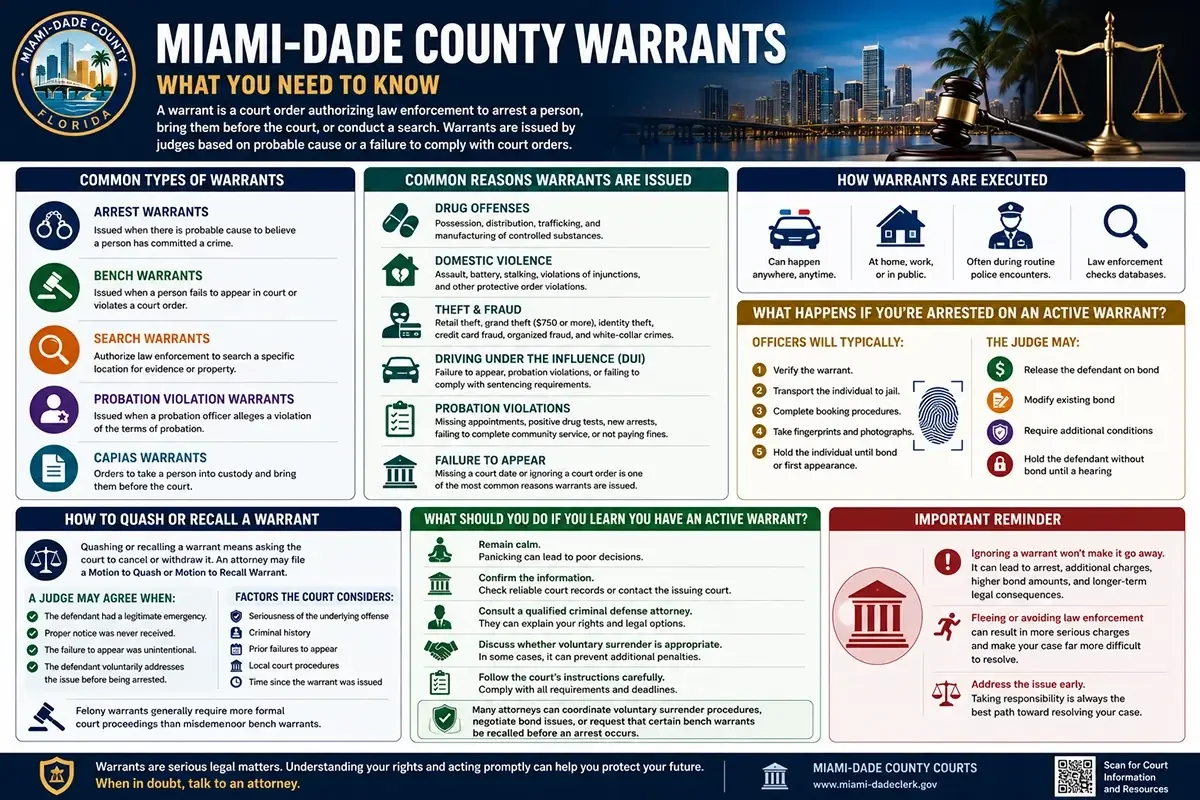
Miami-Dade County is home to Florida's largest population, resulting in thousands of criminal cases being filed each year. While judges can issue warrants for virtually any criminal offense, there are a few categories that occur far more frequently than others.
Failure to Appear
One of the most common reasons judges issue bench orders is when a defendant fails to appear for a scheduled court proceeding. Unlike an arrest order that is issued after probable cause has been established that a crime has been committed, a bench order is issued directly by the court when someone fails to comply with a judicial order. Once issued, that individual is required to reschedule their court appearance or potentially be arrested until their new hearing date.
Bench Orders May Are Typically Issued For Missing:
Arraignments – A defendant's first court appearance, where formal criminal charges are presented and a plea of guilty, not guilty, or no contest is submitted.
Pretrial hearings – Scheduled hearings where the court addresses certain procedural matters, reviews evidence, or considers motions before a trial.
Trial dates – Failing to appear for a scheduled criminal trial can potentially result in an immediate arrest and additional legal consequences.
Probation review hearings – Anyone on probation who misses a required review hearing will likely face allegations of violating the terms of their probation, and lead to their arrest.
In many cases, individuals do not realize a bench warrant has been issued until they are stopped for a routine traffic violation, apply for employment, or undergo a background check. Because these court orders generally remain active until they are resolved, addressing them quickly can often help minimize any additional legal complications.
Drug Offenses
Drug-related offenses regularly lead to arrest warrants involving controlled substances, illegal narcotics, drug possession, distribution, manufacturing, and trafficking charges. In many cases, these judicial orders are issued after lengthy criminal investigations in which law enforcement gathers evidence and presents it to a judge to establish probable cause before making an arrest.
Common Drug-Related Offenses That Result in Arrests Include:
Drug Possession of controlled illegal narcotics or unlawfully possessed prescription medications.
Possession with Intent to Distribute, where evidence suggests the drugs were intended for sale, usually defined by a specific weight above personal consumption.
Drug Trafficking, which typically involves larger quantities of controlled substances and carries significantly more severe criminal penalties.
Drug Manufacturing, including the illegal production or cultivation of controlled substances.
Prescription Fraud, such as forging prescriptions, doctor shopping, or unlawfully obtaining controlled medications.
Depending on the circumstances, these investigations may involve undercover operations, confidential informants, search warrants, surveillance, or controlled purchases before seeking judicial authorization to arrest the suspect.
Domestic Violence
Domestic violence allegations frequently result in a family member’s arrest when law enforcement shows probable cause that a crime has been committed, but the suspect is no longer present at the scene. In these situations, investigators may present the available evidence to a judge, who can authorize an arrest if the probable cause is determined.
Common Domestic Violence-Related Offenses Include:
Domestic battery – Allegations involving the intentional harm of a family member.
Aggravated assault – Assault involving a deadly weapon or circumstances that create a fear of imminent serious harm.
Stalking or Aggravated Stalking – Repeated unwanted contact, harassment, or credible threats that make a person in fear for their safety.
Violation of Protective Injunctions – Failing to comply with the court-set terms of a restraining order or protective injunction, such as contacting or approaching a protected individual against the court order.
Domestic violence investigations often require witness statements, victim interviews, physical evidence, photographs, medical records, affidavits, and other supporting evidence before a judge authorizes an arrest. Because these offenses can carry serious criminal penalties, including jail time and restrictions on firearm ownership, anyone facing these allegations should take the matter seriously and seek a qualified defense attorney.
Theft and Fraud
Theft and fraud investigations often involve financial crimes, property offenses, or allegations of deception for financial gain. Depending on the complexity of the criminal case, investigators may spend weeks or even months gathering evidence before presenting it to a judge to obtain an arrest order.
Common Theft and Fraud Related Offenses Include:
Retail Theft – Shoplifting merchandise from retail stores or businesses, ranging from misdemeanor offenses to felony charges depending on the value of the property and if the person of interest has any prior convictions.
Grand Theft – The theft of property that exceeds $750, often resulting in felony charges with increasingly severe penalties.
Identity Theft – Stealing another person’s identifying information to obtain money, credit, services, or other financial benefits.
Credit Card Fraud – The unauthorized use, theft, or possession of another person's credit or debit card, including fraudulent purchases and financial transactions.
Organized Fraud – Engaging in an ongoing scheme to defraud one or more persons or businesses through false representations, deception, or other fraudulent practices.
White-Collar Crimes – Non-violent financial crimes that may include embezzlement, forgery, insurance fraud, wire fraud, securities fraud, or other various financial crimes.
Because many of these criminal offenses involve extensive financial records, digital evidence, bank transactions, or multiple victims, law enforcement agencies need a significant amount of evidence before seeking a judicial arrest order.
DUI and Traffic Offenses
Although the majority of DUI arrests occur during the initial traffic stop, arrest orders may later be issued if the defendant charged with the DUI fails to comply with court-ordered requirements or violates the conditions of their case after being released.
Common Reasons a Warrant May be Issued Include:
Missing a Scheduled Court Appearance – Failing to appear for an arraignment or trial date may result in that person’s arrest.
Violating Probation – Anyone placed on DUI probation who fails to comply with its terms may face additional legal penalties, fines, and increased probation.
Failing to Comply with Sentencing Requirements – Not completing court-ordered obligations, such as DUI school, community service, alcohol treatment programs, or failing to make payment of fines and court costs, can lead to further court action.
Because DUI-related court orders typically involve strict deadlines, it is important to address any missed court dates or sentencing requirements as quickly as possible to avoid additional penalties.
Probation Violations
When probation officers can show the courts that someone has violated their probation terms, the court may issue a court order requiring that person to appear before a judge to determine whether probation should be modified, extended, or revoked.
Common Probation Violations Include:
Missing scheduled appointments – Failing to report to a probation officer or attend required meetings without authorization.
Positive drug or alcohol tests – Testing positive for controlled substances or alcohol when abstinence is a condition of probation.
New arrests or criminal charges – Being arrested or charged with another offense while serving a probation sentence.
Failure to complete community service – Not fulfilling court-ordered community service hours within the required timeframe.
Failure to pay court-ordered fines, restitution, or fees – Falling behind on financial obligations imposed by the court without obtaining approval or modification.
Violating other probation conditions – Such as leaving the county or state without permission, failing to complete counseling or treatment programs, possessing prohibited firearms, or failing to maintain required employment or education when ordered by the court.
Probation violation warrants often carry serious consequences and, in some cases, may result in harsher penalties than the original offense. Depending on the circumstances, a judge may revoke probation and impose additional restrictions, extend the probationary period, or require the individual to serve part or all of the previously suspended jail or prison sentence.
How to Quash a Warrant
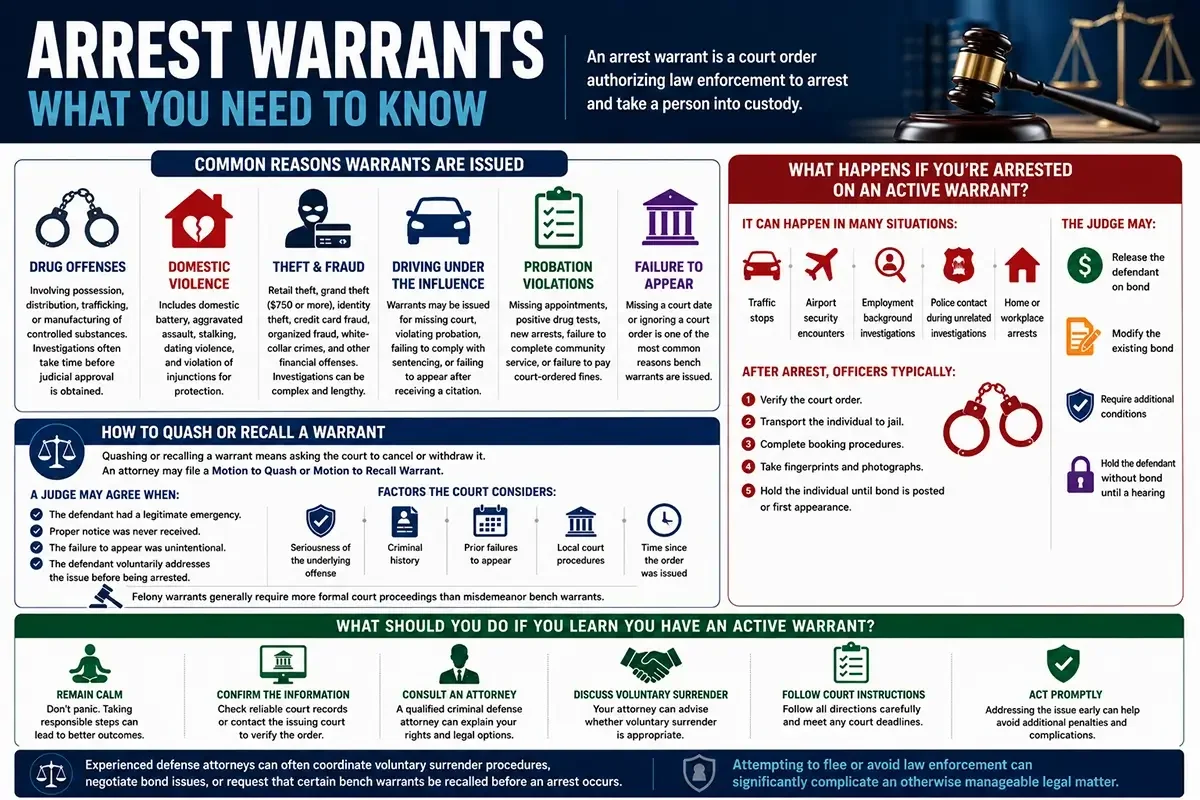
"Quashing" a warrant means asking the court to cancel, recall, or withdraw a judicial order authorizing a person's arrest or requiring them to appear before the court. Depending on the circumstances, a criminal defense attorney may file a Motion to Quash or Motion to Recall Warrant, requesting that the judge set aside the order and allow the individual to resolve the matter through a scheduled court appearance instead of being taken into custody.
Whether a judge grants the request depends on the facts of the case and the reason the court order was issued. In many situations, addressing or resolving the underlying legal situation will demonstrate good faith and may improve the likelihood of the order being quashed.
A Judge May Agree to Recall or Quash the Order When:
The defendant experienced a legitimate emergency that prevented them from appearing in court, such as a medical emergency or another unavoidable circumstance.
Proper notice was never received, meaning the person of interest was unaware of the scheduled court date or legal proceeding. This typically requires evidence to support this claim.
The failure to appear was unintentional, and there is a reasonable explanation of this failure, supported by evidence or documentation.
The defendant voluntarily comes forward to resolve the matter before law enforcement executes the arrest order. The courts tend to look favorably on this, as the individual is being proactive to face their criminal allegations.
The underlying issue has already been corrected, such as paying outstanding court-ordered fines, completing required paperwork, or complying with another court directive. In some situations, there may be paperwork that needs to be filed in order for a judge to remove the order.
Factors the Court May Consider Include:
The seriousness of the underlying criminal offense, including whether the matter involves a misdemeanor or felony.
The defendant's priors and criminal history, particularly any past convictions or pending criminal cases.
Previous failures to appear, which may suggest a pattern of noncompliance with court orders.
The amount of time that has passed since the judicial order was issued.
Whether the individual voluntarily appeared before the court rather than waiting to be arrested.
Local court rules and judicial procedures, which can vary by county and by the type of case.
Although some misdemeanor bench warrants can be resolved through court proceedings, felony arrest orders generally involve more complicated legal procedures and may require the defendant to appear before a judge before any relief is granted. Because every criminal case is different, consulting with a criminal defense attorney can be helpful to understand the available legal options and the best course of action.
What Happens If You're Arrested on an Active Warrant?
Being arrested on an active warrant can happen almost anywhere and often occurs without advance notice. Once a judge issues an arrest order, law enforcement officers have the legal authority to take that person into custody and detain them. Depending on the seriousness of the alleged criminal offense and the circumstances of the case, officers may actively attempt to locate and execute the order at home, work, or pulled over while driving.
Common Situations Include:
Traffic stops – One of the most common ways active court orders are discovered is when being pulled over when an officer runs a driver's information through state law enforcement databases.
Airport or transportation security encounters – Outstanding judicial orders can potentially be identified during security screenings at airports, seaports, or other transportation hubs.
Employment background investigations – Many employers run a criminal background check that may reveal pending criminal cases or active court orders before or during the hiring process.
Police contact during unrelated investigations – If an officer responds to an unrelated incident while conducting another investigation and they discover an active arrest order, that person will likely be detained.
Home or workplace arrests – In many cases, law enforcement will attempt to serve the order at a person's residence, workplace, or another location where they are believed to be found.
Following an Arrest, Officers Typically:
Verify the court order to confirm that it remains active and applies to the person being detained.
Transport the person to jail for processing and detention.
Complete the booking process, which generally includes collecting personal information, and documenting the alleged offense.
Take fingerprints and photographs as part of the standard booking procedure, including mugshots and pictures of tattoos or noticeable markings.
Hold the person until bond is posted or they appear before a judge, depending on the nature of the charges and the court's requirements.
Depending on the Circumstances, a Judge May:
Release the defendant on bond, allowing them to remain out of custody during the criminal case proceedings.
Modify an existing bond, including increasing the amount or imposing additional conditions. This is especially true if the arrested person has prior criminal convictions.
Require additional release conditions, such as electronic monitoring, travel restrictions, or no-contact orders.
Order the defendant held without bond until a first appearance or detention hearing when authorized by law. This typically happens when the defendant is a flight risk.
The outcome largely depends on the seriousness of the underlying offense(s), the defendant's criminal history, prior failures to appear, and the specific facts surrounding the case. Addressing an active court order head-on may help avoid unnecessary complications and provide additional legal options before an arrest occurs.
What Should You Do If You Learn You Have an Active Warrant?
If you discover that there may be an active warrant for your arrest, ignoring the situation rarely improves the outcome. Instead, try to stay calm and verify the information through reliable court records or the issuing courthouse before taking any action. Once you’ve confirmed it’s real, it’s often advisable to consult with a criminal defense attorney to better understand the charges against you, and the various options available for resolving the matter.
Depending on the circumstances, an attorney may recommend voluntarily surrendering to law enforcement, requesting that the court recall or quash the judicial order, or negotiating bond and scheduling arrangements before an arrest occurs. Taking a proactive approach is usually the best course of action and may give you additional legal options that would not be available after being taken into custody.
Attempting to evade law enforcement or ignore an arrest order will likely escalate an otherwise manageable legal matter. Addressing the issue promptly and following the court's instructions can help minimize additional penalties and move your case toward a more favorable resolution.

Miami-Dade Warrants - FAQs
Do warrants ever expire?
Generally, no. Most arrest and bench warrants remain active until the court recalls them, the underlying legal issues have been resolved, or the person of interest is arrested and taken into custody.
Will an active warrant appear on a background check?
They usually do. Many criminal background checks include pending criminal cases and warrant-related information depending on the reporting source and type of background screening. Since these are considered public record in Florida, anyone can accesses this information online.
Does the FDLE Public Access System show warrant information?
Yes, the FDLE Public Access System will show active arrest orders for alleged criminal offenses, however it’s not a complete record of every active warrant. This system is a good starting point for accessing judicial orders however there are occasional delays in reporting. It’s recommended to verify any findings with the issuing county court house.
Can law enforcement arrest me at my home or workplace?
Yes, if an court order was issued by a judge for your arrest. Officers may execute an active arrest order at your residence, workplace, or any another location where they reasonably believe you can be found.
What happens during the booking process?
After an arrest, officers generally verify the judicial order and then transport that person to jail, collect fingerprints and mugshots, complete booking paperwork, and hold the defendant until bond is posted or their arraignment in court.
Can I be arrested for a bench warrant in Miami-Dade County?
Yes, a bench order can be issued for your arrest if you fail to comply with a court order for a criminal case. In Miami-Dade County, judges commonly issue bench arrest orders when a defendant misses a scheduled court appearance, violates probation, fails to pay court-ordered fines, or does not complete certain court-imposed requirements.