

Tarrant County Warrants
🔷
Tarrant County Warrants 🔷
How to Run a Tarrant County Warrant Check
In Tarrant County, warrants are judicial orders issued by a judge that require compliance for either a civil or criminal matter. Warrants can stem from relatively minor violations such as unpaid traffic citations, or from serious felony investigations involving violent crimes, narcotics, theft, or fraud. Because Tarrant County includes major cities such as Fort Worth and Arlington, the county processes thousands of criminal and civil-related court matters each year through multiple misdemeanor and felony courts.
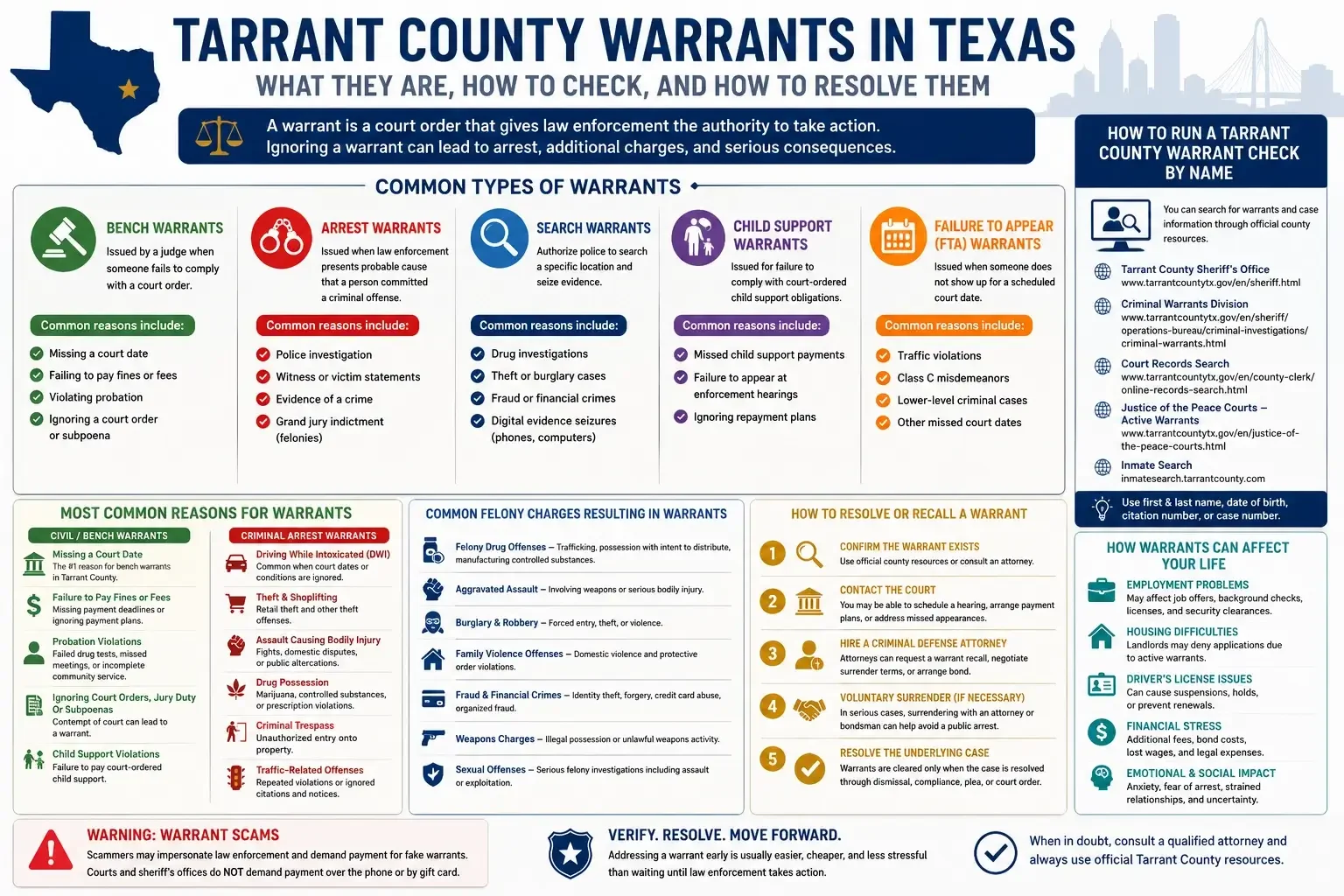
To run a Tarrant County warrant check by name, you have the option to use official channels, or third party resources. You’ll typically need the complete name of the person you want to lookup, as well as their date of birth. Here are the official county resources that are publicly accessible to research county records online:
1). County Sheriff’s Office - Provide access to criminal records, arrest records, inmate searches and enforcement details
2). Criminal Warrants Division - Responsible for issuing and executing court ordered arrests, and offer guidance on how to resolve them
3). County Court Records Search - Allow public access to search court case records by name or case number, tied to open or past cases
4). Texas Department of Public Safety - Offer statewide criminal history records that show active judicial orders, misdemeanors and felonies
5). Background Check Services - Aggregate public records from multiple counties and states, criminal history abstracts, and civil records

Warrant Types Issued in Tarrant County
The most commonly issued court orders stem from a mix of civil violations and criminal allegations. While the terminology can sound similar, each type of warrant serves a very specific purpose within the Texas legal system. Understanding how and why these are issued can help people avoid unnecessary escalation and resolve legal issues before they become much more serious.
Bench Warrants — usually issued after someone fails to appear in court, violates a civil order, misses payments, or ignores court procedures.
Arrest Warrants — issued when probable cause is established by the courts, or law enforcement, that a person has committed a criminal offense.
Search Warrants — gives police authority to search property or seize evidence for an ongoing investigation
Child Support Warrants — usually issued for failure to comply with court-ordered child support obligations.
Failure to Appear (FTA) Warrants — among the most common warrant types tied to traffic citations and misdemeanor cases, according to the city of Fort Worth, Texas. These are commonly issued for failure to comply with an existing judicial order, or probation violation.
While these are the most common types, there are a multitude of different types of legal orders that represent both criminal and civil violations.
How to Resolve a Court Order
Many people assume a court order automatically means immediate arrest and jail time, but that is not always true. In many cases, court orders are civil in nature and only require that person to comply with a civil violation such as rescheduling a missed court appearance or paying overdue legal fees.
Steps to Resolve a Court Order
1). Confirmation: The first step is to confirm the court ordered warrant, and whether it’s a criminal allegation or civil violation. This is important because a civil violation can often be handled by either rescheduling a missed hearing or paying any late fees. Where a a criminal allegation is much more serious that will often require the help of an attorney to avoid jail time.
2). Contact the Court: For the majority of civil court orders, individuals can contact the clerk of the court to handle their violation, or request compliance alternatives without having to show up in person. Most civil orders can be handled remotely.
3). Hire an Attorney: For criminal court orders, that involve allegations of a crime, hiring a criminal defense attorney is often the best strategy. They can plead with the courts, get better bond terms if arrested, and can advocate to have a warrant recalled or quashed.
4). Voluntary Surrender: In more serious felony matters, it may be savvy to voluntarily surrender through an attorney or bonding arrangement. This shows the courts that the person of interest is compliant and willing to face the charges head on, which often results in more favorable outcomes than non-compliance.
5). Resolving the Underlying Case: Since the majority of judicial orders do not expire or go away on their own, the only option is to resolve the underlying legal issues. This can result from compliance, dismissal, plea-bargains, or legal disposition.

How People Discover They Have a Warrant
The majority first learn about warrants until it’s too late. For most people, these legal directives come as a surprise, with no warning until:
A routine traffic stop by the police
Applying for employment opportunities
Undergoing a criminal background check
Attempting to renew a driver’s license
Receiving notice from a bondsman or attorney
Being denied housing or professional licensing
Attempting to travel internationally
Most Common Reasons for Criminal Arrest Warrants
Criminal allegations, whether misdemeanors or felonies, are the primary reasons a judge will issue an arrest order. Civil violations, by contrast, typically do not lead to immediate arrest. Once a person is taken into custody on a criminal matter, they are generally held in jail until arraignment unless they are able to post bond and secure release before their court hearing.
Common Misdemeanor Charges Leading to Arrests
1). Driving While Intoxicated (DWI)
DWI charges frequently result in arrests with the following circumstances:
a). When someone fails to appear in court for their hearing
b). Violates their bond conditions as mandated by the courts
c). Refuses compliance with sentencing (e.g. community service and/or alcohol classes)
2). Theft and Shoplifting
Shoplifting and retail theft remains one of the top misdemeanor offenses in the county, resulting in a person’s immediate arrest
3). Assault Causing Bodily Injury
Simple assault allegations involving fights, domestic disputes, or public altercations often generate warrants. These can lead to misdemeanor or felony charges depending on the severity of the incident.
4). Possession of Controlled Substance
Possession of illegal drugs, controlled substances, or prescription medications without authorization frequently leads to misdemeanor warrants. However, if there is intent to distribute, then those charges will likely fall into the felony category and carry jail sentences.
5). Criminal Trespassing
Trespassing violations and complaints including businesses, apartments, or private property often result in arrests and fines. While these are often considered smaller crimes, they still involve hearings, fines, restitution, community service, and in some cases jail time.
6). Traffic-Related Offenses
Repeated traffic violations may escalate into arrest orders if they are not handled properly. This is especially true when defendants ignore citations or court notices and have multiple points on their driving record, which can also lead to a suspension of driving privileges.
Most Common Reasons for Bench Warrants
Bench orders are generally issued when someone fails to comply with a court directive, rather than committing a new criminal offense. These situations are typically treated as civil violations, meaning they don’t usually result in immediate jail time. However, they should not be taken lightly, and ongoing noncompliance can lead to escalating consequences such as additional fines, court-imposed penalties, liens, or civil judgments. In some cases, if the issue continues to be ignored, a judge may impose stricter enforcement measures that can ultimately result in that person’s arrest.
The Most Common Causes Include:
1). Missing a Court Date
The single most common civil violation that results in a bench order is a failure to appear in court. This is usually centered around these issues:
a). Failing to appear in court for a traffic citation; such as speeding, running a red light, or driving without valid registration. This is one of the most common reasons a bench order is issued.
b). Missing a scheduled court date for a misdemeanor charge, such as a shoplifting or trespassing charges, can rapidly evolve into a bench order requiring someone’s mandatory appearance in court.
c). Someone failing to attend a required probation review hearing. The court may issue a bench order for violating the terms of probation, and in more serious violations, an arrest order may be issued.
D). Not showing up for a civil hearing, such as a lawsuit, small claims case, or court-ordered proceeding. This will often lead to a bench order and additional legal consequences.
E). Failure to appear at a mandatory child-support hearing, or enforcement proceeding, will likely result in a court order, especially if there are specific concerns regarding unpaid or overdue financial obligations.
2). Failure to Pay Court Fines
Courts may issue a civil warrant when defendants:
a). Fail to pay court-ordered fines by the required due date, which will prompt the court to issue a civil order for noncompliance and failure to pay.
b). When a defendant falls stops making agreed-upon installment payments. The court may take enforcement action if reminder notices are ignored.
c). Neglecting to pay mandated court costs, fees, or restitution to victims. This almost always leads to additional penalties and is considered a civil violation.
3). Violating Probation Terms
Violations of probation are relatively common, and may include the following circumstances:
a). Testing positive for drugs or alcohol, while on probation, is a direct violation of court-ordered conditions that can result in a civil or criminal violation depending on the respective court case.
b). Failure to report to a probation officer or a mandated check-in is a common violation that may trigger an arrest or civil order.
c). Not completing required community service hours, within the allotted timeframe, often leads to penalties and civil violations that will extend the original community service duration.
d). Being arrested for a new criminal offense while on probation is a serious violation that can result in immediate court action including arrest and detention.
4). Ignoring Jury Duty or Court Summons
In some cases, judicial orders or contempt actions are issued when a person fails to comply with a jury summons, ignores a direct subpoena to appear to provide testimony. These are all legally binding orders, and failing to respond can be treated as a violation of a court directive.
While courts may initially provide notices or the opportunity to reschedule, ignoring the notice or continued noncompliance often leads to fines, penalties, or an FTA mandate requiring that person to appear before a judge to explain their failure to comply.
Child Support Violations
Failing to pay a court-ordered child support directive can lead to specific enforcement actions, including the issuance of a warrant and sometimes that person’s arrest. Most county courts will provide opportunities to catch up through payment plans or financial hearings, but if the noncompliance continues it will likely be treated as contempt of court violation. Over time, the additional penalties can escalate to include garnished wages, driver’s license suspension, judgement, and incarceration.

Tarrant County Warrants - FAQs
Can I lookup someone warrant by name?
Yes, most public record systems, both official and third-party, allow name-based searches. However, you’ll get more accurate results if you also have their date of birth, as many people share the same first and last name.
What happens if I ignore a court order?
Ignoring a court order can lead to additional penalties, including fines, license holds, or arrest orders depending on the nature of the court order. Most civil violations will not result in a person’s arrest however if ignored, that is a possibility.
Can I resolve my criminal charges without going to jail?
In some cases, yes, particularly with minor offenses. Minor criminal charges can often be resolved without incarceration by working directly with the court to address the underlying issue. Depending on the circumstances, a judge may impose alternative penalties such as probation, community service, fines, or restitution instead of jail time. Being proactive early in the process can significantly improve the chances of avoiding custody altogether, the courts look favorably on this.
Are third-party search websites reliable for looking up criminal records?
t ultimately depends on the website or service you’re using. Some third-party platforms update their records daily, while others may have delays in reporting new information. Background check and public record websites can be convenient and often provide more detailed insights than official channels, but their data isn’t always perfectly current. For that reason, it’s always best to verify any findings directly with the respective official agency to verify accuracy.
How does bond work when someone is arrested?
Bond (or bail) allows a person to be released from custody while their case is pending, making sure they return to court for future appearances. In many cases, a judge will set a bail amount based on the severity of the criminal charges, criminal history, and various risk factors.
To secure a release by bond, a person can either pay the full bail amount directly to the court or by using a bail bondsman, who typically charges a non-refundable fee that’s usually around 10% of the total bail. If that person attends all their required court dates, the bail is returned to them (if paid in full), however the bondsman’s fee is not. That 10% is paid to a bondsman is also their fee for their services.
Are arrest orders considered public in Texas?
Yes, they are generally considered public records unless they are sealed for privacy or security concerns. Arrest orders and the associated court case records can be accessed through the county courts, or third party public record sites.
Can I lose my driver’s license for an arrest warrant?
Yes, if you have outstanding criminal charges, then the courts can suspend your driver’s license or prevent you from being able to renew it. This usually happens when someone evades or ignores criminal court orders for extended periods of time.