


Dallas County Warrants
🔷
Dallas County Warrants 🔷
How to Search For Dallas County Warrants
Dallas County warrants are court-issued legal orders requiring individuals to comply with obligations tied to either civil or criminal matters. A bench warrant, commonly referred to as a civil or procedural court order, is typically issued when someone fails to comply with a court requirement, such as missing a hearing or failing to pay fines. In contrast, an arrest warrant is a criminal order that authorizes law enforcement to locate, detain, and bring an individual before the court based on an alleged criminal offense. While both types of court orders are serious, bench orders are often resolved by addressing the underlying issue, whereas arrest order will likely result in immediate detention and criminal proceedings.
When searching for warrants in Dallas County, Texas, it’s important to first identify whether you’re dealing with a civil (bench/capias) or criminal matter. This distinction helps determine which databases and resources will provide the most accurate results. In most cases, official online search tools are the best place to start. Below are the most effective ways to search for both civil and criminal records online.
Dallas County Wanted Search
A “wanted person” search refers to individuals with outstanding criminal matters, including traffic violations, misdemeanor offenses, or felony charges, who have not yet resolved their cases and may be sought by law enforcement. Dallas County, Texas provides an online search platform that allows users to locate individuals based on various criteria, depending on the nature of the case. These records may include both civil and criminal matters, outstanding fines, and any active warrants associated with the individual.
With the Wanted Search, you can search via the following criteria:
1). Name: Complete first and last name, middle name is not required
2). Case Number: Search by the respective court county case number
3). Citation Number: Lookup moving violations & DUIs by traffic citation number
4). ZIP Code or Vehicle Info: Lookup criminal and civil violations by zip or license plate number
Dallas County Court Records Portal
The County Courts Portal is another official resource that is useful for looking up both civil and criminal court records. These court records will show any ongoing court case information, prior convictions and judgments, and any court orders. Since warrants are issued by the courts, this is a reliable resource for accessing the most accurate and up to date information. To use this resource you’ll need to know the person’s full name, date of birth, or court case number.
The County Courthouse website offers public access to the following records:
1). Criminal Court Cases: Felony and Misdemeanor cases
2). Warrant Status: Type of violation, when it was issued, current status, and issuing judge
3). Court Dates and Filings: Active court cases, upcoming hearings and trials, case filings, court calendar
4). Court Case Outcomes: Convictions & incarcerations, sentencing records, judgments, probation orders
County Sheriff’s Office
The Dallas County Sheriff Department has a direct warrant-line that is publicly accessible @ 214-761-9026, offering one of the fastest ways to check for active arrest warrants. This line connects directly to the Sheriff’s active criminal database, allowing callers to verify whether a specific record is currently on file. It is widely considered the most accurate and up-to-date method for checking Dallas County arrest warrants in real time. Unlike many online tools, which may experience delays or incomplete reporting, the Sheriff’s Office updates its records promptly as new information is received from the courts.
In-Person Searches
For in-person inquiries from any of the government agency, it’s recommended that you first make an appointment so you won’t have long wait times. These government offices maintain official records and can verify active warrant status:
1). Sheriff’s Office: Arrests, jail records, and active arrest orders
2). District Clerk: Check for felony or misdemeanor arrest orders
3). County Clerk: Check for court case records, filings, and arrest and bench order
4). Justice of the Peace Courts: Check for traffic violations and Class-C citations
Third-Party Websites
Private sites such as public record sites, or background check resources, offer a one-stop-shop for all things public records. These are great resources for looking up a person’s complete public record abstract, or criminal record history. It’s also useful for finding active warrants that may be from a different jurisdiction or state. There is a caveat to these resources, and that is they may not be up to date, or fully accurate. If you find what you are looking for through one of these third-party resources, it’s always a good idea to verify that record through official channels.

Common Types of Warrants in Dallas County, Texas
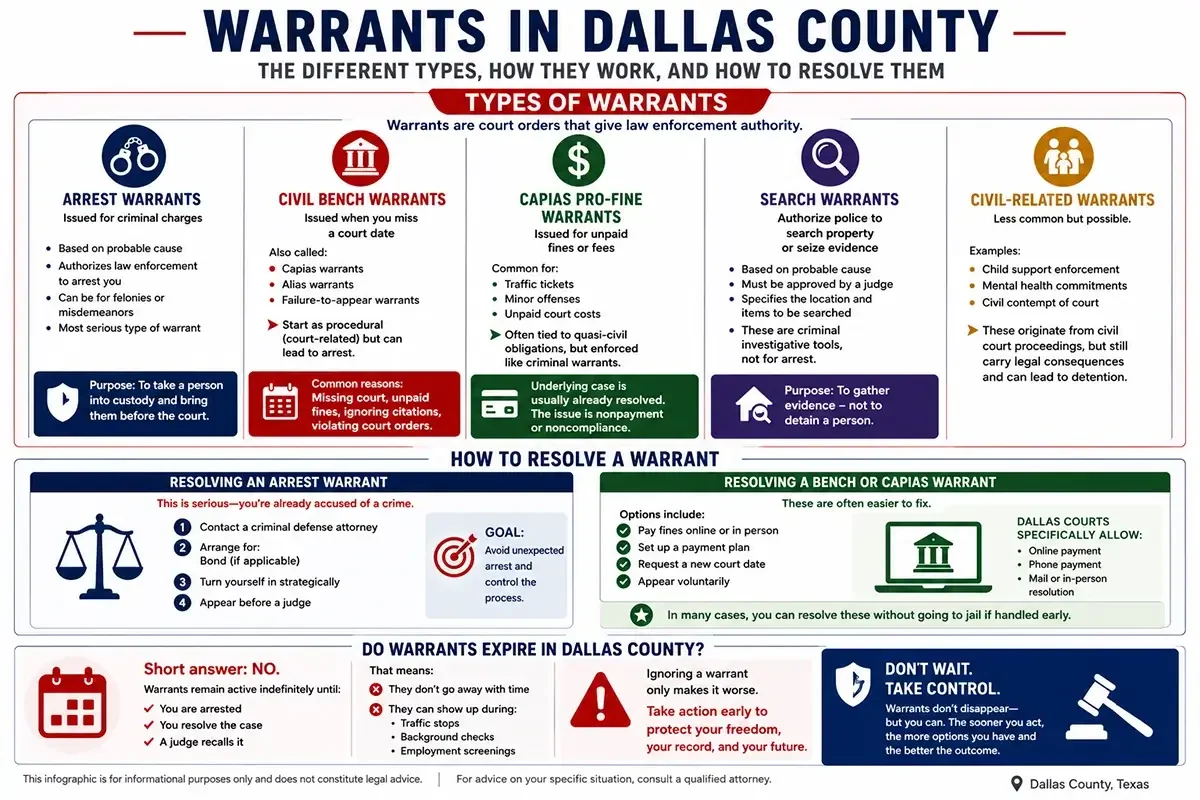
While Dallas County courts can issue a wide range of criminal and civil court orders, a handful of warrant types account for the majority of cases encountered by the general public. These commonly issued judicial court orders typically stem from missed court appearances, unpaid fines, or alleged criminal activity. The most frequent include arrest orders for criminal offenses, civil bench orders for failure to appear in court, and capias or capias-pro-fine orders related to unresolved financial obligations such as traffic tickets or court-ordered payments.
Understanding these common types is important because each carries specific legal implication and different paths to resolving them. Some, like bench or capias civil-orders, are mostly administrative in nature and can usually be resolved by complying with court requirements. Others, such as arrest orders tied to criminal charges, are much more serious and usually result in immediate arrest and jail time. The following categories are the most common types of court orders people typically face in the county.
1. Criminal Arrest Warrants
Criminal arrest orders are among the most serious types of court orders issued in Dallas County. These are only issued by a judge or magistrate when law enforcement, or the district attorney, presents sufficient evidence to establish probable cause that a person has committed a criminal offense.
Once issued, an arrest order direct law enforcement officers, usually the Sheriff Department, to locate, detain, and bring the individual before the court to be arraigned for their criminal charges. The majority of these cases are entered into statewide and national databases, meaning the individual can be arrested not just in in the county it was issued, but anywhere in the U.S.
2. Civil Bench Warrants
Civil bench orders are most commonly issued in Dallas County when someone fails to appear in court, or does not comply with a court mandate. Unlike criminal arrest orders that stem from new criminal charges, bench orders originate from noncompliance with an existing case, often something that started as a minor legal issue.
These court orders are issued directly by a judge (“from the bench”) following a missed hearing, unpaid fines, or failure to comply with court instructions. While civil in nature, they can ultimately result in arrest if left unresolved for an extended period. Bench orders do not expire, so addressing them promptly typically leads to the most favorable outcome.
3. Capias Pro-Fine Warrants
Capias Pro-Fine court orders are issued County when someone fails to pay their court-ordered fines, fees, or court costs after a case has already been resolved. These civil violations typically arise from lower-level offenses but can escalate quickly if ignored, where additional fines and penalties will be added.
4. Search Warrants
These types of criminal search orders are required before law enforcement enters a property and seize evidence related to an ongoing criminal investigation. Unlike arrest orders, they’re not used to detain a person of interest, but rather to gather supporting evidence for an investigation. However, they can eventually lead to a person being arrested and detained to answer for any evidence found at their location.
5. Civil-Related Warrants
Civil-related warrants, other than bench orders, are less common in Dallas County but still play an important role in enforcing legal court obligations that arise from non-criminal proceedings. These almost always originate in civil courts rather than criminal courts, but they can still result in a person’s detention if they fail to comply with a lawful order.
How to Resolve an Active Warrant
Resolving a serious legal situation such as a court ordered warrant really depends on whether it’s civil or criminal in nature. Both require prompt attention but civil matters are often much more straightforward to resolve than criminal cases. Here are the ways to address and resolve each respectively.
Resolving an Arrest Warrant
To resolve an order for your arrest issuance, may require for you to hire an attorney. This is a very serious legal matter because it means you’ve already been formally accused of a crime and law enforcement already has the authority to detain you at any time. Handling it proactively is what’s important if you want to avoid being arrested unexpectedly, such as during a traffic stop or at your home or workplace. Here are the basic process of handling a court order for your arrest:
Confirm the details of your arrest order
Discuss your legal options with an attorney
Surrender yourself if necessary, and look at bail options
Schedule your court date and build your defense
Resolving a Bench or Civil Warrant
Bench and civil warrants are generally tied to noncompliance or civil violations, they are not considered criminal charges. That makes them more flexible, and often much easier to resolve if you act quickly. You can typically resolve these quickly by following through with the failed court orders or scheduling a new court date for the one you missed. Here are the basic steps to resolving these:
Verify the details of your civil order
Pay an fines or court fees
Reschedule any missed court dates
Handle your failed court orders in-person, or through the court clerk
Do Warrants Go Away?
The short answer is no. They do not go away on their own, expire, or have a statute of limitations. This means that by ignoring a specific court order, it will only get worse, and additional fines and charges may be added on.
The only way that warrants go away in Texas as a whole is if the person is arrested, the underlying issues are effectively resolved, or a judge decides to quash one. Other than those reasons outline, you can bet they will only haunt you if left unattended to.
Even if you’ve forgotten about one, it can show up at any time. This means you can be arrested when being pulled over for a traffic citation, at work, at home, or any interaction with law enforcement.
What most people miss is that time is the enemy, meaning the legal situation only gets more complicated and expensive over time. So handling a warrant as quickly as possible is in that person’s best interest.

Why Ignoring a Warrant Is a Bad Strategy
A warrant doesn’t lose its power with age, it will follow you around until you address it head-on. Once it’s active, any law enforcement department can act on it at any time, whether that’s during a routine traffic stop, a minor incident, or worse yet where a Sheriff shows up at your home or workplace to arrest you. Many people go years without issue, only to be caught off guard when it surfaces at the worst possible moment. The reality that most people underestimate is you can be arrested at any time, even years later.
Minor issues can escalate quickly
What starts as something small and innocuous, like a traffic ticket or missed court date, can snowball into a much larger problem. A simple oversight can turn into a situation involving arrest and court appearances, that will become increasingly complicated as more time passes. This can lead to:
1). Additional charges (failure to appear, noncompliance)
2). Higher fines and penalties, and in some cases jail time
3). Increased scrutiny from the court, giving you the maximum penalty
Additional penalties and fees pile up
Ignoring a warrant doesn’t freeze the legal situation, it usually makes it more expensive. The longer it sits, the more complicated, complicated, and costly it will become to resolve. Additional costs of waiting to deal with the underlying issues include:
1). Late fees and court administrative costs, sometimes including interest
2). Collection actions or holds, including liens and judgments
3). Potential license suspensions, including driver’s license and sometimes professional licenses
4). Increased bond amounts in some cases, or not being able to bond out of jail at all
It can impact your daily life in ways you don’t expect
Jobs: Employers may uncover these during background checks, which can affect hiring decisions or job security.
Housing: Landlords often run background screenings, and an active warrant can raise serious red flags.
Credit & Background Checks: While court orders don’t directly impact credit scores, they often appear in background reports tied to financial or legal risk. This means it may complicate getting a loan or equity line.
The hidden risk: loss of control
The biggest downside isn’t just the judicial order itself, it’s losing control over when and how it gets handled. Instead of choosing the time, place, and approach, you leave it up to chance, which never ends well. The longer you wait, the fewer options you will have, and the more likely it is that the situation escalates.

Dallas County Warrants - FAQs
How can I find out if I have an active warrant in Dallas County?
You can start by checking through official county channels such as court record systems, or by contacting the Dallas County Sheriff’s Office directly. You can also search via public record sites and background check services, however it’s best to verify an results using official sources rather than relying solely on third-party websites.
Can I resolve a bench warrant without going to jail?
Yes, most bench orders are only civil violations resulting from missed court dates and unpaid court fees, which do not result in going to jail. To resolve these, simply contact the Clerk of the Court where it was issued and handle the underlying issue by paying any fees, or rescheduling your court appearance.
What happens if I miss a court date in Dallas County?
Missing a scheduled appearance can lead to a judge issuing a bench order requiring you to return to court. The majority of these do not result in your arrest, as they are civil violations. Once you reschedule your court appearance and attend it, the bench order will be removed.
How long do court-issued arrest orders stay active?
They remain active indefinitely until they are resolved, enforced, or formally dismissed by a judge. They do not go away on their own, no matter how much time has passed. It’s important to understand that these can escalate quickly if left ignored and so will the fines and penalties.
How accurate are public record search websites?
They can be helpful for initial research, but they may not always reflect the most current information. Official sources are more reliable. That said, public record sites are often more convenient and offer more information, however once you find the records you are looking for, make sure to verify them through official channels.
What is a capias order in Dallas County, Texas?
It’s a type of legal enforcement action issued when someone fails to comply with a court requirement, most commonly tied to missed appearances or unpaid court obligations. These are civil violations that require prompt attention but usually do not result in a person’s arrest.
Do I need a lawyer to resolve a warrant?
Not always, it really depends on the seriousness of the judicial court order. Minor legal matters, such as civil violations, can often be handled directly, but more serious situations, such as criminal charges, typically benefit from consulting with an attorney.