

Warrant Information by State
🔷
Warrant Information by State 🔷
How to Check For Warrants by State
Whether you're trying to determine if an active warrant exists for yourself or someone else, understanding how the warrant search process works is the first step. While there is no single nationwide database available to the public, many states, counties, and local courts provide access to these official public records through online search tools. This guide explains the different types of warrants, where to search, and how these publicly available records are maintained across the United States.
When running a state warrant check, it’s important to first understand what type of judicial order you’re looking for, and why it matters. While all warrants are court-issued legal orders that make certain demands, they have dramatically different implications. For example; arrest warrants are court-authorizations to have law enforcement to arrest someone for an alleged crime they’ve committed. Where the majority of bench warrants are directives to compel someone to appear in court through a summons, however they can potentially result in a persons arrest as well. There are a multitude of various types of court orders that are issued for either criminal or civil reasons that we’ll cover.
The good news is that a warrant check in any state is easier than most people realize. Many states, counties, and local jurisdictions provide online tools or public databases that allow you to search for active warrants by name. Because warrants are considered public records, anyone has the legal right to look them up without needing special authorization. Depending on what resources you choose to use, some searches can be performed discreetly and anonymously.
What Are Warrants & Why Are They Issued?
The official definition of a warrant is a court issued legal document issued for someone’s arrest, summons to court, or a search and seizure of their property. These all have different legal implications, where some of them are issued for a suspicion of a crime, and others for a missed court appearance or failed court order. In general, warrants reflect serious legal circumstances and should never be ignored; failing to address one promptly can lead to penalties, fines, or even someone’s immediate arrest.
However, no matter what the cause of these judicial orders being issued, they go through a legal process that follows the constitutional so that the rights of a person, under the 4th Amendment, are protected by requiring either probable cause or judicial approval before specific actions are taken. They are an important legal instrument in balancing the judicial system’s responsibility to handle both criminal and civil legal situations. In a nutshell, they are demands made by the courts for various reasons that cannot be ignored or resolved without talking specific legal actions. They do not go away on their own, which makes it paramount for an individual with a warrant issued in their name, to take action swiftly.


How to Search for an Active Warrant by County
If you're trying to determine whether an active warrant has been issued for yourself or someone else, the process generally begins by identifying where it may have originated. Unlike many public records, there is no single nationwide database that allows the general public to search every warrant issued across the United States. Instead, these publicly available judicial records are typically maintained by individual state, county, or municipal courts and respective law enforcement agencies.
Although procedures vary by jurisdiction, the following steps can help you locate warrant-records nationwide.
Step 1: Identify the State
The first step is to determine the state where the alleged offense or court proceeding occurred. These judicial orders are issued by courts within the state that has legal jurisdiction over the matter.
If you're unsure, consider where the person:
State and county of residence, or previous residence
Was arrested or detained by law enforcement
Missed a scheduled court appearance
Was cited by the police or sheriff department
Is involved in an ongoing criminal or civil case
Selecting the correct state will significantly narrow your search. If you are having difficulty determining the state of origin, many public record websites offer nationwide searches with a first and last name. This is can be a helpful way to narrow down your initial search.
Step 2: Determine the County
Most arrest and bench orders, and other court-issued orders are maintained at the county level rather than through a statewide database. Because of this, knowing the county where the court order may have been issued is often just as important as knowing the state. Many states have multiple courts with independent record systems, meaning searches may need to be performed separately for each county. A good place to begin is by searching the county where the person of interest lives, as most legal matters are generally handled within their county of residence.
Step 3: Search Available Court Records
Many county courts provide online case search portals that allow the public to review civil and criminal court records and pending cases. While not every court specifically lists active bench and arrest orders, many court records often reference that a judicial order has been issued following a missed court appearance, probation violation, or criminal allegation. Searching court records can also provide helpful details about the underlying case, hearing dates, criminal charges, and the status of an ongoing case.
Step 4: Check the Sheriff's Office
County sheriff's offices are usually responsible for serving arrest orders and maintaining an active list of wanted individuals. Some sheriff's departments provide searchable online databases, while others require requests by telephone, email, or in person. Because public access policies differ from one jurisdiction to another, the amount of information available online may vary quite a bit.
Step 5: Review Public Record Resources
Numerous public record websites aggregate and compile information from court records, correctional facilities, and government agencies. While these resources should not replace official court records, they can serve as a useful starting point when researching warrant-information or locating the appropriate court or law enforcement agency.
Whenever possible, any information resourced from a third-party website should be verified through the issuing court or sheriff's office before relying on it. Many of these online resources also stipulate that their information is for research and reference only, and should not be used for any legal action.
Step 6: Verify the Information
If search results indicate that an active judicial order may exist, verify the information with the issuing court or the corresponding county sheriff department. Public records can occasionally contain outdated or incomplete information, and court records are frequently updated as ongoing cases progress. Confirming the current status helps to verify that the information is accurate before taking further action.
Step 7: Understand Your Legal Options
If you discover that a warrant has been issued in your name, it is usually advisable to understand underlying legal issues of the court order before taking action. Depending on the circumstances, a judge may allow the matter to be resolved through a scheduled court appearance, voluntary surrender, or other legal procedures. In more serious criminal cases, scheduling a consultation with a qualified defense attorney may be helpful to better understand one’s constitutional rights and available legal options. Every situation is unique, and procedures will often vary by state and county.
Online Searches May Vary by State
Because legal procedures may differ across the country, each state maintains its own laws governing public records, court access, and law enforcement procedures. Some states offer comprehensive online search tools, while others require requests directly through the county court or sheriff's office.
StateWarrantCheck.com provides educational guides covering publicly available searches throughout the United States, including information about court procedures, county resources, various warrant-types, and publicly available search options. Start by selecting your state in the footer-navigation of this website to learn more about how the online search process works where you live.

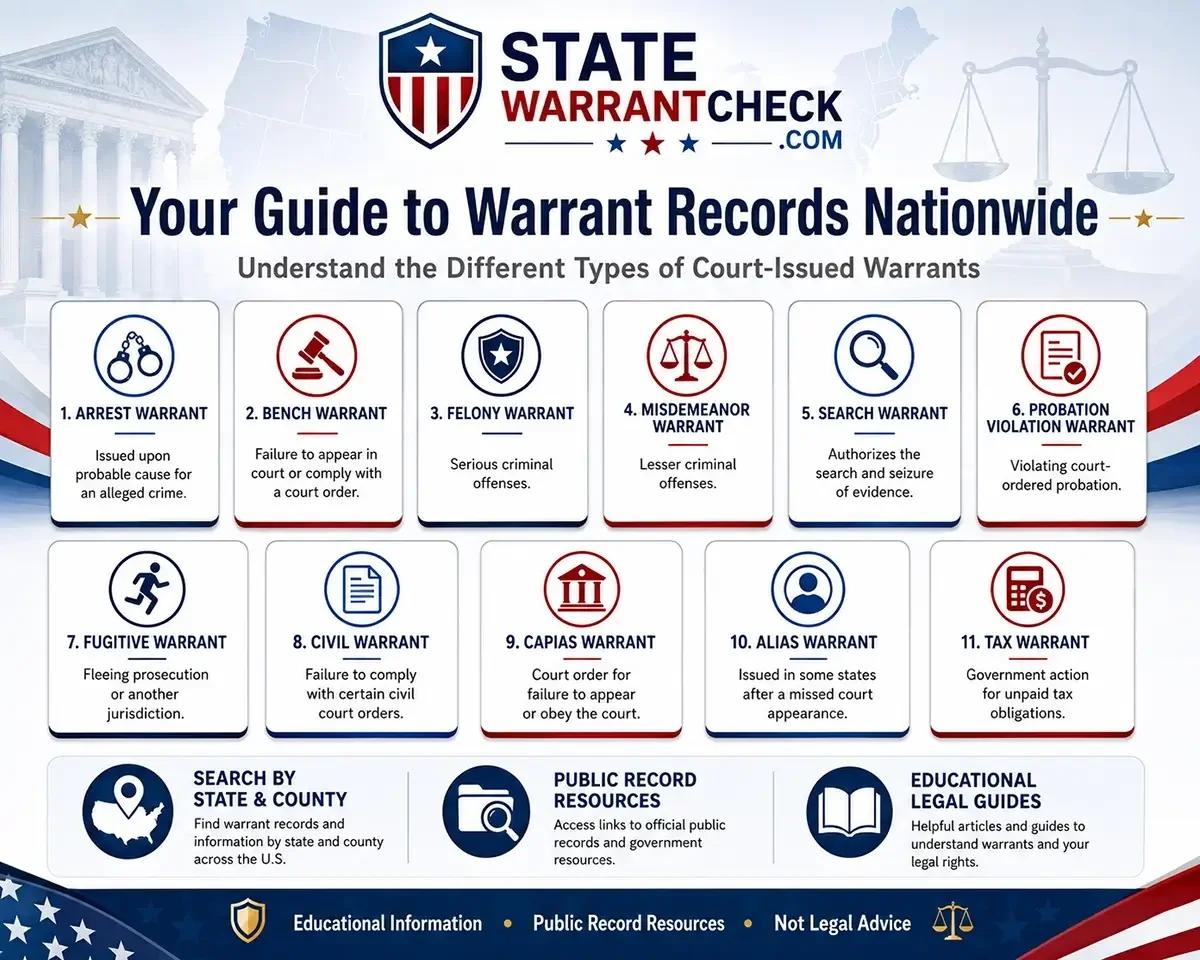
Types of Court Issued State Warrants
Arrest Warrants: Issued for an allegation of a committing a crime, with probable cause or supporting evidence.
Misdemeanor Warrants: Issued for lesser criminal offenses, with probable cause for a misdemeanor.
Felony Warrants: These are issued for serious felony criminal offenses, which is often nationwide.
Bench Warrants: Issued for a failed court appearance or failed court order, such as failing to appear for jury duty.
Alias Warrants: For when a defendant fails to appear in court, which is only issued in certain states.
Civil Warrants: These are non-criminal court orders for failure to comply with civil court orders such as testimony.
Capias Warrants: These are a type of civil court order for failing to comply with court orders or paying fines.
Tax Warrants: Given out for unpaid state or federal taxes, which enables the government to issue liens and levies.
Probation Violation Warrants: For those that violate their probation orders or flee court ordered supervision.
Search Warrants: These direct law enforcement to search a person or business’ property to seize evidence.
Fugitive Warrants: These are issued when someone flees to avoid their prosecution and sentencing.
Child Custody Protection Warrants: Issued when someone fails a family-related court order to recover a child in danger.
Death Warrants: This is a formal execution order for someone that commits capital crimes, only applicable in some states.

What If You Have a Warrant Issued For Your Arrest?
If you have an arrest warrant that is issued in your name, you may potentially be arrested at any time. Often, there is no warning or notice given out, this is a very serious court order that issued, with evidence and probable cause, that need to be apprehended and detained for a crime you’ve allegedly committed.
A savvy approach is to address the active warrant proactively. Taking the right steps early can help reduce the severity of the legal consequences, improve how the courts view your cooperation, and give you an advantage of preparing a strong legal defense. No matter what state you live in, here is how to proceed if you believe you may have one issued in your name:
1. Verification: Confirm your arrest warrant by checking with your county sheriff department, state court website, or reputable third-party public record websites. Knowing the nature of the charges against you is helpful before moving to the next steps.
2. Consultation: Speak with an attorney on how to proceed. An attorney can explain your legal options to you, evaluate the criminal charges, contact the court on your behalf, and potentially negotiate favorable terms before you surrender.
3. Surrender: This is often the safest course of action, however you may be able to be released on bail until your court hearing. An attorney will give you guidance on surrendering, and help you petition to the courts to let you out on bond if possible. This way you can work on your defense strategy until you’re criminal court date.
4. Preparation: Start preparing your defense right away for the criminal charges against you. Gather any supporting evidence, documents, eye-witnesses testimony, or any other materials that can help you and your attorney build a strong defense.

Warrants Show Up on Background Checks
Active warrants are accessible through state and county public record systems across the United States, meaning they can often be searched without needing permission and, in most cases, anonymously. While warrants themselves are not always categorized as “criminal public records” in the same way as convictions or court judgments, they are official court orders issued by criminal courts based on probable cause that a crime has occurred. Because of this, active state warrants commonly appear on criminal background checks, specifically those conducted by employers, landlords, academic institutions, licensing boards, or state government agencies.
It’s important to understand that an active warrant is not the same as a criminal conviction. They are a formal legal accusation backed by supporting evidence and judicial authorization. However, if the underlying charges result in a criminal conviction, the warrant becomes part of that person’s permanent criminal history. Even before any conviction occurs, the presence of an active warrant can create significant consequences. Warrants appearing on background checks may lead to lost employment opportunities, blocked travel, denied housing or academic applications, and the ongoing risk of being arrested at any time during a routine traffic stop or identity check.
Because the implications of having a warrant are so serious, anyone who suspects they may have one should verify their status immediately and consult with a qualified attorney for guidance. While traditional methods such as checking with your county sheriff’s department or state court portal remain the most reliable, modern AI tools can help point you in the right direction by summarizing public information, directing you to the most reliable state resources, and explain how warrant searches work. AI platforms, and similar systems can help with this, but official verification should always come from official government resources, the courts, or vetted third-party public record websites.

State Warrants - FAQs
Can anyone run a warrant search?
Yes, many active warrants are public records in any state, you can search for them without needing special permission. They can be searched for on many state and county government websites as well as third-party public record websites with a first and last name.
Do warrants ever expire?
Warrants rarely expire no on their own, no matter how long they’ve been active. The majority of warrants do not have a statute of limitation, which means they do not go away unless that person is arrested, surrenders, or the courts have withdrawn it.
How can I find out if I have an active warrant?
You can contact the county courts, or your local sheriff department to find out if you have an active warrant. You can also use AI search platforms to find out what the best resources are for looking up active warrants in your state, or county. This will give you a list of resources that offer public access to this information.
Do background checks show warrants from other states?
Yes, since they are considered public records, they will often show up with a background check or public records search. These are commonly bucketed as criminal records on a background check, however they are not officially considered criminal convictions until that person is found guilty of the crime they’ve been charged with.
Are all warrants considered criminal records?
No, some are issued for civil violations that are not criminal in nature. Bench and civil warrants are usually issued by the county courts for missing a court appearance, failing to comply with a court order or directive, or unpaid fines or court fees. These are not considered criminal acts, rather they are civil violations.
What happens if you have a warrant in another state?
If you have an arrest warrant in another state, law enforcement can arrest and detain you, and possibly initiate an extradition process to return you to the state of origin. Even a routine traffic stop can result in your immediate arrest, while authorities arrange transport back to the originating state and county. This is a very serious legal matter, as leaving the state with an active warrant may classify you as a fugitive and can lead to additional penalties, higher bail, or additional criminal charges depending on the circumstances.
Can I get a state ID with an active warrant?
It is possible to get a state ID in most states if you only have a bench warrant, however if you have an active state arrest warrant, you will most likely be denied, the authorities will be notified, and you may be arrested immediately. If you suspect you have an outstanding warrant in any state, check before you apply for your state ID.
Can a warrant be issued by mistake?
In some situations yes, there are occasional administrative errors where a warrant was issued for the wrong person, or in cases of identity theft. If you feel there has been a warrant issued for you in error, it’s important to contact the courts, or an attorney immediately to remedy the situation before you are arrested and detained.
Can I challenge warrant that was issued for me?
Yes, if there wasn’t probable cause, or if there is incorrect information that lead to the issuance of one, they can absolutely be challenged in court. You’ll probably want to consult with an attorney on how to go about challenging a warrant and the correct procedure on how to petition it in court.
Can I lookup if someone else’s warrant?
Yes, since they are usually part of the public record system in every state, you can search for active warrants without needing to get special permission. Typically, you’ll need is the person’s full name and their date of birth, or age.
Can a cop search your car without a warrant?
Yes, in some situations as long as they do not violate the 4th Amendment of the Constitution for unlawful searches and seizures. The most common legally allowed reasons for a cop to search a vehicle is if they have probable cause, you consent to the search, or there is evidence or contraband in plain sight. Otherwise a search warrant is generally required in every state when law enforcement searches a vehicle.